


Kumar Bangarappa to be BJP candidate against his JDS brother in Sorab?

[email protected] (CD Network)
February 21, 2017

Bengaluru, Feb 21: Former Minister Kumar Bangarappa appears poised to shift loyalties from the Congress to the Bharatiya Janata Party, as he is “frustrated with the ill-treatment” meted out to him in the ruling party. He has, however, said that he is yet to take a final call.
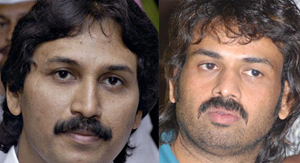
Untitled-1 copyIn the event of Mr. Kumar joining the BJP, it will again be a straight fight between his brother — Madhu Bangarappa (JD-S) and him — in Sorab constituency in 2018, once represented by their late father and former Chief Minister S. Bangarappa. H. Halappa, who contested on the KJP ticket in 2013, and is now in the BJP, is expected to migrate to another constituency in the district to make way for Mr. Kumar.

While Mr. Kumar may be the latest to join the bandwagon, it is speculated that at least half a dozen other Congress leaders will follow in the footsteps of former Chief Minister S.M. Krishna and senior leader V. Srinivas Prasad, who moved out of the Congress recently. Leaders like M.H. Ambareesh, Suresh Gowda, and L.R. Shivarame Gowda, leaders from Mandya, are likely to quit the Congress, sources in the party said.

Like his late father, who used to convene a meeting of his supporters in Sorab town prior to taking important political decisions, Mr. Kumar convened one recently. “In the Sorab meeting, people forced me to join the BJP. I will take a final call after holding another round of consultations with my supporters in Sorab,” he said.

Lashing out at Revenue Minister Kagodu Thimmappa, he said JD(S) activists were nominated for the taluk-level bagair hukum regularisation committee in Sorab constituency, which is represented by his younger brother, Madhu Bangarappa (JD-S).

Mr. Kumar said there was deep discontent among Congress activists against the style of functioning of the government and the Karnataka Pradesh Congress Committee. “The KPCC has remained deaf even to the displeasure expressed by senior leaders C.K. Jaffer Sharief, B. Janardhana Poojary, and H. Vishwanath,” he said.

Meanwhile, Madhu Bangarappa, president of the state youth wing of the JD(S), ruled out the possibility of his brother Kumar Bangarappa joining the party. “He is in a national party; I am a member of a regional one. We cannot be in the same party. That being the case, there is no possibility of him joining the JD(S),” Madhu told reporters in Shivamogga.

Comments

shaji
 - 
Tuesday, 21 Feb 2017

Both these are ruining their future. Its unfortunate that few leaders wants to be in higher position always for their own benefit and they start blaming the party whenever they are not given chance. These are selfish parties who are caring of themselves only and not caring for party or public. These people are now joining the most corrupt party BJP.

dodanna
 - 
Tuesday, 21 Feb 2017

Dear Brothers,

Both are same blood belongs to ONE family let them stay together and allow them to lead a peaceful and happy life.

why the politicians are playing such dirty politics with innocents.
One Shakuni is playing a big game behind the screen is a well known news.

Add new comment

  • Coastaldigest.com reserves the right to delete or block any comments.
  • Coastaldigset.com is not responsible for its readers’ comments.
  • Comments that are abusive, incendiary or irrelevant are strictly prohibited.
  • Please use a genuine email ID and provide your name to avoid reject.
News Network
June 8,2020

Bengaluru, Jun 8: More than two months after the nationwide lockdown was imposed to curb the spread of coronavirus, people offered prayers at Bengaluru's Saint Mary's Church and Shree Dodda Ganapathi Temple as the government has allowed reopening of religious places from today.

Fewer devotees here visited Saint Mary's Church in Shivaji Nagar and were seen maintaining social distancing inside the church premises.

Meanwhile, people queued outside Shree Dodda Ganapathi Temple at Basavanagudi to offer prayers in the wee hours of Monday.

Floor markings have been made here to maintain social distancing.

Social distancing norms are also being followed in Hubli's Nagashetty Koppa where only a few devotees thronged the temple on Monday morning.

In Kalaburagi's Sharana Basaveshwara Temple the visiting hours for devotees have been fixed from 7 am to 10 am and three hours in the evening from 5 pm to 8 pm.

Thermal screening is being conducted here and a disinfectant tunnel has also been installed at the entry point.

Floor markings have also been made here to ensure social distancing while barricades have also been installed on the temple premises.

Comments

Add new comment

  • Coastaldigest.com reserves the right to delete or block any comments.
  • Coastaldigset.com is not responsible for its readers’ comments.
  • Comments that are abusive, incendiary or irrelevant are strictly prohibited.
  • Please use a genuine email ID and provide your name to avoid reject.
News Network
June 16,2020

Shivamogga, Jun 16: The Deputy Commissioner on Tuesday announced a ban on movement of heavy goods vehicles in the Agumbe ghat section between June 15 and October 15 as a precautionary measure, as there was possibility of landslides due to heavy rain during the monsoon season.

All trucks over 12 tonnes will be prohibited from passing through the ghat, DC K B Shivakumar said in a statement here.

The authorities have suggested two alternative routes for the movement of heavy freight vehicles – the Shimoga-Thirthahalli-Sringeri-Kerekatte-Karkala-Udupi-Mangaluru route and the Shimoga-Thirthahalli-Mastikette-Hulikal-Hosangadi-Siddapura-Udupi-Mangaluru route.

Comments

Add new comment

  • Coastaldigest.com reserves the right to delete or block any comments.
  • Coastaldigset.com is not responsible for its readers’ comments.
  • Comments that are abusive, incendiary or irrelevant are strictly prohibited.
  • Please use a genuine email ID and provide your name to avoid reject.
Media Release
February 14,2020

Veteran journalist P. Sainath has said that the nation is in a crisis. And this crisis is not limited to just the rural area. It has become a national crisis at various areas such as agriculture, education, economy, job creation etc.

He was delivering the endowment lecture on the topic ‘Indian democracy at the post-liberalization and post-truth era’ at Media Manthan 2020 organized by the PG department of journalism and mass communication at St Aloysius College (Autonomous). 

Mr Sainath said that the many policies adopted in the 90s led to India becoming unusually unequal. Referring to the speech Ambedkar had made at the Constituent Assembly while handing over the draft of the Constitution, Mr Sainath said, “Ambedkar had warned about the weakness of Indian democracy that liberty without equality allows the supremacy of a few over the multitude. Liberty, equality and fraternity must be kept together as we cannot have one without the other.” 

Mr Sainath stated that the agrarian crisis was no longer about the loss of productivity, employment or about farmer suicide; it was a societal, civilizational crisis. Commenting on the lopsided policies such as cow-slaughter ban, he explained how cow slaughter ban had adversely affected many industries due to their interdependency. While Muslims who slaughtered cows were rendered helpless, the cattle traders who were mostly OBCs lost their earnings as the cattle prices crashed. An important industry like Kolhapur sandals industry in Maharashtra went bankrupt as a result of the cow slaughter ban in Maharashtra. He said the policymakers had no idea how the rural industries were interconnected. Demonetisation too devastated the rural economy as 98 percent of rural transactions happen through cash. 

Mr Sainath also spoke about the crisis of inequality which affects the Dalits and the Adivasis far more than anyone else as 90 percent of the rural households take home less than Rs 10,000/- per month. “Women are yet another group whose labour is never counted in the gross domestic product. Women and girls globally do unpaid work which amounts to about 12.5 billion working hours per year. Monetarily speaking, this is worth 10.8 trillion dollars,” Mr Sainath added. 

Speaking about the crisis of jobs Mr Sainath said that major companies were laying off employees just to create more profits for the investors and the adoption of artificial intelligence in the industry would further destroy millions of jobs.

Rector of St Aloysius College Institutions Fr Dionysius Vaz SJ, Principal Dr (Fr) Praveen Martis SJ, HOD of Journalism and Mass Communication department Dr (Fr) Melwyn Pinto SJ were present.

‘Veerappan and Vijay Mallya’s business models are interesting!’

Addressing the gathering during his endowment lecture on Friday, Mr Sainath made an interesting comment on the so called ‘revenue model’. “Whenever I visit IIMs and IITs for lectures on my PARI project, the students there ask me what my revenue model for my project is. I tell them that I do not have a revenue model. In fact, journalism does not begin with a revenue model. Gandhiji, Ambedkar, Bhagat Singh were all great journalists. But they did not have a revenue model,” Mr Sainath said.

On a lighter note, he said that the best revenue model that he liked was that of forest brigand Veerappan and liquor baron Vijay Mallya. “Veerappan ruled the forest for forty years and from the top ministers to the villagers he could dictate terms and liver royally. Similarly, Mallya’s revenue model was to steal the banks and run away abroad and live like a king,” Mr Sainath added.

Journalism is not and can never be a business. It is a calling, he opined. While newspaper can be a business, television can be a business, journalism per se cannot be reduced to a business. “Unfortunately today, journalists are recruited on a contract basis and they have no bargaining power; and there are no unions to fight for their cause. Hence, they are at the mercy of the corporate media houses for their survival and are made to write stories that cannot be called journalism,” Mr Sainath said.

Answering a question as to the pressures he faced as a journalist, he said that external pressures from the government or others could be very well handled. It is the internal pressures from once own media house that journalists find it difficult to manage.


Comments

Add new comment

  • Coastaldigest.com reserves the right to delete or block any comments.
  • Coastaldigset.com is not responsible for its readers’ comments.
  • Comments that are abusive, incendiary or irrelevant are strictly prohibited.
  • Please use a genuine email ID and provide your name to avoid reject.