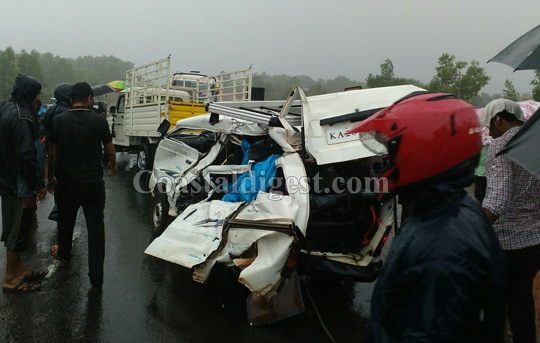
'Kundapur accident that claimed lives of 8 students could have been avoided'

[email protected] (CD Network)
June 21, 2016

Kundapur, Jun 21: The terrific road accident which claimed the lives of eight schoolchildren and injured a dozen others near Trasi in Kundapur taluk on Tuesday could have been avoided if the drivers of the private bus and Maruti Omni were responsible and considerate.

kundapura5

The driver of the Maruti Omni, identified as Martin, who is also the owner of the vehicle, also suffered injuries in the accident and was admitted to a private hospital. Medical sources said that he is out of danger.

Naresh, a passenger on board the private bus, which rammed into the Maruti Omni at Mohadi Cross, claimed that the Omni driver suddenly took a turn.

Even though the van's side indicators were on, the passengers in the bus said that there was poor visibility due to heavy rains in the area.

The bus, which was moving at a high speed, hit the van even though the bus driver applied breaks. “If the Omni driver was cautious and considerate, the tragedy would have been averted,” he said.

The private bus was on its way from Byndoor to Kundapur and the van was plying in the opposite direction.

Moreover, there were 19 people travelling in the Omni including 17 students of Don Bosco School, one of their teachers, identified as Philomena and the driver Martin.

Jurisdictional Gangolli police have registered a case and investigations are on.

Also Read: 8 schoolchildren killed, 10 injured as private bus rams into overloaded Omni

Comments

Siddarth
 - 
Tuesday, 21 Jun 2016

Both bus and Omni drivers are guilty. But no punishment can replace 8 lives. very very unfortunate incident.

Satyameva jayate
 - 
Tuesday, 21 Jun 2016

This could be avoided if our authorities are serious and ever if they think about public safety more than filling their pockets.
Daily we see these school vans...private buses...tippers....killing people over speeding .. etc.. not even a single driver changed himself at least from the fear of law.... time for public to man handle these killer drivers..

mohan
 - 
Tuesday, 21 Jun 2016

RIP,My heart bleeds for them,Heartfelt condolences with the family,May God strengthen them to overcome the loss of their death. please other drivers should drive slowly in rainy season by seeing this.

mohan
 - 
Tuesday, 21 Jun 2016

both drivers should be blamed for the death of the kids. in rainy season this drivers gets josh to drive carelessly. maximum punishment should give to both,

James
 - 
Tuesday, 21 Jun 2016

car driver is a murderer whats the need to put 19 peoples in one small car and drive recklessly.

Add new comment

  • Coastaldigest.com reserves the right to delete or block any comments.
  • Coastaldigset.com is not responsible for its readers’ comments.
  • Comments that are abusive, incendiary or irrelevant are strictly prohibited.
  • Please use a genuine email ID and provide your name to avoid reject.
News Network
March 12,2020

Bengaluru, Mar 12: Karnataka government on Wednesday issued a temporary regulation -- Karnataka Epidemic Diseases, COVID-19 Regulations, 2020 -- which aims to prevent the spread of the disease.

According to the regulation, all government and private hospitals should have flu corners for the screening of suspected cases of COVID-19.

All hospitals during the screening of such cases shall record the history of travel of the person if he or she has travelled to any country or area where COVID-19 has been reported in addition to the history of coming in contact with a suspected or confirmed case of COVID-19 shall be recorded.

Any person with a history of travel in the last 14 days to a country or area from where COVID-19 has been reported must report to the nearest government hospital or call at toll-free helpline number 104 so that necessary measures if required, may be initiated by the Department of Health and Family Welfare.

If a suspected case of COVID-19 refuses admission or isolation, the offices authorised under Section 3 of the regulation shall have powers to forcefully admit and isolate such case of a period of 14 days from the onset of symptoms or till the reports of lab tests are received, or such period as may be necessary.

No person, institution or organisation shall use print or electronic media to spread misinformation on COVID19. If a person is found indulging in any such activity, they will be punished.

If the cases of COVID-19 are reported from a defined geographic area, the district administration of the concerned district shall have the right to implement the following containment measures but not limited to these in order to prevent the spread of diseases:

* Sealing of geographic

* Barring of entry and exit of the population from the containment area

* Closure of schools, offices and banning public gathering

* Banning vehicular movement in the area

* Designating any government or private building as a containment unit for the isolation of cases

* The staff of all govt departments shall be at the disposal of the concerned district administration of the concerned area for discharging the duty of containment measures

Any person, institution or organisation found violating any of these regulations, shall be deemed to have committed an offence punishable under section 188 of the Indian Penal Code (IPC).

Comments

Add new comment

  • Coastaldigest.com reserves the right to delete or block any comments.
  • Coastaldigset.com is not responsible for its readers’ comments.
  • Comments that are abusive, incendiary or irrelevant are strictly prohibited.
  • Please use a genuine email ID and provide your name to avoid reject.
Agencies
May 8,2020

Washington D.C., May 8: The prime time for brain development in a child's life is the first year, where the infant spends most of the time asleep. It is the time when neural connections form and sensory memories are encoded.

However, when sleep is disrupted, as occurs more often among children with autism, brain development may be affected, too.

New research led by the University of Washington finds that sleep problems in a baby's first 12 months may not only precede an autism diagnosis but also may be associated with altered growth trajectory in a key part of the brain, the hippocampus.

The study, which was published in the American Journal of Psychiatry, researchers report that in a sample of more than 400 taken of 6- to 12-month-old infants, those who were later diagnosed with autism were more likely to have had difficulty falling asleep.

It also states that this sleep difficulty was associated with altered growth trajectories in the hippocampus.

"The hippocampus is critical for learning and memory, and changes in the size of the hippocampus have been associated with poor sleep in adults and older children.

As many as 80 per cent of the children with autism spectrum disorder have sleep problems," said Annette Estes, director of the UW Autism Center and senior author of the study.

"In our clinical experience, parents have a lot of concerns about their children's sleep, and in our work on early autism intervention, we observed that sleep problems were holding children and families back," added Estes, who is also a UW professor of speech and hearing sciences.

"It could be that altered sleep is part-and-parcel of autism for some children. One clue is that behavioural interventions to improve sleep don't work for all children with autism, even when their parents are doing everything just right. This suggests that there may be a biological component to sleep problems for some children with autism," said Estes.

To consider links among sleep, brain development, and autism, researchers at the IBIS Network looked at MRI scans of 432 infants, surveyed parents about sleep patterns, and measured cognitive functioning using a standardized assessment.

At the outset of the study, infants were classified according to their risk for developing autism: Those who were at higher risk of developing autism -- about two-thirds of the study sample -- had an older sibling who had already been diagnosed.

Infant siblings of children with autism have a 20 per cent chance of developing autism spectrum disorder -- a much higher risk than children in the general population.

In the current study, 127 of the 432 infants were identified as "low risk" at the time the MRI scans were taken because they had no family history of autism.

They later evaluated all the participants at 24 months of age to determine whether they had developed autism. Of the roughly 300 children originally considered "high familial risk," 71 were diagnosed with autism spectrum disorder at that age.

Problems with sleep were more common among the infants later diagnosed with an autism spectrum disorder, as were larger hippocampi. No other subcortical brain structures were affected, including the amygdala, which is responsible for certain emotions and aspects of memory, or the thalamus, a signal transmitter from the spinal cord to the cerebral cortex.

The authors note that while parents reported more sleep difficulties among infants who developed autism compared to those who did not, the differences were very subtle and only observed when looking at group averages across hundreds of infants.

Sleep patterns in the first years of life change rapidly as infants transition from sleeping around the clock to a more adult-like sleep/wake cycle. Until further research is completed, Estes said, it is not possible to interpret challenges with sleep as an early sign of increased risk for autism.


Comments

Add new comment

  • Coastaldigest.com reserves the right to delete or block any comments.
  • Coastaldigset.com is not responsible for its readers’ comments.
  • Comments that are abusive, incendiary or irrelevant are strictly prohibited.
  • Please use a genuine email ID and provide your name to avoid reject.
News Network
May 29,2020

Bengaluru, May 29: The hotel industry is one of the worst-hit industries due to lockdown, along with the tourism industry. Bengaluru's hotel industry has incurred a loss of around Rs 1200 crore during the lockdown period however, the hotels here are likely to open in June if the State government issues guidelines for the resumption of their services.

Speaking to media, PC Rao, President, Bangalore Hotelier's Association said, "It's not only the loss of business, but we have lost the customer base as well. 
We don't expect any good future for the next six months. There will be a slow down in the business even after opening."

"We have requested our CM to give first preference to the hotels. We are going to restart our business in June if granted permission. Around 10 per cent of the hotels cannot open at all. They are in the stage of merging or closing down position. Few hotels may open after five or six months," he added.

He continued saying that many hotels are for sale but there are no buyers. There are around 21,000 restaurants in Bangalore, 3500 hotels with rooms and restaurant which has an average turnover of Rs 20 crores per day, Rao informed.

"We expect losses of around Rs 1200 crores in these two months. We are giving special online training to all the hoteliers and to our managers particularly to deal with the COVID-19 situation, including how to deal with the guests, employees, how to start the hotel services. 

Each and every manager has already been trained and we are still continuing it. We will conduct face to face meeting as well and brief the managers," said Rao.

Comments

Add new comment

  • Coastaldigest.com reserves the right to delete or block any comments.
  • Coastaldigset.com is not responsible for its readers’ comments.
  • Comments that are abusive, incendiary or irrelevant are strictly prohibited.
  • Please use a genuine email ID and provide your name to avoid reject.