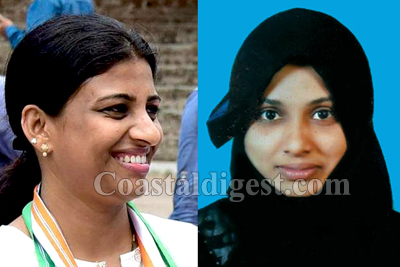
Lecturer, Dubai beautician among the new faces in Dakshina Kannada ZP

[email protected] (CD Network | Khaleel Ahmed)
February 24, 2016

Mangaluru, Feb 24: Rasheeda Banu, a lecturer at a private degree college in Ullal, is probably the only member in Dakshina Kannada Zilla Panchayat who holds a master degree in political science. This hijab-clad woman managed to defeat her closest rival Poornima Shetty of BJP with a margin of 4,580 votes in Konaje seat in just concluded panchayat polls.

zpwinners

Seema Melwyn D'Souza and Rasheeda Banu 

A rank holder in post-graduation at Mangalore University, Rasheeda worked as a guest lecturer in Field Marshal Cariappa College in Madikeri for two years and then joined Syed Madani Women's College in Ullal.

Eldest daughter of two-time taluk panchayat member Muhammed Mustafa Malar, she is married to Muhammed Twaha, an engineer and they have a small child. Thanks to the support and encouragement from her father, husband and health minister UT Khader she decided to enter politics to serve the poor through Congress party a few weeks ago.

“I want to develop my constituency using the funds available from the government. My father has been supporting me throughout the election,” she says.

“I know there is a lot of difference between what I have learnt and what I will be practicing now,” Ms. Banu said. She intends to work with legislators, and taluk panchayat and gram panchayat members to carry out development works.

“It is through development alone that harmony can be built in my constituency,” she said.

Wife replaces husband

Another Congress candidate Seema Melwyn D'Souza, who won from Neermarga seat, was beautician at a firm in Dubai till last year. She quit her Dubai job to join her husband, Melwyn D'Souza, a former ZP member. She opened her own beauty parlour in Neermarga later.

She said that it was her husband who had contested from the constituency during the last term. “As the women reservation was announced for the constituency, I contested the election. I will work towards the development of the constituency.”

Ruling out that his wife's candidature was a case of family politics, Mr. D'Souza said that it was proposed by party workers. “She is yet to get a grip of things. I am here to support her,” Mr. D'Souza said.

Comments

Anwar Sadath
 - 
Wednesday, 24 Feb 2016

Congratulation to my high school class mate Rasheeda Banu

Abu Wafa
 - 
Wednesday, 24 Feb 2016

Congrats, ,,,,, very good news

Ahmed Bava
 - 
Wednesday, 24 Feb 2016

Congratulations Rasheeda Banu ( Masha Allah ) and Seema Melwyn all the very best for your political future i hope you will do something good for poor people.

Siraj
 - 
Wednesday, 24 Feb 2016

Congratulations! It's good sign youngsters are jumping into politics. I wish them all the success for their future political life. Yes. There are many corrupt politicians in and around us. We should not be one among those who just blame politicians. The young and clean hands should jump into the political field and wipe out the corrupt. this is the best solution at the moment.

chammi
 - 
Wednesday, 24 Feb 2016

may Allah bless with u all the happiness and health Ameen

Nazeer
 - 
Wednesday, 24 Feb 2016

Masha Allah Good job Keep it up..
Well done..

Priyanka
 - 
Wednesday, 24 Feb 2016

wow wonderful, all the best do well for the society.

Zahir
 - 
Wednesday, 24 Feb 2016

all the best Rasheeda Banu, please solve our water problem in konaje roads are not clear.

Premanatha
 - 
Wednesday, 24 Feb 2016

all the best ladies, do well for your constituency.

Add new comment

  • Coastaldigest.com reserves the right to delete or block any comments.
  • Coastaldigset.com is not responsible for its readers’ comments.
  • Comments that are abusive, incendiary or irrelevant are strictly prohibited.
  • Please use a genuine email ID and provide your name to avoid reject.
News Network
January 11,2020

Bengaluru, Jan 11: India’s second-biggest IT company, Infosys Ltd, said it found no evidence of financial misconduct by its executives following a investigation into whistleblower complaints.

Bengaluru-headquartered Infosys, which earlier on Friday raised its revenue forecasts due to upbeat demand from Western clients, said an audit committee report exonerated Chief Executive Officer Salil Parekh and Chief Financial Officer Nilanjan Roy of all allegations, including accusations that the duo prevented employees from presenting data on large deals.

“I’m very happy that CEO Salil Parekh and CFO Nilanjan Roy have emerged from this stronger,” Infosys Chairman Nandan Nilekani told reporters. “The last two years since Salil has been here the company has changed dramatically for the better.”

Parekh took over as Infosys CEO in January 2018, after his predecessor Vishal Sikka quit following a public row with the company’s founder executives amid whistleblower allegations of wrongdoing.

The company earlier said it expected revenue to grow between 10 per cent and 10.5 per cent on a constant currency basis in the year ending March 2020, compared with its previous forecast of between 9 per cent and 10 per cent.

“We continue to see momentum in the market and we have an extremely robust pipeline driven by segment leaders,” CEO Parekh told a news conference.

“With the strength of large deal wins and digital momentum, we were able to clearly see that we have support to raise our guidance.”

Comments

Add new comment

  • Coastaldigest.com reserves the right to delete or block any comments.
  • Coastaldigset.com is not responsible for its readers’ comments.
  • Comments that are abusive, incendiary or irrelevant are strictly prohibited.
  • Please use a genuine email ID and provide your name to avoid reject.
News Network
March 25,2020

Bengaluru, Mar 25: The COVID-19 count in Karnataka went up by 10 on Wednesday, reaching 51. The 10 new positives included two girls aged seven and nine who contracted the infection from their father.

The 34-year-old man had returned from Amsterdam on March 19 and tested positive as the 17th confirmed case in Karnataka.

Though his family were kept in isolation and under quarantine in their house, the children developed a cold. They were confirmed for COVID-19 infection while their mother is still negative.

The government remained tightlipped over whether or not a 70-year-old woman from Gouribidanuru who was put under house quarantine and died on Wednesday morning, tested positive for COVID-19. Government officials would neither confirm nor deny anything on the results of tests on the woman.

This evening’s bulletin issued by the Karnataka health department continued to indicate the strong correlation of coronavirus infection and foreign travel.

Among the positive cases identified today were

A 63-year-old Bengaluru man and his 59-year-old wife, with a history of travel to Brazil and Argentina.
Two 26-year-old men with a history of travel to Spain and arrived back in Bengaluru via Dubai.
Two others, a 63-year-old woman and her 69-year-old husband, had a history of travel to Athens and London.
A 34-year-old man, a resident of Udupi, who returned from Dubai
A 37-year old woman, a resident of Chitradurga, with a history of travel to Guyana and arrived back in Bengaluru via Delhi
Speaking to the media, medical education minister K Sudhakar said health officials were apprehensive the positives may go up tonight.

Of the corona positive cases detected in Karnataka so far, three have been discharged after quarantine, and 47 patients are in isolation at designated hospitals in a stable condition. There has been one fatality.

As per a recommendation by the high-level health committee, the government has decided to convert the Bowring Hospital into a coronavirus treatment hospital facility along with the Rajiv Gandhi Hospital for Chest Diseases and Victoria Hospital. 

“The number of positive cases are growing at an alarming rate and the government needs more treatment facilities. The government is for burning of COVID-19 death cases. However, due to some religious practices, it has been decided they would be buried in 8 ft deep pits,'' Dr Sudhakar said.

Comments

Add new comment

  • Coastaldigest.com reserves the right to delete or block any comments.
  • Coastaldigset.com is not responsible for its readers’ comments.
  • Comments that are abusive, incendiary or irrelevant are strictly prohibited.
  • Please use a genuine email ID and provide your name to avoid reject.
Ram Puniyani
February 10,2020

Noam Chomsky is one of the leading peace workers in the world. In the wake of America’s attack on Vietnam, he brought out his classic formulation, ‘manufacturing consent’. The phrase explains the state manipulating public opinion to have the public approve of it policies—in this case, the attack of the American state on Vietnam, which was then struggling to free itself from French colonial rule.

In India, we are witness to manufactured hate against religious minorities. This hatred serves to enhance polarisation in society, which undermines India’s democracy and Constitution and promotes support for a Hindu nation. Hate is being manufactured through multiple mechanisms. For example, it manifests in violence against religious minorities. Some recent ghastly expressions of this manufactured hate was the massive communal violence witnessed in Mumbai (1992-93), Gujarat (2002), Kandhamal (2008) and Muzaffarnagar (2013). Its other manifestation was in the form of lynching of those accused of having killed a cow or consumed beef. A parallel phenomenon is the brutal flogging, often to death, of Dalits who deal with animal carcasses or leather.

Yet another form of this was seen when Shambhulal Regar, indoctrinated by the propaganda of Hindu nationalists, burned alive Afrazul Khan and shot the video of the heinous act. For his brutality, he was praised by many. Regar was incited into the act by the propaganda around love jihad. Lately, we have the same phenomenon of manufactured hate taking on even more dastardly proportions as youth related to Hindu nationalist organisations have been caught using pistols, while police authorities look on.

Anurag Thakur, a BJP minster in the central government recently incited a crowd in Delhi to complete his chant of what should happen to ‘traitors of the country...” with a “they should be shot”. Just two days later, a youth brought a pistol to the site of a protest at Jamia Millia Islamia university and shouted “take Azaadi!” and fired it. One bullet hit a student of Jamia. This happened on 30 January, the day Nathuram Godse had shot Mahatma Gandhi in 1948. A few days later, another youth fired near the site of protests against the CAA and NRC at Shaheen Bagh. Soon after, he said that in India, “only Hindus will rule”.

What is very obvious is that the shootings by those associated with Hindu nationalist organisations are the culmination of a long campaign of spreading hate against religious minorities in India in general and against Muslims in particular. The present phase is the outcome of a long and sustained hate campaign, the beginning of which lies in nationalism in the name of religion; Muslim nationalism and Hindu nationalism. This sectarian nationalism picked up the communal view of history and the communal historiography which the British introduced in order to pursue their ‘divide and rule’ policy.

In India what became part of “social common sense” was that Muslim kings had destroyed Hindu temples, that Islam was spread by force, and that it is a foreign religion, and so on. Campaigns, such as the one for a temple dedicated to the Hindu god Rama to be built at the site where the Babri masjid once stood, further deepened the idea of a Muslim as a “temple-destroyer”. Aurangzeb, Tipu Sultan and other Muslim kings were tarnished as the ones who spread Islam by force in the subcontinent. The tragic Partition, which was primarily due to British policies, and was well-supported by communal streams also, was entirely attributed to Muslims. The Kashmir conflict, which is the outcome of regional, ethnic and other historical issues, coupled with the American policy of supporting Pakistan’s ambitions of regional hegemony, (which also fostered the birth of Al-Qaeda), was also attributed to the Muslims.

With recurring incidents of communal violence, these falsehoods went on going deeper into the social thinking. Violence itself led to ghettoisation of Muslims and further broke inter-community social bonds. On the one hand, a ghettoised community is cut off from others and on the other hand the victims come to be presented as culprits. The percolation of this hate through word-of-mouth propaganda, media and re-writing of school curricula, had a strong impact on social attitudes towards the minorities.

In the last couple of decades, the process of manufacturing hate has been intensified by the social media platforms which are being cleverly used by the communal forces. Swati Chaturvedi’s book, I Am a Troll: Inside the Secret World of the BJP’s Digital Army, tells us how the BJP used social media to spread hate. Whatapp University became the source of understanding for large sections of society and hate for the ‘Other’, went up by leaps and bounds. To add on to this process, the phenomenon of fake news was shrewdly deployed to intensify divisiveness.

Currently, the Shaheen Bagh movement is a big uniting force for the country; but it is being demonised as a gathering of ‘anti-nationals’. Another BJP leader has said that these protesters will indulge in crimes like rape. This has intensified the prevalent hate.

While there is a general dominance of hate, the likes of Shambhulal Regar and the Jamia shooter do get taken in by the incitement and act out the violence that is constantly hinted at. The deeper issue involved is the prevalence of hate, misconceptions and biases, which have become the part of social thinking.

These misconceptions are undoing the amity between different religious communities which was built during the freedom movement. They are undoing the fraternity which emerged with the process of India as a nation in the making. The processes which brought these communities together broadly drew from Gandhi, Bhagat Singh and Ambedkar. It is these values which need to be rooted again in the society. The communal forces have resorted to false propaganda against the minorities, and that needs to be undone with sincerity.

Combating those foundational misconceptions which create hatred is a massive task which needs to be taken up by the social organisations and political parties which have faith in the Indian Constitution and values of freedom movement. It needs to be done right away as a priority issue in with a focus on cultivating Indian fraternity yet again.


Comments

Add new comment

  • Coastaldigest.com reserves the right to delete or block any comments.
  • Coastaldigset.com is not responsible for its readers’ comments.
  • Comments that are abusive, incendiary or irrelevant are strictly prohibited.
  • Please use a genuine email ID and provide your name to avoid reject.