


Less than 8% Indian engineers fit for core engg roles

June 14, 2016

New Delhi, Jun 14: Significant efforts need to be made to improve employability in the engineering sector as less than 8 per cent of Indian engineers are employable in core engineering roles, reveals an Aspiring Minds' report.college-students
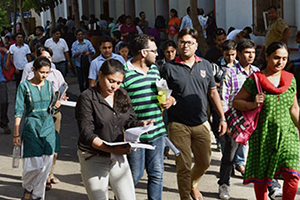
The National Employability Report for the first time this year looked into the employability of specialised and new careers, which are available to engineers, other than core IT and software roles.

The nationwide analysis based on a sample of 1,50,000 engineers showed there was a huge gap in skills of engineers, as needed, to work in the large industry.

"There are several problems with regard to employability in core engineering roles. We need to excite students about these jobs. Everyone's focus today is on IT. We want students to design and build things. We need emphasis on the basics, for instance, basic electrical engineering, basic concepts of mechanics and so on," Varun Aggarwal CTO Aspiring Minds said.

The government's Make in India initiative aspires to create manufacturing capacity in India and generate 100 million jobs by 2022.

Low employability of engineers, however, will impede the growth of manufacturing in India in a big way and requires immediate intervention, the employability assessment firm said.

Aggarwal noted that students do not have these basic concepts right. There is a huge need of a curriculum revamp and to bring in new teaching methods and technology.

"The science of manufacturing has moved way ahead but we continue to teach outdated concepts to students. For India to become the world's manufacturing hub, we need to lead from the front in our understanding of cutting edge methods, knowledge- driven management and implementation capability," he added.

Employability for roles like mechanical design engineer and civil engineer stand at a meagre 5.55 per cent and 6.48 per cent respectively.

The lowest employability percentage was recorded for the Chemical Design Engineer role at 1.64 per cent.

Employability in the domain specific roles is the highest for Electronics engineers at 7.07 per cent.

This percentage is considerably lower compared to employability in IT roles like Software Engineer - IT services and Associate ITeS Operations (Hardware Networking) which stood at 17.91 per cent and 37.06 per cent respectively.

The study on employability across metros reveals higher employability in Delhi and Mumbai with employability for the electronics design engineer role as high as 19 per cent followed by cities like Bengaluru, Kolkata and Hyderabad.

The lowest employability figures across roles is observed in Chennai with employability for the Civil Design Engineer role as low as 1 per cent, the report said.

Comments

Jamal
 - 
Thursday, 16 Jun 2016

Students passing out of IT engineering colleges in mangalore don't know how to code. Its like someone completing a driving course from driving school. But, when u give him a car to drive, he doesn't know how to drive.

I wonder what these so-called \engineering colleges\" teach."

Zahoor Ahmed
 - 
Wednesday, 15 Jun 2016

Our Honourable HRD Minister Dear Smriti is not interest to curriculam revamp,new teaching method or technology. instead she is interesting in Yoga, Sanskrit,dancing,acting to introduce in IIT and Engineering Institutions. LOL

Add new comment

  • Coastaldigest.com reserves the right to delete or block any comments.
  • Coastaldigset.com is not responsible for its readers’ comments.
  • Comments that are abusive, incendiary or irrelevant are strictly prohibited.
  • Please use a genuine email ID and provide your name to avoid reject.
Agencies
April 15,2020

San Diego, Apr 15: Several people lost their sense of smell or taste weeks ago globally and are still waiting for it to come back and now, researchers have identified an association between sensory loss and novel coronavirus 2019 (COVID-19) infection, indicating that loss of smell and taste may be considered as early symptoms of the deadly disease.

Interestingly, the study also found that persons who reported experiencing a sore throat more often tested negative for COVID-19.

The team from University of California-San Diego found high prevalence and unique presentation of certain sensory impairments in patients positive with COVID-19.

Of those who reported a loss of smell and taste, the loss was typically profound, not mild.

"Based on our study, if you have smell and taste loss, you are more than 10 times more likely to have COVID-19 infection than other causes of infection. The most common first sign of a COVID-19 infection remains fever, but fatigue and loss of smell and taste follow as other very common initial symptoms," explained study researcher Carol Yan from UC San Diego.

"We know COVID-19 is an extremely contagious virus. This study supports the need to be aware of smell and taste loss as early signs of COVID-19," Yan added.

For the findings, published in the journal International Forum of Allergy and Rhinology, the research team surveyed 1,480 patients with flu-like symptoms and concerns regarding potential COVID-19 infection who underwent testing at UC San Diego Health from March 3 through March 29, 2020.

Within that total, 102 patients tested positive for the virus and 1,378 tested negatives. The study included responses from 59 COVID-19-positive patients and 203 COVID-19-negative patients.

Encouragingly, the rate of recovery of smell and taste was high and occurred usually within two to four weeks of infection.

"Our study not only showed that the high incidence of smell and taste is specific to COVID-19 infection but we fortunately also found that for the majority of people sensory recovery was generally rapid," said Yan.

"Among the COVID-19 patients with smell loss, more than 70 per cent had reported improvement of smell at the time of the survey and of those who hadn't reported improvement, many had only been diagnosed recently," she added.

Sensory return typically matched the timing of disease recovery.

In an effort to decrease the risk of virus transmission, UC San Diego Health now includes loss of smell and taste as a screening requirement for visitors and staff, as well as a marker for testing patients who may be positive for the virus.

"It is our hope that with these findings other institutions will follow suit and not only list smell and taste loss as a symptom of COVID-19, but use it as a screening measure for the virus across the world," Yan said.

Comments

Add new comment

  • Coastaldigest.com reserves the right to delete or block any comments.
  • Coastaldigset.com is not responsible for its readers’ comments.
  • Comments that are abusive, incendiary or irrelevant are strictly prohibited.
  • Please use a genuine email ID and provide your name to avoid reject.
News Network
June 5,2020

Bengaluru, Jun 5: The Karnataka government has asked all its departments and authorities to avoid during all official transactions the nomenclature "Dalit" for members belonging to the Scheduled Castes.

"All the departments and authorities of government of Karnataka are requested that (use of name Dalit) for all official transactions, matters, dealings, certificates, among others," the official circular said.

The Constitutional term Scheduled Caste in English and its appropriate translation in other national languages should alone be used for denoting the persons belonging to the Scheduled Castes/ Scheduled Tribes notified in the presidential orders issued under Article 341 of the Constitution, the circular said.

The circular issued on May 20 notes instructions issued by the Central government in 2018, with reference to the order of the High Court of Madhya Pradesh, Gwalior Bench.

"That the Central government/state government and its functionaries would refrain from using the nomenclature "Dalit" for the members belonging to Scheduled Castes and Scheduled Tribes as the same does not find mentioned in the Constitution or any statute," the order had said.

Pointing out that the Central government had earlier issued instructions that the words "Harijan" and "Girijan" should not be used, the circular said accordingly the Karnataka government also had issued a Government Order in 2010.

Comments

Add new comment

  • Coastaldigest.com reserves the right to delete or block any comments.
  • Coastaldigset.com is not responsible for its readers’ comments.
  • Comments that are abusive, incendiary or irrelevant are strictly prohibited.
  • Please use a genuine email ID and provide your name to avoid reject.
News Network
March 7,2020

Bengaluru, Mar 7: Customs officials intercepted a Guatemalan national at Kempegowda International Airport here on March 2 and recovered cocaine.

The accused confessed that she had swallowed 150 cocaine capsules and concealed a tube-like structure in her vagina.

The passenger egested the total 1.385 kg of cocaine (150 cocaine capsules) over a period of two days, under medical supervision. She has been arrested.

Further, an investigation is underway.

Comments

Add new comment

  • Coastaldigest.com reserves the right to delete or block any comments.
  • Coastaldigset.com is not responsible for its readers’ comments.
  • Comments that are abusive, incendiary or irrelevant are strictly prohibited.
  • Please use a genuine email ID and provide your name to avoid reject.