


Less than 8% Indian engineers fit for core engg roles

June 14, 2016

New Delhi, Jun 14: Significant efforts need to be made to improve employability in the engineering sector as less than 8 per cent of Indian engineers are employable in core engineering roles, reveals an Aspiring Minds' report.college-students
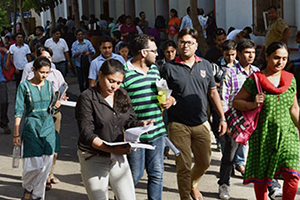
The National Employability Report for the first time this year looked into the employability of specialised and new careers, which are available to engineers, other than core IT and software roles.

The nationwide analysis based on a sample of 1,50,000 engineers showed there was a huge gap in skills of engineers, as needed, to work in the large industry.

"There are several problems with regard to employability in core engineering roles. We need to excite students about these jobs. Everyone's focus today is on IT. We want students to design and build things. We need emphasis on the basics, for instance, basic electrical engineering, basic concepts of mechanics and so on," Varun Aggarwal CTO Aspiring Minds said.

The government's Make in India initiative aspires to create manufacturing capacity in India and generate 100 million jobs by 2022.

Low employability of engineers, however, will impede the growth of manufacturing in India in a big way and requires immediate intervention, the employability assessment firm said.

Aggarwal noted that students do not have these basic concepts right. There is a huge need of a curriculum revamp and to bring in new teaching methods and technology.

"The science of manufacturing has moved way ahead but we continue to teach outdated concepts to students. For India to become the world's manufacturing hub, we need to lead from the front in our understanding of cutting edge methods, knowledge- driven management and implementation capability," he added.

Employability for roles like mechanical design engineer and civil engineer stand at a meagre 5.55 per cent and 6.48 per cent respectively.

The lowest employability percentage was recorded for the Chemical Design Engineer role at 1.64 per cent.

Employability in the domain specific roles is the highest for Electronics engineers at 7.07 per cent.

This percentage is considerably lower compared to employability in IT roles like Software Engineer - IT services and Associate ITeS Operations (Hardware Networking) which stood at 17.91 per cent and 37.06 per cent respectively.

The study on employability across metros reveals higher employability in Delhi and Mumbai with employability for the electronics design engineer role as high as 19 per cent followed by cities like Bengaluru, Kolkata and Hyderabad.

The lowest employability figures across roles is observed in Chennai with employability for the Civil Design Engineer role as low as 1 per cent, the report said.

Comments

Jamal
 - 
Thursday, 16 Jun 2016

Students passing out of IT engineering colleges in mangalore don't know how to code. Its like someone completing a driving course from driving school. But, when u give him a car to drive, he doesn't know how to drive.

I wonder what these so-called \engineering colleges\" teach."

Zahoor Ahmed
 - 
Wednesday, 15 Jun 2016

Our Honourable HRD Minister Dear Smriti is not interest to curriculam revamp,new teaching method or technology. instead she is interesting in Yoga, Sanskrit,dancing,acting to introduce in IIT and Engineering Institutions. LOL

Add new comment

  • Coastaldigest.com reserves the right to delete or block any comments.
  • Coastaldigset.com is not responsible for its readers’ comments.
  • Comments that are abusive, incendiary or irrelevant are strictly prohibited.
  • Please use a genuine email ID and provide your name to avoid reject.
coastaldigest.com news network
July 11,2020

Mangaluru, Jul 11: Deputy Commissioner Sindhu B Rupesh has set up an expert committee to look into the cause of deaths of covid patients in Dakshina Kannada.

The development comes after eight more fatalities including that of a CISF personnel attached to MRPL, were reported in the district on Friday.

The district has recorded 23 deaths since July 1 and 38 death cases have been reported in the district since April 19.

Of the 38 deaths, five were from outside the district. All the eight patients, who lost their battle to the virus in the district on Friday, were suffering from co-morbidities.

According to the govt bulletin on Covid-19 cases, comorbid conditions, like kidney failure, brain tumour, TB, pneumonia, liver damage, high BP, diabetes and others, were the main reasons behind the Covid-19 deaths reported in the district.

Comments

Add new comment

  • Coastaldigest.com reserves the right to delete or block any comments.
  • Coastaldigset.com is not responsible for its readers’ comments.
  • Comments that are abusive, incendiary or irrelevant are strictly prohibited.
  • Please use a genuine email ID and provide your name to avoid reject.
News Network
February 21,2020

Bengaluru, Feb 21: The Supreme Court in its interim order on Thursday allowed the plea of the Karnataka government for implementation of the final award by a tribunal for sharing of water between Goa, Karnataka and Maharashtra from the Mahadayi river.

The interim order was passed by a bench comprising Justice D Y Chandrachud and Justice Hemant Gupta after hearing the counsel from the three states. The bench said the final hearing in the matter will take place in July.

It also said the interim order is subject to the final outcome of the petitions filed by the three states against the tribunal's award.

The Mahadayi Water Dispute tribunal had passed the order on August 14, 2018, allocating 13.42 TMC ( Thousand Million Cubic Feet.) water (including 3.9 TMC for diversion into the depleted Malaprabha river basin) from the Mahadayi river basin to Karnataka.

Maharashtra was allotted 1.33 TMC water while Goa was given 24 TMC in the final decision of the tribunal. The UPA-2 government had constituted Mahadayi Water Disputes Tribunal in 2010.

Karnataka government, which has locked horns with the neighbouring Goa on the larger issue of sharing Mahadayi River water between both the states, had petitioned the tribunal seeking the release of 7.56 tmcft of water for the Kalasa-Banduri Nala project.

The Kalasa-Banduri Nala (diversion) project, which will utilise 7.56 tmcft of water from the inter-state Mahadayi river, is being undertaken by Karnataka to improve drinking water supply to the twin cities of Hubballi-Dharwad and the districts of Belagavi and Gadag.

It involves building barrages across Kalasa and Banduri, the tributaries of the Mahadayi River, to divert 7.56 tmc water to the Malaprabha river which fulfils the drinking water needs of the twin cities.

Comments

Add new comment

  • Coastaldigest.com reserves the right to delete or block any comments.
  • Coastaldigset.com is not responsible for its readers’ comments.
  • Comments that are abusive, incendiary or irrelevant are strictly prohibited.
  • Please use a genuine email ID and provide your name to avoid reject.
coastaldigest.com news network
May 27,2020

Bengaluru, May 27: A yet incomplete state-wide survey has revealed that there are over 53.99 lakh households vulnerable to the infection in Karnataka. The survey is being conducted by the government to find COVID-19 vulnerable population particularly with comorbidities and cases like SARI and ILI.

The survey, which is 67.16% complete so far, finds 1.37 lakh households across Karnataka have people with comorbid conditions, excluding a further 13,341 households with symptoms of Influenza Like Illness (ILI), Severe Acute Respiratory Infection (SARI) and Covid-19.

Over 48 lakh households have senior citizens, who on account of their age are at highest risk of death from the disease.

Munish Moudgil, Director of the State COVID War Room, clarified that households could have multiple types of vulnerable people. According to the survey data (which is dated May 26), Kalaburagi and Bengaluru Urban have the highest cases of SARI, ILI with 1,902 households and 1,703 households respectively, although these numbers are likely to rise, as the survey is still incomplete in these districts. 

A BBMP source said that 68% of the survey has been completed in the city, but the data has not been logged yet. The number of SARI/ILI cases is next highest in Shivamogga with 1,217 households, Mysuru with 1,200 and Davangere with 1,178.

The government regards SARI and ILI as indicators of coronavirus and on April 17, had passed an order instructing healthcare workers to test people with these conditions for the coronavirus. Consequently, 51 COVID-19 cases were discovered by testing people with these symptoms.

Belagavi, meantime, has reported the highest incidents of households with comorbid conditions with 12,427 identified so far, followed by Mandya with 9,289, Kalaburagi with 8,311, Shivamogga with 8,140 and Bengaluru Urban with 7,562. Importantly, 3,45,443 vulnerable people have been identified in Bengaluru Urban within 28.26% of data logged in so far.

Comments

Add new comment

  • Coastaldigest.com reserves the right to delete or block any comments.
  • Coastaldigset.com is not responsible for its readers’ comments.
  • Comments that are abusive, incendiary or irrelevant are strictly prohibited.
  • Please use a genuine email ID and provide your name to avoid reject.