Less than 8% Indian engineers fit for core engg roles

June 14, 2016

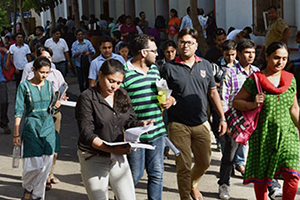
New Delhi, Jun 14: Significant efforts need to be made to improve employability in the engineering sector as less than 8 per cent of Indian engineers are employable in core engineering roles, reveals an Aspiring Minds' report.college-students
The National Employability Report for the first time this year looked into the employability of specialised and new careers, which are available to engineers, other than core IT and software roles.

The nationwide analysis based on a sample of 1,50,000 engineers showed there was a huge gap in skills of engineers, as needed, to work in the large industry.

"There are several problems with regard to employability in core engineering roles. We need to excite students about these jobs. Everyone's focus today is on IT. We want students to design and build things. We need emphasis on the basics, for instance, basic electrical engineering, basic concepts of mechanics and so on," Varun Aggarwal CTO Aspiring Minds said.

The government's Make in India initiative aspires to create manufacturing capacity in India and generate 100 million jobs by 2022.

Low employability of engineers, however, will impede the growth of manufacturing in India in a big way and requires immediate intervention, the employability assessment firm said.

Aggarwal noted that students do not have these basic concepts right. There is a huge need of a curriculum revamp and to bring in new teaching methods and technology.

"The science of manufacturing has moved way ahead but we continue to teach outdated concepts to students. For India to become the world's manufacturing hub, we need to lead from the front in our understanding of cutting edge methods, knowledge- driven management and implementation capability," he added.

Employability for roles like mechanical design engineer and civil engineer stand at a meagre 5.55 per cent and 6.48 per cent respectively.

The lowest employability percentage was recorded for the Chemical Design Engineer role at 1.64 per cent.

Employability in the domain specific roles is the highest for Electronics engineers at 7.07 per cent.

This percentage is considerably lower compared to employability in IT roles like Software Engineer - IT services and Associate ITeS Operations (Hardware Networking) which stood at 17.91 per cent and 37.06 per cent respectively.

The study on employability across metros reveals higher employability in Delhi and Mumbai with employability for the electronics design engineer role as high as 19 per cent followed by cities like Bengaluru, Kolkata and Hyderabad.

The lowest employability figures across roles is observed in Chennai with employability for the Civil Design Engineer role as low as 1 per cent, the report said.

Comments

Jamal
 - 
Thursday, 16 Jun 2016

Students passing out of IT engineering colleges in mangalore don't know how to code. Its like someone completing a driving course from driving school. But, when u give him a car to drive, he doesn't know how to drive.

I wonder what these so-called \engineering colleges\" teach."

Zahoor Ahmed
 - 
Wednesday, 15 Jun 2016

Our Honourable HRD Minister Dear Smriti is not interest to curriculam revamp,new teaching method or technology. instead she is interesting in Yoga, Sanskrit,dancing,acting to introduce in IIT and Engineering Institutions. LOL

Add new comment

  • Coastaldigest.com reserves the right to delete or block any comments.
  • Coastaldigset.com is not responsible for its readers’ comments.
  • Comments that are abusive, incendiary or irrelevant are strictly prohibited.
  • Please use a genuine email ID and provide your name to avoid reject.
News Network
February 16,2020

Bengaluru, Feb 16: Radhakrishnan V Nair embarked on a journey of exploring complex subjects and opening up the cocoon of existence that puts people in a zone of comfort. One sole mission of the book is to encourage the readers to break out of that comfort zone.

The architect by profession has a novel to his credit, 'The Cave of Freedom' that had earned him critical acclaim from Jnanpith Awardee UR Ananthamurthy. On February 13, a discussion and the reading of his book had the audience riveted to their seats.

The launch of the book on February 13 at Bangalore International Centre was presided over by Bhaskar Rao, Commissioner of Police, Bengaluru, along with Vasudev Murthy, Technology Management Consultant, leadership trainer and author and Ramessh RK, an industrial designer and choir singer who read out passages from the book.

'Radhakrishnan is trying to inspire you to discover the pleasure of breaking the glass barrier along with the protagonist Dr Prateek. The story 'burst out'", said Radhakrishnan when it could not be contained any longer.

The glass ceiling saw a lot of interest from the audience present. The book includes Dr Prateek who is obsessed with saving lives in the Emergency Room (ER) as the world slept. Then on an eerie rainy night, he is kidnapped.

He struggles to come to terms with the improbability of waking up somewhere in Europe and making his serendipitous escape and being back at work the next morning - all physically impossible from the point of view of time and locality.

The glass ceiling challenges you to see tragedies and their impact on a person's mental well-being from a different perspective.

Radhakrishnan V Nair is an architect by profession and runs his Bengaluru-based firm - Archaid, the tagline of which is 'Architecture in Collaboration with Nature'.

Comments

Add new comment

  • Coastaldigest.com reserves the right to delete or block any comments.
  • Coastaldigset.com is not responsible for its readers’ comments.
  • Comments that are abusive, incendiary or irrelevant are strictly prohibited.
  • Please use a genuine email ID and provide your name to avoid reject.
News Network
March 7,2020

Bengaluru, Mar 7: As a precautionary measure to control the spread of coronavirus in Karnataka, the state government has planned to suspend biometric attendance for the time-being at its offices, also in corporate and IT companies, Medical Education Minister Dr K Sudhakar said on Saturday.

He said the government has taken all precautionary measures to control the spread of the virus in the state.

"Our Additional Chief Secretary has already spoken to IT companies yesterday on behalf of the government regarding guidelines that need to be followed, it is part of it...we will do it in the government also in the days to come," Sudhakar told reporters here.

He was responding to a question about suspending biometric attendance at offices in the wake of the coronavirus outbreak.

Asked about suspending biometric attendanceat government offices, he said, "we have planned to do it yesterday."

Sudhakar said so far in Karnataka not even one case has been identified, to that extent we have been taking precautionary measures effectively.

He said from villages to state capital Bengaluru at all levels the health department officials have been activated as part of the precautionary measures.

Also, committees headed by Deputy Commissioners have been formed in all district, he added.

"We have given certain guidelines to people. We have also included private hospitals. We have taken all precautionary measures to stop the virus from entering the state," he added.

In response to a question regarding masks, the Minister clarified that those who have the symptoms of the disease only should use them.

He said, "N95 masks are required only for those who have tested positive, there is not even a single positive case in the state so far...surgical masks that will have three layers can be used by those who have symptoms like cough, cold, fever."

In the state as a precautionary measure 2,500 beds have been kept ready if the situation arises, despite not having a single case.

Comments

Add new comment

  • Coastaldigest.com reserves the right to delete or block any comments.
  • Coastaldigset.com is not responsible for its readers’ comments.
  • Comments that are abusive, incendiary or irrelevant are strictly prohibited.
  • Please use a genuine email ID and provide your name to avoid reject.
News Network
July 28,2020

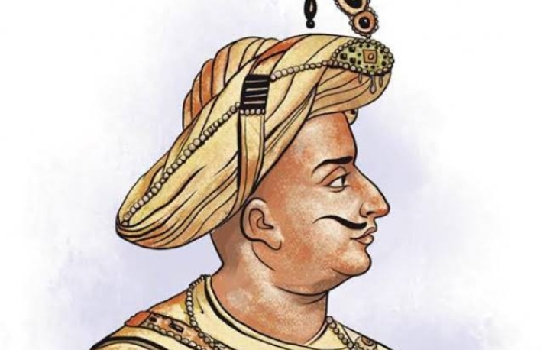
Bengaluru, Jul 28: After the Central Board of Secondary Education (CBSE) reduced the syllabi for Classes 9 to 12 due to COVID-19 pandemic, the Karnataka government has followed the suit. The Department of Public Instruction has omitted the chapters on legendary south Indian rulers Hyder Ali and Tipu Sultan from the textbooks of Class 7 in their attempt to reduce syllabus for state board schools by 30 per cent. 

The department, however, has decided to retain similar chapters on Tipu Sultan in 6th and 10th Classes, though the syllabus in text books for all classes from 1 to 10th has been trimmed. 

The trimmed textbooks uploaded on the website of the Department of State Education Research and Training (DSERT) by Karnataka state Textbook Society revealed removal of chapters on Tipu Sultan for the seventh grade.

Justifying the decision, officials said, "students study similar chapters in Class 6 and more in the 10th grade." Yet another senior official from the Text Book Society said, "Trimming does not mean we have removed half of the syllabus from textbooks. It is only keeping in mind the repetition we have condensed the chapters. In case students study about a particular dynasty in higher grades, then the same had been removed from lower grades."

A few months ago, there was an uproar over dropping of content on Tipu Sultan and MLAs from the ruling BJP also demanded the same and petitioned to the Chief Minister. Even an expert committee led by Prof Baraguru Ramachandrappa suggested to not drop any content on the historic figure. However, the department still decided to drop lessons from one of the classes while keeping the syllabus short for the next 120 active academic days.

Earlier this month, a controversy had erupted over the CBSE's decision to omit topics like federalism, secularism, citizenship, etc while reducing the syllabus for Classes 9 to 12. The education board had issued a detailed clarification later, stating that topics claimed to be dropped "are either being covered by the rationalised syllabus or in the Alternative Academic Calendar of NCERT".

"The rationalisation of syllabus up to 30 per cent has been undertaken by the Board for nearly 190 subjects of class 9 to 12 for the academic session 2020-21 as a one-time measure only. The objective is to reduce the exam stress of students due to the prevailing health emergency situation and prevent learning gaps," it said.

Last week, the Congress in Uttar Pradesh expressed its concern over 'deliberate and systematic' deletions of chapters related to the freedom struggle and the party's role in it from the Class 10-12 syllabi of the Secondary Education Board.

Comments

Add new comment

  • Coastaldigest.com reserves the right to delete or block any comments.
  • Coastaldigset.com is not responsible for its readers’ comments.
  • Comments that are abusive, incendiary or irrelevant are strictly prohibited.
  • Please use a genuine email ID and provide your name to avoid reject.