


Less than 8% Indian engineers fit for core engg roles

June 14, 2016

New Delhi, Jun 14: Significant efforts need to be made to improve employability in the engineering sector as less than 8 per cent of Indian engineers are employable in core engineering roles, reveals an Aspiring Minds' report.college-students
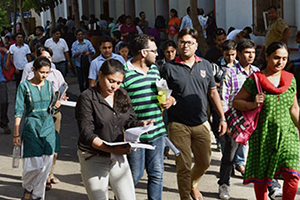
The National Employability Report for the first time this year looked into the employability of specialised and new careers, which are available to engineers, other than core IT and software roles.

The nationwide analysis based on a sample of 1,50,000 engineers showed there was a huge gap in skills of engineers, as needed, to work in the large industry.

"There are several problems with regard to employability in core engineering roles. We need to excite students about these jobs. Everyone's focus today is on IT. We want students to design and build things. We need emphasis on the basics, for instance, basic electrical engineering, basic concepts of mechanics and so on," Varun Aggarwal CTO Aspiring Minds said.

The government's Make in India initiative aspires to create manufacturing capacity in India and generate 100 million jobs by 2022.

Low employability of engineers, however, will impede the growth of manufacturing in India in a big way and requires immediate intervention, the employability assessment firm said.

Aggarwal noted that students do not have these basic concepts right. There is a huge need of a curriculum revamp and to bring in new teaching methods and technology.

"The science of manufacturing has moved way ahead but we continue to teach outdated concepts to students. For India to become the world's manufacturing hub, we need to lead from the front in our understanding of cutting edge methods, knowledge- driven management and implementation capability," he added.

Employability for roles like mechanical design engineer and civil engineer stand at a meagre 5.55 per cent and 6.48 per cent respectively.

The lowest employability percentage was recorded for the Chemical Design Engineer role at 1.64 per cent.

Employability in the domain specific roles is the highest for Electronics engineers at 7.07 per cent.

This percentage is considerably lower compared to employability in IT roles like Software Engineer - IT services and Associate ITeS Operations (Hardware Networking) which stood at 17.91 per cent and 37.06 per cent respectively.

The study on employability across metros reveals higher employability in Delhi and Mumbai with employability for the electronics design engineer role as high as 19 per cent followed by cities like Bengaluru, Kolkata and Hyderabad.

The lowest employability figures across roles is observed in Chennai with employability for the Civil Design Engineer role as low as 1 per cent, the report said.

Comments

Jamal
 - 
Thursday, 16 Jun 2016

Students passing out of IT engineering colleges in mangalore don't know how to code. Its like someone completing a driving course from driving school. But, when u give him a car to drive, he doesn't know how to drive.

I wonder what these so-called \engineering colleges\" teach."

Zahoor Ahmed
 - 
Wednesday, 15 Jun 2016

Our Honourable HRD Minister Dear Smriti is not interest to curriculam revamp,new teaching method or technology. instead she is interesting in Yoga, Sanskrit,dancing,acting to introduce in IIT and Engineering Institutions. LOL

Add new comment

  • Coastaldigest.com reserves the right to delete or block any comments.
  • Coastaldigset.com is not responsible for its readers’ comments.
  • Comments that are abusive, incendiary or irrelevant are strictly prohibited.
  • Please use a genuine email ID and provide your name to avoid reject.
News Network
June 22,2020

Bengaluru, June 22: Even as the covid-19 positive cases are steadily increasing in Karnataka, an expert has claimed that community transmission has begun in Bengaluru and cases could keep rising over the next two months.

“If you look at the natural course of this virus across countries around the world, it is about six months. Now we’re in the fourth month. This will go on for another two months. It also sounds like this is the beginning of the peak. There is also a possibility of the number of cases going up from now on. Even across India, cases are increasing,” says Dr CN Manjunath, director of Sri Jayadeva Institute of Cardiovascular Sciences and Research and State Task Force member.

Besides the increase in number of cases, the virus is advancing silently, stealthily. A lot of people who are testing positive are asymptomatic. In areas like Padarayanapura, Nanjangud and many places in north Karnataka, there have been positive cases who have not had any contact with infected individuals. Some cases recorded in Bengaluru over the last two to three days have not had any contact with Covid-positive people.

Dr Manjunath adds: “We are in community transmission. This will happen because nature is ahead of everything. We have to take all possible precautionary measures at our command. This has to happen. Only then some kind of herd immunity will be developed.”

“We are expanding the guidelines of testing to include a large number of people to be tested. Now, according to the Indian Council for Medical Research (ICMR) guidelines, only symptomatic Influenza like Illness (ILI) or Severe Acute Respiratory Infection (SARI), or a person coming in contact with an infected person are being tested.

But since we have crossed 100 days in Karnataka from the first reported case and we’re getting cases with no travel history or contact with a Covid-positive person, we have to start random testing across the sub-group population. Only then will we understand the burden of the disease and what precautions need to be taken,” he says.

Comments

Add new comment

  • Coastaldigest.com reserves the right to delete or block any comments.
  • Coastaldigset.com is not responsible for its readers’ comments.
  • Comments that are abusive, incendiary or irrelevant are strictly prohibited.
  • Please use a genuine email ID and provide your name to avoid reject.
News Network
April 16,2020

New Delhi, Apr 16: Minority Affairs Minister Mukhtar Abbas Naqvi on Thursday directed state waqf boards to ensure strict implementation of lockdown and social distancing guidelines during the holy month of Ramzan starting next week amid the coronavirus pandemic.

At a meeting via video conferencing, Naqvi asked the state waqf boards' officials to create awareness among people to offer prayers and perform other religious rituals like "iftar (breaking of fast)" during Ramzan, which begins on April 24 or 25, staying inside their homes.

More than seven lakh registered mosques, eidgahs, imambadas, dargahs and other religious and social institutions come under state waqf boards across the country. The Central Waqf Council is the regulatory body of state waqf boards in India.

"We should cooperate with health workers, security forces, administrative officers, sanitation workers. They are working for our safety and well-being even putting their own lives at risk in this coronavirus pandemic," Naqvi said.

"We should also demolish rumours and misinformation being spread about quarantine and isolation centres by creating awareness among people that such centres are only meant to protect people, their families and the society from the pandemic," the minister said.

Naqvi told all the state waqf boards and religious and social organisations that everyone should remain cautious of any type of fake news and conspiracies aimed at creating misinformation. 

"Authorities have been working for safety and well-being of all citizens of the country without any discrimination. Such type of rumours and conspiracies are a nefarious design to weaken the fight against coronavirus," he said.

"We should work united to win this fight against corona by defeating any type of rumour, misinformation and conspiracy," the minister said.

Naqvi asked officials of all the state waqf boards to play an active and effective role in ensuring that people follow the guidelines of the Union Home Ministry, state governments and the Central Waqf Council while fulfilling religious responsibilities during Ramzan.

In view of the challenges of the COVID-19 pandemic, all religious and social activities and mass gatherings in all the temples, gurdwaras, churches and other religious and social places of the country have been stopped, he said. 

Similarly, any mass gatherings in mosques and other Muslim religious places of the country has also been stopped, Naqvi said.

He said that due to the COVID-19 threat, religious leaders as well as religious and social organisations from all regions of the country, have appealed to people to offer prayers and perform all other religious rituals staying inside their homes during Ramzan. 

Most of the Muslim nations of the world have also banned mass gatherings at mosques and other religious places during the holy month, he pointed out.

Prime Minister Narendra Modi, in cooperation with all the state governments, has been working effectively for the safety and well-being of the people, he said.

The cooperation of the people has brought great relief to India in the war against COVID-19 Naqvi said, adding that several challenges are still there before the country. 

"We can defeat these challenges of the coronavirus pandemic by following all the guidelines of the central and state governments strictly," he asserted.

Chairman and senior officials from state waqf boards such as Uttar Pradesh (Shia & Sunni), Andhra Pradesh, Bihar (Shia & Sunni), Dadra & Nagar Haveli, Haryana, Karnataka, Kerala, Madhya Pradesh, Punjab, West Bengal, Andaman & Nicobar, Assam, Manipur, among others participated in the meeting.

State waqf boards from Rajasthan, Telangana, Delhi, Chhattisgarh, Gujarat, Himachal Pradesh, Jammu and Kashmir, Jharkhand, Maharashtra, Odisha, Puducherry, Tamil Nadu, Tripura and Uttarakhand also participated.

Comments

Add new comment

  • Coastaldigest.com reserves the right to delete or block any comments.
  • Coastaldigset.com is not responsible for its readers’ comments.
  • Comments that are abusive, incendiary or irrelevant are strictly prohibited.
  • Please use a genuine email ID and provide your name to avoid reject.
News Network
January 11,2020

Bengaluru, Jan 11: Scholar and writer M Chidanadamurthy passed away at a private hospital here on Saturday.

He was 88 and is survived by wife, son and daughter.
He was a well-known scholar in Karnataka specialising in the history of Kannada language and ancient Karnataka.

He was also known for his campaign to conserve the monuments Hampi and to secure classical language status to Kannada Language. Murthy has also articulated that uniform civil code and an anti-conversion law must be enacted by the Government in India.

Murthy was the head of the department of Kannada Bangalore University. He was also associated with Kannada Shakti Kendra. As a historian most of Murthy's work has focused on scientific study of the Kannada Inscriptions.

He has attempted to contextualise inscriptions in their socio cultural setup. He has produced many books on the history of Kannada language and Karnataka. He has guided many research students.

Murthy was recipient of Rajayothsava, Sathiya Academy Award , Papama award and Alava’s Nudisiri award.
His mortal remains were kept at his residence for his fellow mates and relatives.

Several dignatories like B S Yediyurappa, S L Bhyrappa, S Suresh Kumar, V Somanna expressed their condolences to the veteran's death.

The final rituals will be held on Sunday with state honour.

Comments

Add new comment

  • Coastaldigest.com reserves the right to delete or block any comments.
  • Coastaldigset.com is not responsible for its readers’ comments.
  • Comments that are abusive, incendiary or irrelevant are strictly prohibited.
  • Please use a genuine email ID and provide your name to avoid reject.