


Less than 8% Indian engineers fit for core engg roles

June 14, 2016

New Delhi, Jun 14: Significant efforts need to be made to improve employability in the engineering sector as less than 8 per cent of Indian engineers are employable in core engineering roles, reveals an Aspiring Minds' report.college-students
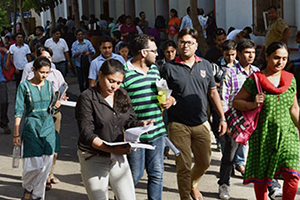
The National Employability Report for the first time this year looked into the employability of specialised and new careers, which are available to engineers, other than core IT and software roles.

The nationwide analysis based on a sample of 1,50,000 engineers showed there was a huge gap in skills of engineers, as needed, to work in the large industry.

"There are several problems with regard to employability in core engineering roles. We need to excite students about these jobs. Everyone's focus today is on IT. We want students to design and build things. We need emphasis on the basics, for instance, basic electrical engineering, basic concepts of mechanics and so on," Varun Aggarwal CTO Aspiring Minds said.

The government's Make in India initiative aspires to create manufacturing capacity in India and generate 100 million jobs by 2022.

Low employability of engineers, however, will impede the growth of manufacturing in India in a big way and requires immediate intervention, the employability assessment firm said.

Aggarwal noted that students do not have these basic concepts right. There is a huge need of a curriculum revamp and to bring in new teaching methods and technology.

"The science of manufacturing has moved way ahead but we continue to teach outdated concepts to students. For India to become the world's manufacturing hub, we need to lead from the front in our understanding of cutting edge methods, knowledge- driven management and implementation capability," he added.

Employability for roles like mechanical design engineer and civil engineer stand at a meagre 5.55 per cent and 6.48 per cent respectively.

The lowest employability percentage was recorded for the Chemical Design Engineer role at 1.64 per cent.

Employability in the domain specific roles is the highest for Electronics engineers at 7.07 per cent.

This percentage is considerably lower compared to employability in IT roles like Software Engineer - IT services and Associate ITeS Operations (Hardware Networking) which stood at 17.91 per cent and 37.06 per cent respectively.

The study on employability across metros reveals higher employability in Delhi and Mumbai with employability for the electronics design engineer role as high as 19 per cent followed by cities like Bengaluru, Kolkata and Hyderabad.

The lowest employability figures across roles is observed in Chennai with employability for the Civil Design Engineer role as low as 1 per cent, the report said.

Comments

Jamal
 - 
Thursday, 16 Jun 2016

Students passing out of IT engineering colleges in mangalore don't know how to code. Its like someone completing a driving course from driving school. But, when u give him a car to drive, he doesn't know how to drive.

I wonder what these so-called \engineering colleges\" teach."

Zahoor Ahmed
 - 
Wednesday, 15 Jun 2016

Our Honourable HRD Minister Dear Smriti is not interest to curriculam revamp,new teaching method or technology. instead she is interesting in Yoga, Sanskrit,dancing,acting to introduce in IIT and Engineering Institutions. LOL

Add new comment

  • Coastaldigest.com reserves the right to delete or block any comments.
  • Coastaldigset.com is not responsible for its readers’ comments.
  • Comments that are abusive, incendiary or irrelevant are strictly prohibited.
  • Please use a genuine email ID and provide your name to avoid reject.
News Network
April 28,2020

Kundapur, Apr 28: The local police have arrested two people for threatening and preventing an Associated Social Health Activist (ASHA) workers from discharging their duties during the lockdown.

Police said on Tuesday that the arrested are Sandeep Mesta and Mahesh Kharvi.

According to official sources, the health officials had put Sandeep under quarantine for 28 days.

However, he was seen wandering in the streets and ASHA worker C Laxmi warned him to stay indoors.

Irked by the warning Sandeep, along with his friend Mahesh Kharvi waylaid her and threatened to kill for objecting his movement.

Comments

well wisher
 - 
Tuesday, 28 Apr 2020

Unfortunately both patriot Indians are not belong to any minor community other wise it will be a SUGGHI for karnob Bhow Swamy. Fellow finally lost a bumper crop news.


Add new comment

  • Coastaldigest.com reserves the right to delete or block any comments.
  • Coastaldigset.com is not responsible for its readers’ comments.
  • Comments that are abusive, incendiary or irrelevant are strictly prohibited.
  • Please use a genuine email ID and provide your name to avoid reject.
coastaldigest.com web desk
June 14,2020

Benglauru, June 14: Even as schools are divided over providing online education, the state Higher Education Department is stressing on continuing online education.

Deputy Chief Minister and Higher Education Minister Dr C N Ashwath Narayan has stressed the need for digital learning to eliminate educational inequalities.

Taking part in a Webinar on ‘Digitising Higher Education - Challenges and Opportunities,’ organised by the Padmashree Institute of Management, he asked educational institutions to give emphasis to digital learning.

“Digital learning is a means to ensure quality education to all sections of the society without discrimination on the basis of caste, region and religion. This is a solution to eliminate discrimination. Through digital learning, a student in a remote village will also get an opportunity to learn from an experienced and highly qualified teacher.”

In addition to this, students are getting study material in digital form. Keeping these important aspects in mind, all educational institutions should give stress to digital learning without wasting any time,’’ he said.

He, however, admitted that digital learning has its own challenges like - quality internet connectivity, laptops and mobile gadgets.

“We are trying to find a solution to it by raising funds through Corporate Social Responsibility or through government funds,” he said. “We are making efforts to provide 4G network across the State,” he said.

Comments

Add new comment

  • Coastaldigest.com reserves the right to delete or block any comments.
  • Coastaldigset.com is not responsible for its readers’ comments.
  • Comments that are abusive, incendiary or irrelevant are strictly prohibited.
  • Please use a genuine email ID and provide your name to avoid reject.
News Network
June 26,2020

Bengaluru, Jun 26: The National Restaurant Association of India (NRAI) on Thursday came up with a Standard Operating Procedure (SOP) for restaurants whereby among other physical distancing norms, it has suggested a 2-metre gap between tables.

Formulated in partnership with Releski, a Bengaluru based skill-tech company, the SoP suggests that in case of back-to-back seating, people sitting with their backs towards each other will have their seats divided by 'Plexiglass' divider raised up to 2 meters from the ground.

"In a typical restaurant, the improvised seating plan should have a minimum distance of 2 metres between tables. The distance of 2 metres (6 feet) between tables should measure from one edge of the table to the other table's edge," it said.

In case of loose or free seating such as in banquet style or food court style seating, a minimum 2 meters of distance should be maintained between tables.

The guidelines noted that, to encourage physical distancing, restaurants have to sacrifice their seating capacity, to promote health and safety, and also to gain trust from their patrons.

"In order to perform this, divide your restaurants under different sectors. Pull out your restaurant's floor plan and colour code different sections red and yellow. Red sections are potential areas where maximum footfall or traffic is observed. Yellow sections are areas where the footfalls are average," it said.

All the red sections are encircled or bordered by placing barricades or Q manager and will open at specific points to access the yellow section and all the opening points will have hand sanitisers and sprays, and every guest who walks from red zones to yellow zones will sanitise himself/herself to reduce the chances of contamination.

For air conditioning, the guidelines of CPWD shall be followed which inter alia emphasises that the temperature setting of all air conditioning devices should be in the range of 24-30 degree Celsius, relative humidity should be in the range of 40- 65 per cent, intake of fresh air should be as much as possible and cross ventilation should be adequate, the guidelines suggested.

The industry body has also suggested appointment of a COVID-free Ambassador who would operate as the Chief Health Officer within the restaurant team, preferably from the management team in each shift.

The ambassador's would put the new daily work routines into practice, to monitor compliance with good practice and to lead the preventative measures, adapt to health & safety recommendations and requirements of the restaurant and oversee the implementation of the norms.

Anurag Katriar, President of NRAI and CEO & Executive Director of deGustibus Hospitality, said: "Every restaurant cutting across formats is facing the harsh reality of subdued to shut business volumes in the present and the uncertainty of business environment in the future. One thing is certain that hygiene and safety will be a key differentiator in the post-pandemic restaurant operations."

Comments

Add new comment

  • Coastaldigest.com reserves the right to delete or block any comments.
  • Coastaldigset.com is not responsible for its readers’ comments.
  • Comments that are abusive, incendiary or irrelevant are strictly prohibited.
  • Please use a genuine email ID and provide your name to avoid reject.