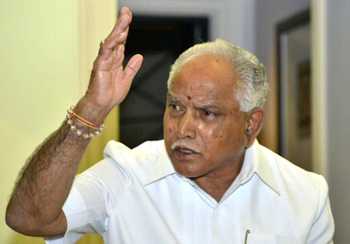
Let them eat beef at home and die: Yeddyurappa

Agencies
June 28, 2017

Ballari, Jun 28: Former chief minister B S Yeddyurappa said on Tuesday, “Let them consume beef at home and die,” in reference to those who ate beef at a public function in Mysuru on Sunday.bsy

He termed those who eat beef in public as mad people. The former chief minister was addressing a press conference in the city.

“We have no objection if people eat beef at home,” Yeddyurappa said. He demanded punishment for and boycott of people who consumed beef on the Kalamandira premises in Mysuru.

“People will not accept such an act. Even god will not approve of it,” he said, adding that 99% of the people were opposed to consumption of beef in public.

Yeddyurappa said MLAs representing BSR Congress and independents would vote for NDA’s presidential candidate Ram Nath Kovind.

The former chief minister had breakfast at the house of Dalit woman, Sunkalamma, at Bapuji Nagar and distributed a stove and LPG cylinder to her.

Lok Sabha member Shobha Karandlaje, who accompanied Yeddyurappa, said it was not right on the part of Pejawar seer Vishwesha Theertha Swami to host an iftar party at the Krishna Mutt in Udupi.

Comments

Rameez
 - 
Wednesday, 28 Jun 2017

Former CM,
1- u r ok if consumed @ home, & ur ppl pull family out of the house & kill the innocents - and u say u r OK
2- U say God will also not accept it - u into the dept of ur religious book , else try n meet a person who has more knowledge abt vedas etc, he will update u what to eat what not to eat.
3 - And lastly Madam, SK, get involved in some public work , accompany him later.
Thanks

Add new comment

  • Coastaldigest.com reserves the right to delete or block any comments.
  • Coastaldigset.com is not responsible for its readers’ comments.
  • Comments that are abusive, incendiary or irrelevant are strictly prohibited.
  • Please use a genuine email ID and provide your name to avoid reject.
News Network
June 18,2020

Bengaluru, Jun 18: The ruling Bharatiya Janata Party (BJP) nominated Prathap Simha Nayak, M.T.B. Nagaraj, R. Shankar and Sunil Valyapure to contest in the June 29 biennial elections for 4 of the 7 Karnataka legislative Council seats, an official said.

"Our high command selected 3 of the 4 candidates the state core committee recommended on Tuesday, excluding H.R. Vishwanath, a former Janata Dal-Secular (JD-S) rebel, who lost in the December 5 Assembly by-elections from Hunsur in Mysuru district on a BJP ticket," a party official said.

Nagaraj, a former Congress rebel, who also lost in the Assembly by-election from Hoskote in Bengaluru Rural district on a BJP ticket, was the state housing minister in the 14-month-old JD-S-Congress coalition government, which fell on July 23, 2019 after 17 of their rebels resigned then.

Shankar, who was an Independent and a minister in the former coalition government, was not given the BJP ticket to contest in the December Assembly bypolls though he too resigned from the Ranebennur assembly seat in Haveri district, about 340km northwest of Bengaluru, along with former Congress and JD-S rebels.

Valyapure is the party's grass-root leader from Chincholi in Gulbarga district in the state's northern region, about 586km from Bengaluru.

Valyapure extensively campaigned in the May 2019 general elections and ensured the victory of BJP candidate Umesh Yadav from the reserved Gulbarga Lok Sabha seat, defeating Congress senior leader Mallikarjun Kharge.

Nayak is also the party's grassroot cadre who rose from the ranks to become its Dakshina Kannada district president in the state's coastal region.

As the ruling party has 116 legislators in the 225-member Assembly, all its 4 candidates will need 28 votes each to win the contest.

Of the 7 outgoing Council members, 5 are from the Congress and one each from the Janata Dal-Secular (JD-S) and an Independent.

With 68 lawmakers, the Congress will be able to retain 2 seats and the JD-S one as it has only 34 legislators in the lower house.

The Congress has nominated its outgoing Rajya Sabha member B.K. Hariprasad and outgoing Council member Naseer Ahmed to contest for 2 Council seats.

Of the 75-member Council, the opposition Congress has 37, BJP 19, JD-S 16, two Independents and one Chairman.

Comments

Add new comment

  • Coastaldigest.com reserves the right to delete or block any comments.
  • Coastaldigset.com is not responsible for its readers’ comments.
  • Comments that are abusive, incendiary or irrelevant are strictly prohibited.
  • Please use a genuine email ID and provide your name to avoid reject.
Ram Puniyani
February 10,2020

Noam Chomsky is one of the leading peace workers in the world. In the wake of America’s attack on Vietnam, he brought out his classic formulation, ‘manufacturing consent’. The phrase explains the state manipulating public opinion to have the public approve of it policies—in this case, the attack of the American state on Vietnam, which was then struggling to free itself from French colonial rule.

In India, we are witness to manufactured hate against religious minorities. This hatred serves to enhance polarisation in society, which undermines India’s democracy and Constitution and promotes support for a Hindu nation. Hate is being manufactured through multiple mechanisms. For example, it manifests in violence against religious minorities. Some recent ghastly expressions of this manufactured hate was the massive communal violence witnessed in Mumbai (1992-93), Gujarat (2002), Kandhamal (2008) and Muzaffarnagar (2013). Its other manifestation was in the form of lynching of those accused of having killed a cow or consumed beef. A parallel phenomenon is the brutal flogging, often to death, of Dalits who deal with animal carcasses or leather.

Yet another form of this was seen when Shambhulal Regar, indoctrinated by the propaganda of Hindu nationalists, burned alive Afrazul Khan and shot the video of the heinous act. For his brutality, he was praised by many. Regar was incited into the act by the propaganda around love jihad. Lately, we have the same phenomenon of manufactured hate taking on even more dastardly proportions as youth related to Hindu nationalist organisations have been caught using pistols, while police authorities look on.

Anurag Thakur, a BJP minster in the central government recently incited a crowd in Delhi to complete his chant of what should happen to ‘traitors of the country...” with a “they should be shot”. Just two days later, a youth brought a pistol to the site of a protest at Jamia Millia Islamia university and shouted “take Azaadi!” and fired it. One bullet hit a student of Jamia. This happened on 30 January, the day Nathuram Godse had shot Mahatma Gandhi in 1948. A few days later, another youth fired near the site of protests against the CAA and NRC at Shaheen Bagh. Soon after, he said that in India, “only Hindus will rule”.

What is very obvious is that the shootings by those associated with Hindu nationalist organisations are the culmination of a long campaign of spreading hate against religious minorities in India in general and against Muslims in particular. The present phase is the outcome of a long and sustained hate campaign, the beginning of which lies in nationalism in the name of religion; Muslim nationalism and Hindu nationalism. This sectarian nationalism picked up the communal view of history and the communal historiography which the British introduced in order to pursue their ‘divide and rule’ policy.

In India what became part of “social common sense” was that Muslim kings had destroyed Hindu temples, that Islam was spread by force, and that it is a foreign religion, and so on. Campaigns, such as the one for a temple dedicated to the Hindu god Rama to be built at the site where the Babri masjid once stood, further deepened the idea of a Muslim as a “temple-destroyer”. Aurangzeb, Tipu Sultan and other Muslim kings were tarnished as the ones who spread Islam by force in the subcontinent. The tragic Partition, which was primarily due to British policies, and was well-supported by communal streams also, was entirely attributed to Muslims. The Kashmir conflict, which is the outcome of regional, ethnic and other historical issues, coupled with the American policy of supporting Pakistan’s ambitions of regional hegemony, (which also fostered the birth of Al-Qaeda), was also attributed to the Muslims.

With recurring incidents of communal violence, these falsehoods went on going deeper into the social thinking. Violence itself led to ghettoisation of Muslims and further broke inter-community social bonds. On the one hand, a ghettoised community is cut off from others and on the other hand the victims come to be presented as culprits. The percolation of this hate through word-of-mouth propaganda, media and re-writing of school curricula, had a strong impact on social attitudes towards the minorities.

In the last couple of decades, the process of manufacturing hate has been intensified by the social media platforms which are being cleverly used by the communal forces. Swati Chaturvedi’s book, I Am a Troll: Inside the Secret World of the BJP’s Digital Army, tells us how the BJP used social media to spread hate. Whatapp University became the source of understanding for large sections of society and hate for the ‘Other’, went up by leaps and bounds. To add on to this process, the phenomenon of fake news was shrewdly deployed to intensify divisiveness.

Currently, the Shaheen Bagh movement is a big uniting force for the country; but it is being demonised as a gathering of ‘anti-nationals’. Another BJP leader has said that these protesters will indulge in crimes like rape. This has intensified the prevalent hate.

While there is a general dominance of hate, the likes of Shambhulal Regar and the Jamia shooter do get taken in by the incitement and act out the violence that is constantly hinted at. The deeper issue involved is the prevalence of hate, misconceptions and biases, which have become the part of social thinking.

These misconceptions are undoing the amity between different religious communities which was built during the freedom movement. They are undoing the fraternity which emerged with the process of India as a nation in the making. The processes which brought these communities together broadly drew from Gandhi, Bhagat Singh and Ambedkar. It is these values which need to be rooted again in the society. The communal forces have resorted to false propaganda against the minorities, and that needs to be undone with sincerity.

Combating those foundational misconceptions which create hatred is a massive task which needs to be taken up by the social organisations and political parties which have faith in the Indian Constitution and values of freedom movement. It needs to be done right away as a priority issue in with a focus on cultivating Indian fraternity yet again.


Comments

Add new comment

  • Coastaldigest.com reserves the right to delete or block any comments.
  • Coastaldigset.com is not responsible for its readers’ comments.
  • Comments that are abusive, incendiary or irrelevant are strictly prohibited.
  • Please use a genuine email ID and provide your name to avoid reject.
coastaldigest.com news network
July 25,2020

Mangaluru/Udupi, Jul 25: Karnataka’s twin coastal districts of Dakshina Kannada and Udupi recorded 400 new covid-19 cases and nine fatalities in past 24 hours. While DK’s death toll mounted to 115, Udupi’s toll mounted to 15.

Dakshina Kannada

Dakshina Kannada alone recorded 218 new covid cases and eight deaths. The total number of positive cases mounted to 4,612. Out of these, 2,370 cases are currently active. As many as 2,127 persons have recovered and been discharged.

Of the 218 who tested positive on Saturday, 46 are primary contacts, 87 have ILI symptoms, 15 have SARI symptoms, and contacts of 70 are being traced.

Among the eight deaths that occurred on Saturday, the first is of a 44-year-old man from Mangaluru. He was admitted to private hospital on July 23, and breathed his last on same day. He was suffering from sepsis with septic shock and viral infection. 

The second is 78-year-old man from Bhatkal. He was admitted to a private hospital on July 18, and passed away July 23. He suffered from refractory hypoxemia, refractory ARDS and secondary bacterial infection. 

The third is an 88-year-old man from Mangaluru. He was admitted to a private hospital on July 10, and passed away on July 23. He suffered from hypoxemia, refractory ARDS and renal failure. 

The fourth is a 68-year-old man from Bantwal. He was admitted to a private hospital on June 7, and passed away on July 23. He suffered from septic shock. 

The fifth is a 68-year-old man from Mangaluru. He was admitted to a private hospital on July 17, and passed away on July 23. He was suffering from ARDS and Acute coronary event. 

The sixth is a 75-year-old man from Mangaluru. She was admitted to private hospital on July 14 and passed away on July 24. He was suffering from refractory hypoxemia, refractory ARDS and respiratory distress. 

The seventh is a 76-year-old female from Mangaluru. She was admitted to private hospital on July 21 and passed away on July 24. She was suffering from refractory hypoxemia, refractory ARDS, viral pneumonia, T2 DM and hypertension. 

The eighth is a 53-year-old female. She was admitted to private hospital on July 24 and passed away on July 24. She was suffering from sepsis with multi-organ dysfunction, cardiogenic shock, hypertension, type 2 diabetes mellitus, peripheral vascular disease and diabetic foot on right side LRTI.

Udupi

Udupi recorded 182 new covid cases in past 24 hours and the total reached 3,218. As many as 2,008 patients have been discharged so far including 79 on Saturday, and 1,199 cases are currently active. 

Among the new cases, 96 are in Udupi, 37 in Kundapur, and 49 in Karkala. They include 109 men and 68 women, and two boys and three girls. As many as 539 are under home isolation.

As many as 15 covid related deaths have occurred in the district so far including the one on Saturday. 

45-year-old man from Kollur was admitted to KMC Hospital, Manipal, as he was suffering from lung cancer. He was tested positive for coronavirus and then shifted to covid-19 hospital, where he breathed his last.

Comments

Add new comment

  • Coastaldigest.com reserves the right to delete or block any comments.
  • Coastaldigset.com is not responsible for its readers’ comments.
  • Comments that are abusive, incendiary or irrelevant are strictly prohibited.
  • Please use a genuine email ID and provide your name to avoid reject.