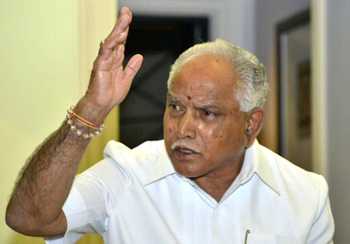
Let them eat beef at home and die: Yeddyurappa

Agencies
June 28, 2017

Ballari, Jun 28: Former chief minister B S Yeddyurappa said on Tuesday, “Let them consume beef at home and die,” in reference to those who ate beef at a public function in Mysuru on Sunday.bsy

He termed those who eat beef in public as mad people. The former chief minister was addressing a press conference in the city.

“We have no objection if people eat beef at home,” Yeddyurappa said. He demanded punishment for and boycott of people who consumed beef on the Kalamandira premises in Mysuru.

“People will not accept such an act. Even god will not approve of it,” he said, adding that 99% of the people were opposed to consumption of beef in public.

Yeddyurappa said MLAs representing BSR Congress and independents would vote for NDA’s presidential candidate Ram Nath Kovind.

The former chief minister had breakfast at the house of Dalit woman, Sunkalamma, at Bapuji Nagar and distributed a stove and LPG cylinder to her.

Lok Sabha member Shobha Karandlaje, who accompanied Yeddyurappa, said it was not right on the part of Pejawar seer Vishwesha Theertha Swami to host an iftar party at the Krishna Mutt in Udupi.

Comments

Rameez
 - 
Wednesday, 28 Jun 2017

Former CM,
1- u r ok if consumed @ home, & ur ppl pull family out of the house & kill the innocents - and u say u r OK
2- U say God will also not accept it - u into the dept of ur religious book , else try n meet a person who has more knowledge abt vedas etc, he will update u what to eat what not to eat.
3 - And lastly Madam, SK, get involved in some public work , accompany him later.
Thanks

Add new comment

  • Coastaldigest.com reserves the right to delete or block any comments.
  • Coastaldigset.com is not responsible for its readers’ comments.
  • Comments that are abusive, incendiary or irrelevant are strictly prohibited.
  • Please use a genuine email ID and provide your name to avoid reject.
News Network
January 2,2020

Mysuru, Jan 2: Mysuru-based Karnataka State Open University is gearing up to offer courses online from this year onwards and a proposal in this connection will be placed before the University Grants Commission (UGC) this month, after approval from the board of management.

As of now, the university offers 31 courses, including undergraduate, postgraduate, and diploma programmes.

Vice-chancellor Vidyashankar S Said that the university will submit its proposal to the UGC soon.

“This is being done to make learning convenient and help students study their courses of choices from the comfort of their homes.”

After launching online admissions for courses, this is another step to go paperless and towards an e-campus, the V-C explained.

The university has also proposed to launch 12 new courses for 2020-21.

A proposal in this regard will be placed before the board for approval on Thursday and the same will be submitted to the UGC for its nod.

Prof. Vidyashankar said the these courses will be in addition to the 31 already available.

The new courses include LLM, MA in Education, BBA, BSc, BCA, diploma in Information Technology, postgraduate diploma in Information Technology, BSc in Information Technology, MSc in Information Technology, MSc in Botany, PG diploma in Banking and Insurance, MSc in Zoology, MA in Telugu, Executive MBA, and MSc in Food Sciences and Nutrition.

The new courses had been proposed based on students’ feedback and the trend.

The V-C said the admissions for the January cycle have begun and over 380 students had so far taken admissions online.

“We are hoping for good admissions this cycle and are expecting around 12,000 admissions,” he replied.

Comments

Add new comment

  • Coastaldigest.com reserves the right to delete or block any comments.
  • Coastaldigset.com is not responsible for its readers’ comments.
  • Comments that are abusive, incendiary or irrelevant are strictly prohibited.
  • Please use a genuine email ID and provide your name to avoid reject.
Agencies
May 8,2020

Washington D.C., May 8: The prime time for brain development in a child's life is the first year, where the infant spends most of the time asleep. It is the time when neural connections form and sensory memories are encoded.

However, when sleep is disrupted, as occurs more often among children with autism, brain development may be affected, too.

New research led by the University of Washington finds that sleep problems in a baby's first 12 months may not only precede an autism diagnosis but also may be associated with altered growth trajectory in a key part of the brain, the hippocampus.

The study, which was published in the American Journal of Psychiatry, researchers report that in a sample of more than 400 taken of 6- to 12-month-old infants, those who were later diagnosed with autism were more likely to have had difficulty falling asleep.

It also states that this sleep difficulty was associated with altered growth trajectories in the hippocampus.

"The hippocampus is critical for learning and memory, and changes in the size of the hippocampus have been associated with poor sleep in adults and older children.

As many as 80 per cent of the children with autism spectrum disorder have sleep problems," said Annette Estes, director of the UW Autism Center and senior author of the study.

"In our clinical experience, parents have a lot of concerns about their children's sleep, and in our work on early autism intervention, we observed that sleep problems were holding children and families back," added Estes, who is also a UW professor of speech and hearing sciences.

"It could be that altered sleep is part-and-parcel of autism for some children. One clue is that behavioural interventions to improve sleep don't work for all children with autism, even when their parents are doing everything just right. This suggests that there may be a biological component to sleep problems for some children with autism," said Estes.

To consider links among sleep, brain development, and autism, researchers at the IBIS Network looked at MRI scans of 432 infants, surveyed parents about sleep patterns, and measured cognitive functioning using a standardized assessment.

At the outset of the study, infants were classified according to their risk for developing autism: Those who were at higher risk of developing autism -- about two-thirds of the study sample -- had an older sibling who had already been diagnosed.

Infant siblings of children with autism have a 20 per cent chance of developing autism spectrum disorder -- a much higher risk than children in the general population.

In the current study, 127 of the 432 infants were identified as "low risk" at the time the MRI scans were taken because they had no family history of autism.

They later evaluated all the participants at 24 months of age to determine whether they had developed autism. Of the roughly 300 children originally considered "high familial risk," 71 were diagnosed with autism spectrum disorder at that age.

Problems with sleep were more common among the infants later diagnosed with an autism spectrum disorder, as were larger hippocampi. No other subcortical brain structures were affected, including the amygdala, which is responsible for certain emotions and aspects of memory, or the thalamus, a signal transmitter from the spinal cord to the cerebral cortex.

The authors note that while parents reported more sleep difficulties among infants who developed autism compared to those who did not, the differences were very subtle and only observed when looking at group averages across hundreds of infants.

Sleep patterns in the first years of life change rapidly as infants transition from sleeping around the clock to a more adult-like sleep/wake cycle. Until further research is completed, Estes said, it is not possible to interpret challenges with sleep as an early sign of increased risk for autism.


Comments

Add new comment

  • Coastaldigest.com reserves the right to delete or block any comments.
  • Coastaldigset.com is not responsible for its readers’ comments.
  • Comments that are abusive, incendiary or irrelevant are strictly prohibited.
  • Please use a genuine email ID and provide your name to avoid reject.
News Network
July 7,2020

Tumakuru, Jul 7: Coronavirus is spreading at the community level in Karnataka, said minister, JC Madhuswamy on Monday.

"Medical condition of eight infected with coronavirus admitted in Tumkur COVID Hospital is critical. There is no guarantee of their lives as per the information. We somewhere feel we are worried that coronavirus is spreading at the community level," Madhuswamy, Tumakuru district-in-charge minister, told reporters here.

"We have reached a point where it is difficult for the district authorities to restrain it, even though we are trying to restrain it. Somewhere the situation is going out of hand," he said.

The minister confirmed that the cumulative toll in the district due to COVID-19 rises to 9.

Earlier, Chief Minister BS Yediyurappa, Deputy CM Ashwath Narayan, Medical Education Minister Dr Sudhakar have denied of community transmission of coronavirus in Karnataka.

According to the Ministry of Health and Family Welfare, there are 23,474 coronavirus cases in Karnataka including 13,255 and 372 deaths.

Comments

Add new comment

  • Coastaldigest.com reserves the right to delete or block any comments.
  • Coastaldigset.com is not responsible for its readers’ comments.
  • Comments that are abusive, incendiary or irrelevant are strictly prohibited.
  • Please use a genuine email ID and provide your name to avoid reject.