Lord Ganesha to write commerce exam, issued admit card by a university in Bihar

Agencies
October 6, 2017

Patna, Oct 6: In a surprising turn of events, Lord Ganesha has been issued an admit card by a university in Bihar and if everything goes smoothly then he will write the examination on behalf of an undergraduate commerce student.

The Lalit Narayan Mithila University (LNMU) in Darbhanga district of Patna issued the admit card, bearing the photograph and signature of the Hindu deity to Krishna Kumar Roy, a first-year BCom (Hons) student of JN College, Nehera.

According to the controller of the exam of the university, the mistake was not made at their end; rather it was at the fault of the cyber cafe where the student had gone to submit his examination form online.

The registrar confirmed that the fault has been rectified and the student will be allowed to appear in the exam.

LNMU is among the 16 state-run universities in Bihar. It has 25 affiliated colleges and 43 constituent colleges under it.

Comments

HOnest
 - 
Saturday, 7 Oct 2017

When people are ignorant about God, they make this mockery... If U want to know who is the TRUE GOD who gave us this life and who takes our life... Then U need to read the QURAN... which is a guidance to MANKIND.

QURAN clearly explains such fake gods which can b played around.There is no God but ALLAH and Muhammad pbuh is the last and final messenger of ALLAH who conveyed the message of Oneness and to worship him alone who is most merciful...

Please i request non muslims to hold for few days in your life of MEDIA islam which is fed to the viewers as a demonic religion... infact ALLAH(True God) ask us to use our INTELLECT to know the CREATOR who created U me and all that exists. and also to verify, research and do your own way of finding GOD ... If U  R honest U wil find your CREATOR... Best of Luck 


Add new comment

  • Coastaldigest.com reserves the right to delete or block any comments.
  • Coastaldigset.com is not responsible for its readers’ comments.
  • Comments that are abusive, incendiary or irrelevant are strictly prohibited.
  • Please use a genuine email ID and provide your name to avoid reject.
News Network
June 25,2020

India has jumped past 4.5 lakh coronavirus cases and 14,476 people have succumbed to the viral infection so far. In this backdrop, speaking to IANS in an exclusive interview, AIIMS Director Randeep Guleria said India is also vulnerable to second wave of coronavirus and people should continue to follow social distancing, wearing mask and other precautions, after cases begin to decline.

He added that in order to contain the outbreak of Covid-19, a limited lockdown in hotspots, where volume of cases is very high, may be considered along with a micro-plan to prevent leakage of cases from these areas to other non-containment areas. Excerpts of the interview are below:

Q: Reports say China and South Korea are witnessing a second wave of coronavirus infection, what is this second wave, is India also vulnerable to this?

A: When cases come down significantly, people tend to drop their guard against the viral infection, and this leads to the second wave (which means a sudden increase in the number of cases). After cases begin to decline, people should continue to follow the precautions -- continue to maintain social distancing and wear masks regularly. See what happened in Singapore, it was struck by a second wave of coronavirus. Look, what happened in the 1918 pandemic, people dropped their guard and the second wave of viral infection struck back. If people do not follow social distancing then the spike in cases is apparent. We need to take these precautions at least for one year. India is also vulnerable to this second wave.

Q: If Covid-19 cases continue to rise rapidly, do you think we need another lockdown in areas where volume of cases are very high?

A: A large volume of cases is concentrated in specific areas like hotspots, and in order to maintain things in order, we may need a limited lockdown in these areas. This should be followed by a micro-plan which entails extensive testing of people and also extensive contact tracing of people who have got in touch with positive people. Need to ensure there is no leakage of cases from these areas. People from these areas should not mix with others in non-containment areas. This will aid in containing the outbreak of the virus. People who have developed symptoms should get themselves tested, especially in the containment areas.

Q: With more than 4.5 lakh cases and close to 14,500 deaths, do you think India has reached its peak and a decline in cases is prominent?

A: The cases will continue to increase for some time. The doubling time of cases has also increased. But, the cases will also begin to flatten. Though, it is difficult to give an exact time period in this viral infection, it seems, the growth in cases will flatten in the end of July or beginning of August. A decline will come to this viral infection, but it does not mean that people should drop their guard. As a measure, we need to decrease community participation and citizens should continue to follow social distancing. People should get themselves tested. All these efforts will help in preventing people from contracting this virus. These precautions will also prevent us from the second wave, and we must continue to take precautions. The virus has not gone away, it is still lurking.

Q: India has crossed the 4.5 lakh coronavirus cases so far, although our recovery rate is good, but still 10,000 to 15,000 cases are reported daily. Why do cases continue to spiral, what is the reason?

A: We have to remember a few things -- the bulk of cases are in 10 cities, nearly 70 per cent, and if we take into account cases per million population, the number is not very high, as compared with countries including countries in Europe. Many European countries put together still do not add up to the Indian population. Do not compare India to countries like Italy, Spain etc. We need to focus on hotspots, which contribute to between 70 -80 per cent of cases, and we have to identify cases in these areas at an early stage. The population density is very high in these cities. People in lower socio-economic status are highly vulnerable to the viral infection, as many live together in small spaces and there is a lot of mixing of people happening there. Look at the market places, people are not following social distancing and not wearing masks. In fact, many are in close vicinity of each other.


Comments

Add new comment

  • Coastaldigest.com reserves the right to delete or block any comments.
  • Coastaldigset.com is not responsible for its readers’ comments.
  • Comments that are abusive, incendiary or irrelevant are strictly prohibited.
  • Please use a genuine email ID and provide your name to avoid reject.
Agencies
August 2,2020

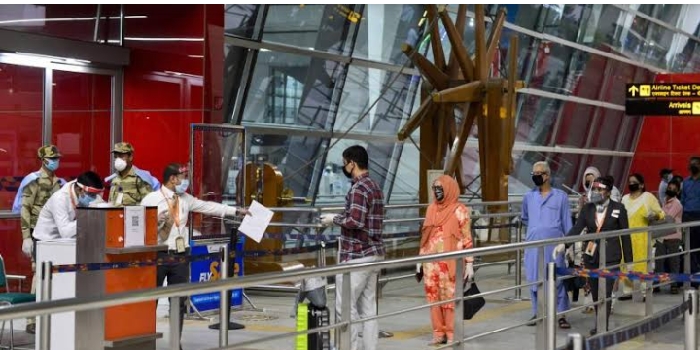
New Delhi, Aug 2: The Ministry of Health and Family Welfare on Sunday issued fresh guidelines for international passengers coming to India amid the COVID-19 pandemic. The new guidelines will be implemented from 12:01 am on August 8.

The ministry has also asked all passengers to submit a self-declaration form online at least 72 hours before travel.

"All travellers should submit self-declaration form on the on the online portal (www.newdelhiairport.in) at least 72hours before the scheduled travel," the guidelines said.

It also said that those coming to India must give an undertaking that they would undergo mandatory quarantine for 14 days as prescribed by the government. "They should also give an undertaking on the portal that they would undergo mandatory quarantine for 14 days i.e. 7 days paid institutional quarantine at their own cost, followed by 7 days isolation at home with self-monitoring of health," it added.

Giving exemptions in some cases, the guidelines mentioned, "Only for compelling reasons/cases of human distress such as pregnancy, death in the family. Serious illness and parent (s) with children of 10 years or below, home quarantine may be permitted for 14 days."

"If they wish to seek such exemption, they shall apply to the online portal at least 72 hours before boarding. The decision taken by the government as communicated on the online portal will be final," it said further.

The guidelines further said that travellers could request for exemption from institutional quarantine by submitting a negative RT-PCR test report on arrival.

"This test should have been conducted within 96 hours prior to undertaking the journey. The test report should be uploaded on the portal for consideration," it added.

Passengers have also been asked to download the Aarogya Setu app on their mobile phones.

Comments

Add new comment

  • Coastaldigest.com reserves the right to delete or block any comments.
  • Coastaldigset.com is not responsible for its readers’ comments.
  • Comments that are abusive, incendiary or irrelevant are strictly prohibited.
  • Please use a genuine email ID and provide your name to avoid reject.
News Network
February 12,2020

New Delhi, Feb 12: The Centre on Wednesday said the NRC data in Assam is safe even though some technical issues were visible and that will be resolved soon.

The Union Home Ministry clarification came in view of reports that data of the final list of the National Register of Citizens has been made offline from its official website.

"The NRC data is safe. Some technical issues are in visibility on cloud. These are being resolved soon," a home ministry spokesperson said.

The data was not available for a couple of days and it created panic in the public, mostly among the people excluded from the list as the rejection certificates were yet to be issued.

NRC State Coordinator Hitesh Dev Sarma accepted that the data has been made offline, but refuted the allegation of any "malafide" intent in it.

The cloud service for the huge set of data was provided by IT firm Wipro and their contract was till October 19 last year. However, this was not renewed by the previous coordinator.

So, the data got offline from December 15 after it was suspended by Wipro, Sarma said.

He said the state coordination committee had decided to do necessary formalities in its meeting on January 30 and wrote to the Wipro during the first week of February.

"Once Wipro makes the data live, it will be available for public. We hope people will be able to access it in the next 2-3 days," Sarma said.

The complete detail of exclusion and inclusion of bonafide Indian citizens in the NRC was uploaded on its official website http://www.nrcassam.nic.in after the final list was published on August 31, 2019.

The final NRC was published by excluding 19,06,657 persons. A total of 3,11,21,004 names were included out of 3,30,27,661 applicants.

After the earlier NRC State Coordinator Prateek Hajela relinquished the charge on November 11 following his transfer to home state Madhya Pradesh on a direction from the Supreme Court, Sarma was appointed in his place on November 9.

Comments

Add new comment

  • Coastaldigest.com reserves the right to delete or block any comments.
  • Coastaldigset.com is not responsible for its readers’ comments.
  • Comments that are abusive, incendiary or irrelevant are strictly prohibited.
  • Please use a genuine email ID and provide your name to avoid reject.