



Lord, Why Am I Banned from your Abode?

[email protected] (Ram Puniyani)
February 17, 2016

One is witnessing strange incidents where the women from Muslim and Hindu community are facing similar obstacles. This relates to the issue of entry into places of worship. While the women from Bhumata Brigade are struggling to get entry into Shani Shingnapur temple (Ahmadnagar Mahrashtra), the Muslim women are fighting a legal battle to restore their access to mazar of Haji Ali dargah in Mumbai. In yet another incident the women are trying to get the right of worship in Sabrimala temple. The Hindu women in an act of brave initiative landed up in many buses to the Shani Shingnapur temple, where they were denied the entry while police had to resort to some force to prevent their entry.
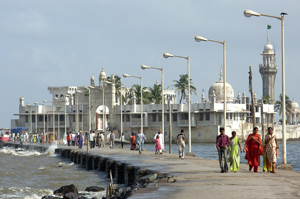
haji ali dargahIn case of Shani Shingnapur while men are allowed to the Chabutara (raised platform) it is believed that going to the Chabutara will be of bad omen for women as Lord Shani (Saturn) will cast an evil eye. So it is claimed that prohibiting women to enter is a matter of spiritual science. Sanatan Prabhat, the rightwing daily says that the movement of women must be prevented to save the Hindu traditions. In response to the agitation led by Trupti Deasai of Bhumata Brigade the spiritual Guru Sri Sri Ravishankar of Art of Living tried to mediate between the women’s group and the temple trustees. Interestingly he advised that neither women nor men should be allowed to the Chabutara. The matter is being negotiated; solution does not to be near the sight. Also the RSS mouth piece Organiser opines that while initiating any move to amend the existing regulations care should be taken to preserve tradition and prestige of these places.

In case of Sabrimala shrine, the argument is that Lord is a celibate and the women in menstrual age group will be distracting him. One recalls that one IAS officer, who happened to be a woman had visited the shrine for overseeing the arrangements in readiness for the pilgrimage in her official capacity. She was also denied entrance on the ground of her being a woman. In case of Haji Ali in Mumbai the local women’s group Bhartiya Muslim Mahila Andolan has filed a writ in the court demanding the entry of women to the mazar be restored. The women’s groups have cited different clauses of the Constitution where one have equality before the law and that one cannot be discriminated against on the grounds of gender. The argument of Dargah trustees is on the ground of security of women, which to say the least is ridiculous. In case of Sabrimala the earlier argument that the path to the shrine is difficult for women on the grounds of security was later was clarified by the Devswom Board Travancore by stating the ‘real’ reason for denying entry to women is celibacy of Lord Ayappa.

Muslim women have a varying degree of access to the mosques, much lesser in South Asian Countries than in countries like Turkey for example. In Hindu temples the entry is again not uniform; there are different pretexts to prevent their full access to the places of worship. While in many countries the law for equality is very much there, the traditions and the controllers of these places have been preventing the women from having full access to the holy deity. The patriarchal control over access top places of worship is there in various degrees.

This does not apply to Churches in general, where access is not the issue, what is talked there is as to why women do not have the right to be on the higher levels of priest hood. In Hindu temples, Muslim mosques and shrines the women priests are practically not there, some claims of such positions will be more as an exception than as a rule or norm.

In case of India where the equality is guaranteed by law, these laws of equality don’t have entry into the places controlled by the conservative trusts. The controllers of institutions of religion are generally exclusively male bastion, the degree of control and its expression is varying though. In Hindu fold there is an additional factor is that is that of caste. One understands there is ‘caste in the practice’ of Muslims and Christians also, but so far as the places of worship are concerned they are accessible to all, irrespective of caste. One recalls the struggles of Babasaheb Ambedkar for temple entry, the Kalaram Temple agitation, before he decided to renounce Hinduism calling it as being Brahminic theology. As such most religions do have the hierarchical structure in-built into the institution of religion.

Talking of South Asia as a whole the Mosques, Dargahs and temples have lot of rigid rules as far as women are concerned. These are the norms which are imposed by traditions. Thus we see a bit of variation in different religions, different religions as far as treating women is concerned. As such it the differential treatment and this depends on the degree of secularization of the particular institution and particular country and region. By secularization we mean the extent of erosion of hold of landlord-clergy combine on the society. No uniform pattern is discernible but at the core there is the understanding which regards women as inferior beings, secondary to the men, being regarded as property of men so to say.

Earlier it was regarded that their secondary position is purely due to biological functions, with time and with the impact of women’s movement, it is clear that the gender roles are psychological and social, determined by time and location. In early matriarchal societies women had a predominant role in the family and social affairs. With the rise of slave society and later the feudal society, women’s subservient role came to be the norm. Again with Industrial revolution and the values of Liberty, Equality and Fraternity gaining political ground, women started entering into social space and the social equations started changing towards those of equality. As degree of secularization is different the degree of success of women towards equality is different. The nations which saw Industrial revolutions, the path to women’s equality were paved by the underlining slogan of revolutions or social transformations. Still the equality of women has not been automatic, there is a path of struggle through which women expressed their aspiration; longings and struggled for new equations towards equality.

The movement for gender equality again has highs and lows; ups and downs. Currently one understands that the politics in the name of any religion, fundamentalism-communalism, is a politics of status quo to begin with and then it aims to throw back the society to the earlier feudal values of caste and gender hierarchy. Talking of recent times world witnessed this first in the form of rise of Christian fundamentalism in America in the decade of 1920, in the face of the rise of industrial society with modern education and industrialization coming to the fore. In the societies which had to undergo the painful experience of Fascism, Nazism, there also the role of women were defined to be in the confines of ‘Kitchen Church and Children’ by the political ideology, which can be regarded as the close cousin of religious nationalism. With coming of Islamic fundamentalism again the attempt was made to further subjugate the women to lower positions in society. The cover of Islam was used for this social-political agenda. Afghanistan, Iran, Pakistan are few examples of that.

Here in India we saw the rise of majoritarian and minoritarian communalism. Both these again try to push back the women, to restrict their social space, all in the name of religion. With the rise of religious nationalism in India, various issues came up which gave a glimpse of the attitude towards women. Many of these are not the fully blown up pictures, but they have in root the goal of subjugation of women, in the language of Sharia or a sophisticated version of Manu Smriti. In India while the secularization process; the overthrow of the hold of landlord-clergy combine; remained half way through. With the assertion of religious nationalism primarily Hindutva, the striving of women for equality is being countered strongly.

In the ideology of dominating Hindutva the subordination and secondary position of women is asserted by invoking the noble traditions. In literature from Gita Press Gorakhpur, the major publication promoting traditional conservative values amongst Hindus which is generally the base of Hindutva politics, one can see millions of books being distributed which advise the home making role, the ideal of Sati (women being burnt on the funeral pyre of their husband), the stree dharma(duties of women as ordained by their religion) are propounded. Instructions to women about dress code and choice of life partner are handed down. One of the major agenda of the divisive love jihad campaign is to restrain the Hindu girls, to do away with their choice in matters of life and choice of life partner.

Overall the role of religious institutions has been to maintain the social status quo, And the issues related to priesthood in holy places, the entry to these shrines do reflect the same in varying degrees. It seems that despite the obstacles, the women from different religious communities are making their statement loud and clear that their march towards equality cannot be halted by these institutions, and that’s is the portent of these moves for entry to the abodes of the Lord!

Comments

shaji
 - 
Tuesday, 23 Feb 2016

I could not understand why few Muslim women who are tryng to be moderate are so eager to visit tombs and Masjids whereas it is not preffered as per the religion. For a woman, her home is more sacred than Masjid. Woman is given facility by the Creator and they are not willing to take it and wish to show their beauty on the road. Few woman are trying to mislead the others. May i ask such women if they would like a man also to deliver baby. Why are these women wasting their time and trying to be more religious in public. they have to be practical first.

Add new comment

  • Coastaldigest.com reserves the right to delete or block any comments.
  • Coastaldigset.com is not responsible for its readers’ comments.
  • Comments that are abusive, incendiary or irrelevant are strictly prohibited.
  • Please use a genuine email ID and provide your name to avoid reject.
Ram Puniyani
January 26,2020

During last couple of decades we have been witnessing the coming up of various statues in different parts of the country. There is diverse political logic and different set of political tendencies for erecting these statues. When Mayawati was UP CM, she got multiple of her own statues made, in addition to many statues of major dalit icons, irrespective of the criticism against that act. As per her strategy it was a symbol of identity of dalit assertion. The biggest statue to come up was that of Sardar Vallabh Bhai Patel, a lifelong Congressman, whom RSS combine is trying to appropriate. This statue of Unity was ‘Made in China’. The clever trick was that the same forces were behind this statue, which was banned by Patel in the aftermath of Gandhi murder. Interestingly while currently BJP is blaming Congress for Partition of India, ironically it was Sardar Patel who was in the committee which gave final stamp of approval for the partition of India.

There is also a talk in UP, where the Ram temple campaign yielded rich electoral dividends for BJP, to have tallest statue of Lord Ram in Ayodhya. In a state where children are dying in hospitals due to lack of Oxygen cylinders, a huge budgetary allocation will be required for such project. While on statues one should also remember that in Maharashtra a tall statue of Chatrapati Shivaji Maharaj is underway in Arabian Sea, near Mumbai. Only few voices of protest against it came up, e.g. that of renowned journalist, now, MP, Kumar Ketkar, whose house was vandalised for his opposing the move on the grounds that same massive amount can be utilized for welfare-development activities in the state.

On the back of this comes a comparatively low budget 114 feet tall statue of Jesus Christ in Karnataka, in Kappala hills Harobele village, where Christian pilgrims have been thronging from last several centuries. The land for this has been donated by Congress leader Shivaprasad and his brother, a Congress MP. It is planned to be carved out from a single rock. The plan of this statue is being opposed by those who have been behind most of the statue projects so far. Hindu Jagran Vedike, VHP, RSS are up in arms saying that they will not let this come up. There are various arguments cited for this opposition. It is being said that this was a place of worship of Lord Munnieshwara (a form of Lord Shiva).

More than this it is being argued that Shivakumar is trying to please his Italian boss in the party. Also that this will bring back the period of slavery of foreign rule, the colonial rule of British. As such this opposition is more in tune with the ideology of RSS combine, which has been for a statue here and a statue there. Their politics regards Christianity as a ‘foreign religion’! It is true that in Citizenship Amendment Act, they have not excluded Christianity while other religion, which they regard as ‘Foreign’ i.e. Islam. Here they are using a different logic, that the countries from where persecuted minorities are coming, are Muslim countries, Pakistan, Afghanistan and Bangla Desh.

In India the major targeting by RSS combine has been against Muslims, but Christians are also not spared. Starting in the decade of 1980, an intense propaganda has been going on that Christian Missionaries are converting. As RSS affiliate Vanvasi Kalyan Ashram became active in Adivasi areas, the likes of Swami Aseemanand, Swami Laxmanand and followers of Aasaram bapu spread out in Tribal areas. They started their programs to popularise Shabri and Hanuman, with congregations like Shabri Kumbh being regularly organized in these areas. The aim was to Hinduize the people in those areas.

The first major anti Christian violence came up in the ghastly form of burning alive of Pastor Graham Steward Stains along with his two minor sons Timothy and Philip. RSS affiliate Bajrang Dal's Dara Siingh aka Rajendra Pal was behind this and he is serving the life term for that. At the same time Wadhva Commission was appointed to investigate this crime which shook the country and President K.R. Narayan termed it as the one belonging to the inventory of the black deeds of human history.

The Wadhva commission report pointed out that there was no statistical significant change in the region where the pastor was working. Similarly the national figures tell us that the Christian population, if at all, has marginally declined in last five decades as per the census figures. They stand like this, percentage of Christians in population, 1971-2.60, 1981- 2.44, 1991-2.34, 2001-2.30 and 2011-2.30. There are arguments that some people are converting to Christianity but are not revealing their religion. This may be true in case of miniscule percentage of dalits, who may not reveal there conversion, as they stand to loose reservation provisions if they convert.

The anti Christian violence is scattered and is below the radar most of the places. There was massive valence in Kandhamal, Orissa, when on the pretext that Christians have murdered Swami Laxmananand, a massive violence was unleashed in 2008. On regular basis prayer meetings of Christians are attacked on the pretext that these are attempts at conversion. While there is a huge demand for the schools and colleges run by Christian groups, in Adivasis areas and remote areas the work of Swamis is on.

Now the trend is to dump Christian traditions. Since Ramnath Kovind became President, the usual practice of Carol Singers visiting Rashtrapati Bhavan has been stopped. In the army retreat so far ‘Abide with me’ by Scottish poet, Henri Francis Lyte, a Christian song, a favourite of Gandhi, has been dropped. The Christian minorities have perceived the threat in various forms. Currently they are as much part of the protests against CAA, NPR and NRIC as any other community.

While statues and identity issues cannot have primacy over the social development issues, it cannot be selective. To oppose Jesus Christ statue while spending fortunes for other statues is a part of the agenda of RSS combine, which is unfolding itself in various forms. opposition to Jesus Christ statue being yet another step in the direction.

Comments

Add new comment

  • Coastaldigest.com reserves the right to delete or block any comments.
  • Coastaldigset.com is not responsible for its readers’ comments.
  • Comments that are abusive, incendiary or irrelevant are strictly prohibited.
  • Please use a genuine email ID and provide your name to avoid reject.
Ram Puniyani
March 14,2020

In the wake of Citizenship Amendment Act (CAA) UN High Commissioner, Michele Bachelet, has filed an intervention in the Supreme Court petition challenging the constitutionality of the Citizenship Amendment Act, as she is critical of CAA. Responding to her, India’s Foreign Minister S. Jai Shanker strongly rebutted her criticism, saying that the body (UNHCR) has been wrong and is blind to the problem of cross border terrorism. The issue on hand is the possibility of scores of people, mainly Muslims, being declared as stateless. The problem at hand is the massive exercise of going through the responses/documents from over 120 crore of Indian population and screening documents, which as seen in Assam, yield result which are far from truthful or necessary.

The issue of CAA has been extensively debated and despite heavy critique of the same by large number of groups and despite the biggest mass opposition ever to any move in Independent India, the Government is determined on going ahead with an exercise which is reminiscent of the dreaded regimes which are sectarian and heartless to its citizens, which have indulged in extinction of large mass of people on grounds of citizenship, race etc. The Foreign minister’s assertion is that it is a matter internal to India, where India’s sovereignty is all that matters! As far as sovereignty is concerned we should be clear that in current times any sovereign power has to consider the need to uphold the citizenship as per the principle of non-discrimination which is stipulated in Art.26 of the International Covenant on Civil and Political (ICCPR) rights.

Can such policies, which affect large number of people and are likely to affect their citizenship be purely regarded as ‘internal’? With the World turning into a global village, some global norms have been formulated during last few decades. The norms relate to Human rights and migrations have been codified. India is also signatory to many such covenants in including ICCPR, which deals with the norms for dealing with refugees from other countries. One is not talking of Chicago speech of Swami Vivekanand, which said that India’s greatness has been in giving shelter to people from different parts of the World; one is also not talking of the Tattariaya Upanishad’s ‘Atithi Devovhav’ or ‘Vasudhaiva Kutumbkam’ from Mahaupanishad today.

What are being talked about are the values and opinions of organizations which want to ensure to preserve of Human rights of all people Worldwide. In this matter India is calling United Nations body as ‘foreign party’; having no locus standi in the case as it pertains to India’s sovereignty. The truth is that since various countries are signatories to UN covenants, UN bodies have been monitoring the moves of different states and intervening at legal level as Amicus (Friend of the Court) to the courts in different countries and different global bodies. Just to mention some of these, UN and High Commissioner for Human Rights has often submitted amicus briefs in different judicial platforms. Some examples are their intervention in US Supreme Court, European Court of Human Rights, International Criminal Court, and the Inter-American Court of Human Rights. These are meant to help the Courts in areas where UN bodies have expertise.

 Expertise on this has been jointly formulated by various nations. These interventions also remind the nations as to what global norms have been evolved and what are the obligations of individual states to the values which have evolved over a period of time. Arvind Narrain draws our attention to the fact that, “commission has intervened in the European Court of Human Rights in cases involving Spain and Italy to underscore the principle of non-refoulement, which bars compulsory expulsion of illegal migrants… Similarly, the UN has intervened in the International Criminal Court in a case against the Central African Republic to explicate on the international jurisprudence on rape as a war crime.”

From time to time organizations like Amnesty International and Human Rights Watch have been monitoring the status of Human rights of different countries. This puts those countries in uncomfortable situation and is not welcome by those establishments. How should this contradiction between ‘internal matter’, ‘sovereignty’ and the norms for Human rights be resolved? This is a tough question at the time when the freedom indices and democratic ethos are sliding downwards all over the world. In India too has slid down on the scale of these norms.

In India we can look at the intervention of UN body from the angle of equality and non discrimination. Democratic spirit should encourage us to have a rethink on the matters which have been decided by the state. In the face of the greatest mass movement of Shaheen bagh, the state does need to look inwards and give a thought to international morality, the spirit of global family to state the least.

The popular perception is that when Christians were being persecuted in Kandhmal the global Christian community’s voice was not strong enough. Currently in the face of Delhi carnage many a Muslim majority countries have spoken. While Mr. Modi claims that his good relations with Muslim countries are a matter of heartburn to the parties like Congress, he needs to relook at his self gloating. Currently Iran, Malaysia, Indonesia and many Muslim majority countries have spoken against what Modi regime is unleashing in India. Bangladesh, our neighbor, has also seen various protests against the plight of Muslims in India. More than the ‘internal matter’ etc. what needs to be thought out is the moral aspect of the whole issue. We pride ourselves in treading the path of morality. What does that say in present context when while large section of local media is servile to the state, section of global media has strongly brought forward what is happening to minorities in India.   

The hope is that Indian Government wakes up to its International obligations, to the worsening of India’s image in the World due to CAA and the horrific violence witnessed in Delhi.

Comments

Add new comment

  • Coastaldigest.com reserves the right to delete or block any comments.
  • Coastaldigset.com is not responsible for its readers’ comments.
  • Comments that are abusive, incendiary or irrelevant are strictly prohibited.
  • Please use a genuine email ID and provide your name to avoid reject.
Ram Puniyani
March 8,2020

They say ‘history repeats itself first as a tragedy and then as a farce’. In case of India, communal violence not only keeps repeating itself, the pattern of the tragedy keeps changing every next time. Some features of the violence are constant, but they are under the wraps mostly. The same can be said about the Delhi violence (February 2020). The interpretations, the causative factors are very discernible, but those who are generally the perpetrators have a knack of shifting the blame on the victim community or those who stand for the victims.

As the carnage began presumably in the aftermath of statement of Kapil Mishra of BJP, which was given in front of a top police official, in which he threatened to get the roads emptied. The roots of violence were sown earlier. The interpretations given by the Hindu Nationalist camp is that the riot is due to the changing demographic profile of the area with Muslims increasing in number in those areas, and coming up of Shaheen Bagh which was presented was like ‘Mini Pakistan’. As per them the policies of BJP in matters of triple talaq, Article 370 and CAA, NPR, NRC has unnerved the ‘radical’ elements and so this violence.

As such before coming to the observations of the activists and scholars of communal violence in India, we can in brief say that violence, in which nearly 46 people have died, include one from police and another from intelligence. Majority victims are Muslims. The violence started right under the nose of the police and the ruling party. From the videos and other eye accounts, police not only looked the other way around, at places it assisted those attacking the innocent victims and burning and looting selective shops. Home minister, Amit Shah, was nowhere on the scene. For first three days the rioters had free run. After the paramilitary force was brought in; the violence simmered and slowly reduced in intensity. The state AAP Government, which in a way is the byproduct of RSS supported Anna Hazare movement, was busy reading Hanuman Chalisa and praying at Rajghat with eyes closed to the mayhem going in parts of Delhi.

Communal violence is the sore point of Indian society. It did begin during colonial period due to British policy of ‘Divide and Rule’. At root cause was the communal view of looking at history and pro active British acts to sow the seeds of Hindu-Muslim divide. At other level the administrative and police the British were fairly neutral. On one hand was the national movement, uniting the people and creating and strengthening the fraternal feeling among all Indians. On the other were Muslim Communalists (Muslim League) and Hindu Communalists (Hindu Mahasabha, RSS) who assisted the British goal of ‘divide and rule’ promoting hatred between the communities. After partition the first major change was the change in attitude of police and administration which started tilting against Muslims. Major studies by Dr. Asghar Ali Engineer, Paul Brass and Omar Khalidi demonstrated that anti Muslim bias is discernible in during and after the riots.

Now the partisan role of police has been visible all through. Sri Krishna Commission report brought forth this fact; as did the research of the Ex DIG of UP police Dr. V.N.Rai. Dr. Rai’s studies also concluded that no communal violence can go on beyond 24 hours unless state administration is complicit in the carnage. In one of the violence, investigation of which was done by concerned Citizen’s team (Dhule, 2013) this author observed that police itself went on to undertake the rampage against Muslims and Muslim properties.

General observation about riots is that violence sounds to be spontaneous, as the Home Minister is pointing out, but as such it is well planned act. Again the violence is orchestrated in such a way that it seems Muslims have begun the riots. Who casts the First stone? To this scholars point out that the carnage is so organized that the encircled community is forced to throw the first stone. At places the pretext is made that ‘they’ (minorities) have thrown the first stone.

The pretexts against minorities are propagated, in Gujarat violence Godhra train burning, in Kandhamal the murder of Swami Laxamannand and now Shaheen bagh! The Hindu Muslim violence began as riots. But it is no more a riot, two sides are not involved. It is plain and simple anti Minority violence, in which some from the majority are also the victims.

This violence is possible as the ‘Hate against this minority’ is now more or less structural. The deeper Hate against Muslims and partly against Christians; has been cultivated since long and Hindu nationalist politics, right from its Shakhas to the social media have been put to use for spreading Hatred. The prevalent deeper hate has been supplanted this time by multiple utterances from BJP leaders, Modi (Can be recognized by clothes), Shah (press EVM machine button so hard that current is felt in Shaheen Bagh), Anurag Thakur (Goli (bullet) Maro) Yogi Aditya Nath (If Boli (Words)Do not work Goli will) and Parvesh Varma (They will be out to rape).

The incidental observation of the whole tragedy is the coming to surface of true colors of AAP, which not only kept mum as the carnage was peaking but also went on to praise the role of police in the whole episode. With Delhi carnage “Goli Maro” seems to be becoming the central slogan of Hindu nationalists. Delhi’s this violence has been the first one in which those getting killed are more due to bullets than by swords or knifes! Leader’s slogans do not go in vain! Courts the protectors of our Constitution seem to be of little help as if one of them like Murlidhar Rao gives the verdict to file against hate mongers, he is immediately transferred.

And lastly let’s recall the academic study of Yale University. It concludes; BJP gains in electoral strength after every riot’. In India the grip of communalism is increasing frighteningly. Efforts are needed to combat Hate and Hate mongers.

Comments

Add new comment

  • Coastaldigest.com reserves the right to delete or block any comments.
  • Coastaldigset.com is not responsible for its readers’ comments.
  • Comments that are abusive, incendiary or irrelevant are strictly prohibited.
  • Please use a genuine email ID and provide your name to avoid reject.