Mahasabha firm on Veerashaiva-Lingayat dharma

DHNS
August 3, 2017

Bengaluru, Aug 3: The stand-off continued between the Akhila Bharata Veerashaiva Mahasabha and Lingayat community members who claim Lingayat dharma is different from Veerashaiva.


The Mahasabha on Wednesday stuck to its stand that Veerashaivas and Lingayats are one and the same and that separate religion status should be given for Veerashaiva-Lingayat dharma. Executive committee of the Mahasabha passed a resolution to this effect. 

Senior Congress leader Shamanur Shivashankarappa is the Mahasabha president, while Municipal Administration Minister Eshwar Khandre is its secretary general.

On the contrary, Water Resources Minister M B Patil, who is among the prominent leaders who are claiming Lingayat dharma is different from Veerashaiva, said that he is ready to face any consequence or make any sacrifice till his aim of getting separate religion tag for Lingayat dharma is achieved. 

“Basavanna (12th century social reformer) founded the Lingayat religion 800 years back. What it requires is only a constitutional recognition,” Patil said and suggested that the Mahasabha must come to a conclusion only after a comprehensive discussion involving scholars and seers of various community mutts. 

“Let there not be a street fight... Let us all sit together and discuss the issue,” Patil added. 

Briefing reporters on decisions taken by the Mahasabha, Shamanur said the Mahasabha was formed 110 years ago. Confusion regarding Veerashaivas and Lingayats is only a fortnight-old. The Mahasabha will hold a meeting with all those who are talking of separation and will take everybody along, he added. 

Veerashaivas and Lingayats are like two sides of the same coin. It was the Mahasabha that first demanded separate religion status for the dharma. The Mahasabha will work towards a consensus on the issue and will soon recommend to the Centre granting separate religion status to the Veerashaiva-Lingayat dharma, Khandre said. 

Comments

Venki
 - 
Thursday, 3 Aug 2017

Why do they want separate religion status? Therein lies the problem! Do they want it for the sake of Dharma, or is there any Adharmic plan behind the demand? Most probably the latter. Most of such divisions are caused over money, property and similar matters of greed, in the name of religion. If no money were involved, the parties concerned would not waste time bickering with each other! That is the simple and honest truth. The followers of either religion should reject the calls for violence by crooked leaders.

Danish
 - 
Thursday, 3 Aug 2017

lol new dirty tricks played by congis to divide Hindus

Chandrashekhar
 - 
Thursday, 3 Aug 2017

it is better to make them separate religion, and drive away from any reservation they are enjoying in Andhra and TG area since their's is egalitarian society

Ganesh
 - 
Thursday, 3 Aug 2017

Veerashaivas and Lingayats don't want to be known as Hindus ? Many Dravidians say that they are not Hindus.

Unknown
 - 
Thursday, 3 Aug 2017

I think Shiva and Linga are Hindu icons/motifs/God. If Shiva followers feel they are not hindus, it is strange. Also, Basavanna is a avatar of Nandi, Shiva's prime devotee. And to say that Basava is NOT a HINDU is strange. I can understand that they want a identity, but to claim that they are not hindus is....wrong.

Add new comment

  • Coastaldigest.com reserves the right to delete or block any comments.
  • Coastaldigset.com is not responsible for its readers’ comments.
  • Comments that are abusive, incendiary or irrelevant are strictly prohibited.
  • Please use a genuine email ID and provide your name to avoid reject.
News Network
April 29,2020

Washington, Apr 29: A US government panel on Tuesday called for India to be put on a religious freedom blacklist over a "drastic" downturn under Prime Minister Narendra Modi, triggering a sharp rebuttal from New Delhi.

The US Commission on International Religious Freedom recommends but does not set policy, and there is virtually no chance the State Department will follow its lead on India, an increasingly close US ally.

In an annual report, the bipartisan panel narrowly agreed that India should join the ranks of "countries of particular concern" that would be subject to sanctions if they do not improve their records.

"In 2019, religious freedom conditions in India experienced a drastic turn downward, with religious minorities under increasing assault," the report said.

It called on the United States to impose punitive measures, including visa bans, on Indian officials believed responsible and grant funding to civil society groups that monitor hate speech.

The commission said that Modi's Hindu nationalist government, which won a convincing election victory last year, "allowed violence against minorities and their houses of worship to continue with impunity, and also engaged in and tolerated hate speech and incitement to violence."

It pointed to comments by Home Minister Amit Shah, who notoriously referred to mostly Muslim migrants as "termites," and to a citizenship law that has triggered nationwide protests.

It also highlighted the revocation of the autonomy of Kashmir, which was India's only Muslim-majority state, and allegations that Delhi police turned a blind eye to mobs who attacked Muslim neighborhoods in February this year.

Coronavirus state-wise India update: Total number of confirmed cases, deaths on April 29

The Indian government, long irritated by the commission's comments, quickly rejected the report.

"Its biased and tendentious comments against India are not new. But on this occasion, its misrepresentation has reached new levels," foreign ministry spokesman Anurag Srivastava said.

"We regard it as an organization of particular concern and will treat it accordingly," he said in a statement.

The State Department designates nine "countries of particular concern" on religious freedom -- China, Eritrea, Iran, Myanmar, North Korea, Pakistan, Saudi Arabia, Tajikistan and Turkmenistan.

The commission asked that all nine countries remain on the list. In addition to India, it sought the inclusion of four more -- Nigeria, Russia, Syria and Vietnam.

Pakistan, India's historic rival, was added by the State Department in 2018 after years of appeals by the commission.

In its latest report, the commission said that Pakistan "continued to trend negatively," voicing alarm at forced conversions of Hindus and other minorities, abuse of blasphemy prosecutions and a ban on the Ahmadi sect calling itself Muslim.

India's citizenship law fast-tracks naturalization for minorities from neighbouring countries -- but not if they are Muslim.

Modi's government says it is not targeting Muslims but rather providing refuge to persecuted people and should be commended.

But critics consider it a watershed move by Modi to define the world's largest democracy as a Hindu nation and chip away at independent India's founding principle of secularism.

Tony Perkins, the commission's chair, called the law a "tipping point" and voiced concern about a registry in the northeastern state of Assam, under which 1.9 million people failed to produce documentation to prove that they were Indian citizens before 1971 when mostly Muslim migrants flowed in during Bangladesh's bloody war of independence.

"The intentions of the national leaders are to bring this about throughout the entire country," Perkins told an online news conference.

"You could potentially have 100 million people, mostly Muslims, left stateless because of their religion. That would be, obviously, an international issue," said Perkins, a Christian activist known for his opposition to gay rights who is close to President Donald Trump's administration.

Three of the nine commissioners dissented -- including another prominent Christian conservative, Gary Bauer, who voiced alarm about India's direction but said the ally could not be likened to non-democracies such as China.

"I am deeply concerned that this public denunciation risks exactly the opposite outcome than the one we all desire," Bauer said.

Trump, who called for a ban on Muslim immigration to the US when he ran for president, hailed Modi on a February visit to New Delhi.


Comments

Add new comment

  • Coastaldigest.com reserves the right to delete or block any comments.
  • Coastaldigset.com is not responsible for its readers’ comments.
  • Comments that are abusive, incendiary or irrelevant are strictly prohibited.
  • Please use a genuine email ID and provide your name to avoid reject.
News Network
March 3,2020

Bengaluru, Mar 3: Bengaluru mayor Gautam Kumar on Tuesday said that the decision to ban protests in front of Town Hall was made by the council and not only by him.

"The decision to ban the protest in front of the Town Hall was made by the entire council and not only my decision. Also, the things which are approved by the councillor are also read by the ruling party leaders," Bengaluru mayor told media.

"Still it is the discretion of the Commissioner to take a call after the council also. As of now, we have banned any protests in front of Town Hall," he added.

Meanwhile, Congress leaders staged a protest against Bruhat Bengaluru Mahanagara Palike (BBMP) Mayor Gautam Kumar and BJP at Council BBMP building against the decision.

"If people will start protesting, it will badly affect the traffic of the city," said Kumar, while commenting on the protest. If they want to talk about the matter, let us have a healthy discussion. I don't have a problem with and I don't think the ruling party has a problem too," he added.

On Sunday, pro-Kannada activist and former MLA Vatal Nagraj staged a protest in front of Sir KP Puttanna Chetty Town Hall (Bangalore Town Hall) against the decision taken by Bengaluru mayor.

Talking to reporters, Nagraj had said: "He does not know the history of the Town Hall. It is a historic building and protests can be staged there."

"Mayor's decision is against Bengaluru's tradition and culture, that's why we are condemning it and are protesting against this decision. We will not allow Mayor's programs in Bengaluru and he will be shown black flags", he added.

Comments

Add new comment

  • Coastaldigest.com reserves the right to delete or block any comments.
  • Coastaldigset.com is not responsible for its readers’ comments.
  • Comments that are abusive, incendiary or irrelevant are strictly prohibited.
  • Please use a genuine email ID and provide your name to avoid reject.
News Network
July 29,2020

Bengaluru, Jul 29: The Karnataka High Court’s division bench of Chief Justice Abhay Oka and Justice H P Sandesh today rejected an application that wanted Amulya Leona’s case to be transferred from Karnataka Police to the National Investigation Agency (NIA).

The bench, while observing that extraordinary jurisdiction can’t be exercised for transferring the case to the NIA, asked “What is so special that investigation should be transferred to NIA?”

The court, in its previous hearing, had questioned the maintainability of the petition seeking transfer of the sedition case against Leona to the NIA.

According to the petitioner, advocate Pavana Chandra Shetty, the case is a serious matter against national integration and unity and has not been investigated properly by the police. The state police also failed to file the chargesheet within 90 days, he said, and also asked for cancellation of her bail.

The bench asked the petitioner as to how a bail, already granted to a person, can be cancelled. “Is it not the indefeasible right of the accused to be released on bail if chargesheet is not filed within stipulated time? How can you make a prayer for cancellation of bail?”  the Court asked.

The counsel for the petitioner also stated that in cases of a cognizable offence, when the chargesheet is purposely not filed within the stipulated time, the matter will have to transferred to the appropriate authority.

The court responded to his contention by asking him how could the court override law and cancel the bail. “Where is the question of cancellation of bail? Can we override the law and say that bail should be cancelled?” said the bench.

Advocate Vishal Raghu had filed the petition for transfer of Leona’s case, who was accused of raising pro-Pakistan slogans at an anti-CAA rally on February 20 at Freedom Park. The advocate had blamed the probe team for not filing a chargesheet on time and has asked the state government to approach the higher court against bail granted to Leona.

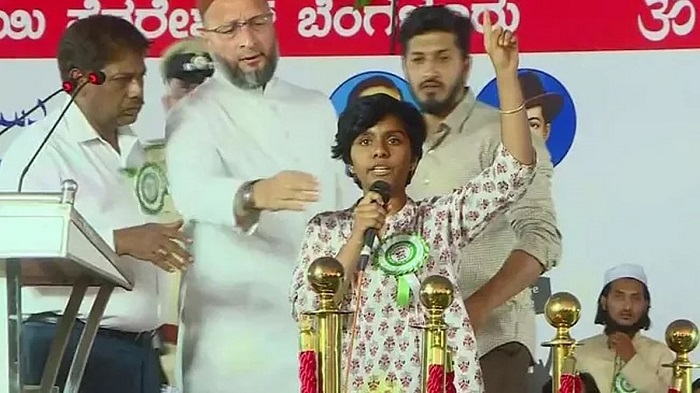
Bengaluru student Amulya Leona was charged with sedition for her actions in the presence of All India Majlis-e-Ittehad-ul-Muslimeen chief Asaduddin Owaisi. She was arrested by the Bengaluru police for allegedly shouting ‘Pakistan Zindabad’ slogans at an anti- CAA Protest in Bengaluru in February this year. On June 11, she was granted conditional bail by the Bengaluru civil court.

Her bail plea was earlier rejected by a Bengaluru court, after she had spent a three-month period in jail, stating that she may abscond if she is released. The sessions judge Vidhyadhar Shirahatti had also stated that if the petitioner is granted bail, she may abscond and may involve in similar offence which affects peace at large and hence her petition is liable to be rejected. The court had also noted that Amulya Leona is an influential person who may threaten and influence the witness and hamper the case in case of the prosecution and will abscond if released on bail.

Comments

Add new comment

  • Coastaldigest.com reserves the right to delete or block any comments.
  • Coastaldigset.com is not responsible for its readers’ comments.
  • Comments that are abusive, incendiary or irrelevant are strictly prohibited.
  • Please use a genuine email ID and provide your name to avoid reject.