


Majority of Muslims want Ram temple in Babri Masjid land: UP deputy CM

Agencies
August 21, 2018

Lucknow, Aug 21: Uttar Pradesh Deputy Chief Minister Keshav Prasad Maurya on Tuesday clarified his previous statement on Ramjnamabhoomi dispute and said that even majority of Muslims want Ram temple to be built in Ayodhya.

Speaking to ANI, Maurya criticised the Congress party for looking at Ayodhya dispute as a political issue.

"Just like other devotees of Lord Ram, I also want that Ram temple should be constructed in Ayodhya at the earliest. Currently, the matter is being heard in the Supreme Court. We are waiting for its judgement. The Bharatiya Janata Party (BJP) has always been in favour of the construction of Ram temple. It's not a political issue, rather it's about our faith," Maurya said.

"We have a majority in Lok Sabha, but we don't have the numbers in Rajya Sabha to pass a bill for the construction of Ram temple in Ayodhya. Majority of Muslims also want Ram temple to be made, but due to some political reasons, especially the Congress party does not want consecutive hearings in the Supreme Court. They do not want Ram temple to be built in Ayodhya," he added.

Earlier on Monday, Maurya suggested two options to resolve the dispute. He said either a dialogue process can be started among the stakeholders or a law can be passed in Parliament to resolve it.

"There is demand from saints to resolve the issue at the earliest. If there is any delay in the judgement, there are other options, such as dialogue or passing a law in Parliament. But the signals we are getting indicate that there would not be any delay," he had said.

The Babri Masjid, built by Mughal emperor Babur in Ayodhya in 1528, was, on December 6, 1992, razed to the ground allegedly by Hindu activists, claiming that the mosque was constructed after demolishing a Ram temple that originally stood there. Since then, several hearings have been held in the Supreme Court regarding this matter.

Comments

A Kannadiga
 - 
Tuesday, 21 Aug 2018

Currently the country is in critical situation due to food in Kerala and Karnataka, but the nonsence UP Deputy Chief Minister is in great hurry to construct Ram

 Temple in Ayodhya, too strange. 

Add new comment

  • Coastaldigest.com reserves the right to delete or block any comments.
  • Coastaldigset.com is not responsible for its readers’ comments.
  • Comments that are abusive, incendiary or irrelevant are strictly prohibited.
  • Please use a genuine email ID and provide your name to avoid reject.
Agencies
August 3,2020

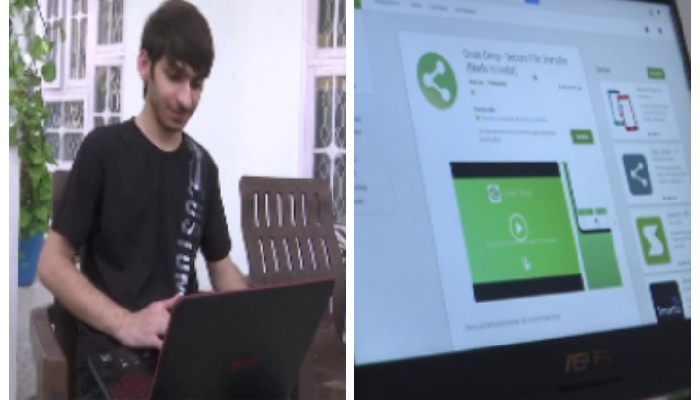
Rajouri, Aug 3: Ashfaq Mehmood Choudhary, a 17-year-old boy from Chattyear of Jammu and Kashmir's Rajouri district, has developed a file-sharing app 'Dodo Drop' which would enable users to share audios, videos, images, and texts between two devices without Internet access.

While speaking to media persons, Ashfaq Mehmood said that the 'Dodo Drop' application is an alternative to the Chinese 'SHAREit' app. "The Indian government has banned several Chinese apps due to data breaching, and among those apps was SHAREit which was used for sharing files.

Users faced a lot of problems due to the ban, and so I decided to make this file-sharing app. With 'Dodo Drop', users can share audios, videos, images, and even texts," he said.

Ashfaq said that it took him four weeks to develop the application, and it was launched on August 1 this year. The 'Dodo Drop' application has a transfer rate of up to 480 mbps, which is faster than the SHAREit app and is "quite easy" to use.

"Users can transfer data comprising photos, videos, audios, apps, texts, etc. between two devices with no Internet access. The transfers are fully encrypted and secure," he added.

"Our Prime Minister has always asserted the need for decreasing the dependency on foreign products and apps and to focus on the development of India-based apps. I tried to be part of the initiative of 'Aatmanirbhar Bharat' by developing an India-based file-sharing app. I want to develop global-standard apps for India," he added.

"We support and cooperate with him. He generates his own income by working on some projects and utilises it. We will continue to support him," said Parvez Ahmed Choudhary, Ashfaq's father.

In July, the Ministry of Electronics and Information Technology (MEITY) banned 47 apps, which were variants and cloned copies of the 59 apps banned earlier in June. These banned clones included SHAREit Lite, Tiktok Lite, Helo Lite, BIGO LIVE Lite, and VFY Lite.

The 59 apps had been banned by the Centre in June in view of the information available that they were engaged in activities which were "prejudicial to sovereignty and integrity and defence" of the country.

Almost all the apps banned had some preferential Chinese interest and the majority had parent Chinese companies.

The ban came amid border tensions with China in the Eastern Ladakh region.

Comments

Add new comment

  • Coastaldigest.com reserves the right to delete or block any comments.
  • Coastaldigset.com is not responsible for its readers’ comments.
  • Comments that are abusive, incendiary or irrelevant are strictly prohibited.
  • Please use a genuine email ID and provide your name to avoid reject.
Agencies
July 23,2020

Expressing concern over the ban imposed on TikTok by the government of India, Facebook CEO Mark Zuckerberg has reportedly called the development in the south Asian country “worrisome”.

TikTok was amongst the 59 Chinese apps that were banned in India but why it hogs the maximum limelight because TikTok had the second-largest user base in India with over 200 million users.

As per The Verge writer Casey Newton, Zuckerberg was worried about TikTok’s India ban. Although it soon cashed into the opportunity and released a TikTok clone “Reels”, the government’s reason behind banning the app in India wasn’t received well by Mark Zuckerberg. 

He had said that if India can ban a platform with over 200 million users in India without citing concrete reasons, it can also ban Facebook if something goes amiss on the security and privacy front.

Why Mark finds it particularly worrisome because Facebook is already involved in a lot tussle with the governments across the world involving national security concerns. 

“Facebook already faces fights around the world from governments on both the left and the right related to issues that fit under the broad umbrella of national security: election interference, influence campaigns, hate speech, and even just plain-old democratic speech. Zuckerberg knows that the leap from banning TikTok on national security grounds to banning Facebook on national security grounds is more of a short hop,” the report by Casey read.

Facebook till now has not faced any kind of issue in India but considering the debacle with the other governments, it is not entirely wrong to worry about its future in India if any national security issue arises. Back in 2016, Facebook’s Free Basics service, which means a free but restricted internet service, was banned in India by the telecom regulators. 

The TRAI had said that the Free Basic services were banned in India because it violated the principles of net neutrality. With Free Basics services, Facebook had planned to bring more unconnected users online. But since 2016, there has been no major tussle between the Indian government and Zuckerberg due to national security issues.

Comments

Add new comment

  • Coastaldigest.com reserves the right to delete or block any comments.
  • Coastaldigset.com is not responsible for its readers’ comments.
  • Comments that are abusive, incendiary or irrelevant are strictly prohibited.
  • Please use a genuine email ID and provide your name to avoid reject.
Agencies
June 4,2020

New Delhi, Jun 4: Press Council of India (PCI) member BR Gupta has resigned from his post, saying he was unable to work individually or collectively for the media, which is in a "deep crisis".

"I have tendered my resignation as a Press Council of India member," Gupta told PTI.

He said the PCI had the responsibility to encourage media and media professionals constantly.

"But everyone now realises that the media scenario is in a deep crisis. The motto for which the Council was created was not being fulfilled and I felt I was not doing anything remarkable for the freedom of media," Gupta said.

He claimed that the PCI was not a wholly representative body for the media.

"Then how can we come out of the crisis being faced by the media and mediapersons? It is a big challenge for us. I have quit as I have not been able to work individually or collectively being a PCI member," Gupta added.

Referring to salary cuts and job losses, he said media and mediapersons were struggling for social, political and economic justice.

When contacted, PCI chairman Justice C K Prasad said Gupta's resignation has not been accepted yet.

"I have received it (the resignation). I have not gone through it. It has not been accepted," Prasad told PTI.

Gupta was appointed as a PCI member for a three-year term on May 30, 2018.

He said liberty is one of the basic features of the preamble to the Constitution that continues to inspire people and the media.

"It is difficult (for me) to fulfil the unbiased role and responsibility to help citizens and the media for making democracy stronger," Gupta said.

Comments

Add new comment

  • Coastaldigest.com reserves the right to delete or block any comments.
  • Coastaldigset.com is not responsible for its readers’ comments.
  • Comments that are abusive, incendiary or irrelevant are strictly prohibited.
  • Please use a genuine email ID and provide your name to avoid reject.