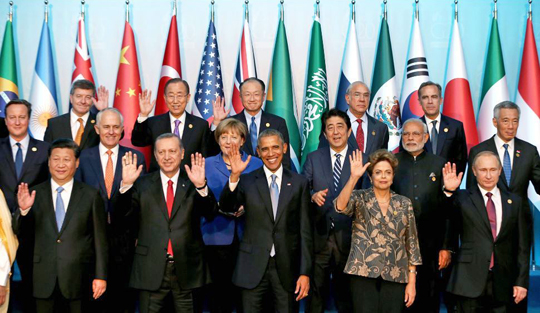
'Make public administration more resilient against corruption'

Agencies
July 9, 2017

Hamburg, Jul 9: India and other G20 members today made a strong commitment to fight corruption, including in public administration, by putting in place necessary institutional frameworks in their respective countries.

corruption

The leaders today adopted 'G20 High Level Principles on Organising Against Corruption', which noted that corruption hampers the efficient and effective operation of government, as well as its fairness and impartiality of decision-making and the delivery of government services.

"A public administration, resilient against corruption, underpinned by a culture of integrity, accountability and transparency not only fosters citizens' trust but can also affect the attractiveness of a country as a business location," it added.

The G20 Anti-Corruption Action Plan 2017-2018 identifies public sector integrity and transparency including organising against corruption (such as structuring the public administration to detect and minimise corruption risks) as a priority.

Fighting corruption in public administration should not only focus on measures targeting individual employees, responses to reporting of corruption and effective law enforcement. It should also build upon a comprehensive, transparent and accountable organisational structure that makes public administration more resilient against corruption, it said.

G20 countries have already committed themselves to a number of measures to strengthen transparency and integrity in the public sector, including requirements for the conduct of public officials.

However, corruption prevention measures with regard to the organisational structure and work flow management are also essential for the fight against corruption, the leaders said.

Comments

Add new comment

  • Coastaldigest.com reserves the right to delete or block any comments.
  • Coastaldigset.com is not responsible for its readers’ comments.
  • Comments that are abusive, incendiary or irrelevant are strictly prohibited.
  • Please use a genuine email ID and provide your name to avoid reject.
News Network
June 23,2020

New Delhi, Jun 23: In an unexpected development, the pump price of diesel is all set to surpass the petrol price in the capital, making it the most expensive transport fuel for the first time in a long time.

Globally, diesel is priced slightly above petrol prices due to the very nature of the product that has a higher cost of production. But in India, due to the lopsided taxation structure, diesel attracts lesser of the tax between the two auto fuels keeping its prices lower than petrol for last several years.

Diesel is currently priced at Rs 79.40 a litre in the Capital, just 36 paise short of petrol price that is being retailed at Rs 79.76 a litre. Going by the trend of price movement in the two products for the last few days where diesel prices have consistently increased by 50-60 paise per litre while the daily increase in petrol prices have fallen to just 20 paise on Tuesday, it is set to surpass petrol prices in next few days.

"Diesel price movement is sharper in international market and if oil companies follow the global price trend, diesel prices will surpass that of petrol later this week. It will be after many years that this would happen and is expected to sustain for some time unless government changes the tax structure of the petroleum products again," said an oil sector expert from one of the big four audit and advisory firms asking not to be named.

Interestingly, even in India the base price of diesel is expensive than petrol. According to the Indian Oil Corporation (IOC), while the base price of petrol in Delhi currently comes to Rs 22.11 per litre, the same for diesel is higher at Rs 22.93 per litre (effective from June 16, 2020). This has been the case for a long time, but retail price of petrol can be higher than diesel due to central and state taxes.

What has now brought diesel prices to a whisker of petrol prices in the capital is the Delhi government's decision early May to increase the Value Added Tax on diesel from 16.75 per cent to 30 per cent and on petrol from 27 per cent to 30 per cent. This increased the retail price of diesel and petrol in Delhi by Rs 7.10 and Rs 1.67 a litre respectively. With Central taxes on the two products already reaching identical levels, the Delhi governments move hastened price parity between petrol and diesel.

Currently, the Central excise on petrol is Rs 32.98 a litre while that on diesel it is Rs 31.83 a litre. The VAT on petrol in Delhi is Rs 17.71 a litre and that on diesel is Rs 17.60 a litre.

While the movement of retail pricing is being seen with a sigh of relief by vehicle owners whose cars run on petrol, those buying the relatively expensive diesel cars are now repenting on their decision. The development is also being seen with caution by automobile companies who have spent millions to ramp up their facilities for diesel run vehicles. The expectation is that demand for such cars will now fall, causing more damage to companies where sales are already impacted due to persistent economic slowdown and now the spread of COVID-19 pandemic.

"The pricing development would push automobile companies to strategies being followed by companies in the western markets where diesel run cars are not sold on fuel pricing differential, but on overall make and quality that puts them ahead of petrol run cars," the expert quoted earlier.

Yes, but for commercial vehicle sector the rising price of diesel had not been welcomed. In fact, the commercial transport sector had time an again threatened strike against the move to raise fuel prices.

With petrol and diesel retail prices closing, the case for adultering fuel has also gone down much to the relief of vehicle owners.


Comments

Add new comment

  • Coastaldigest.com reserves the right to delete or block any comments.
  • Coastaldigset.com is not responsible for its readers’ comments.
  • Comments that are abusive, incendiary or irrelevant are strictly prohibited.
  • Please use a genuine email ID and provide your name to avoid reject.
News Network
February 11,2020

Aligarh, Feb 11: Paediatrician Dr Kafeel Khan, who was arrested from Mumbai on January 29 after he delivered a speech at Aligarh Muslim University (AMU) against communalism and politics of hate, will be released from jail on Tuesday after he was granted bail by an Aligarh court.

Khan will be released from Mathura jail on Tuesday after legal formalities are completed.

Chief judicial magistrate Karuna Singh granted bail to Khan on Monday on a bail bond of Rs 60,000. Two surety bonds of Rs 60,000 each would also be furnished by the guarantors.

Dr Khan's lawyer, Mohammad Irfan Gazi, told reporters, "The court was told that Khan was falsely implicated by police under political pressure. After hearing the arguments, the court granted him bail."

The suspended doctor was arrested by special task force (STF) of the UP police from Mumbai on January 29, when he reached the city to attend a protest against the Citizenship (Amendment) Act.

He was arrested in connection with a case registered against him in Aligarh under section 153-A (promoting enmity between different groups on ground of religion) of the Indian Penal Code at Civil Lines police station on December 13

The case was filed after his speech at Aligarh Muslim University (AMU).

According to the FIR, while addressing students, without naming anyone, Dr Kafeel Khan said that 'Mota Bhai' is teaching everyone to become Hindu or Muslim but not a human being. "This is a fight for our existence. We have to fight."

The FIR also said that Dr Kafeel Khan made an attempt to vitiate the peaceful atmosphere and disturb the communal harmony with his speech.

Dr Khan was in the news in 2017 when he was named as one of the nine accused in a case involving deaths of several children due to alleged disruption in supply of oxygen at the BRD Medical College in Gorakhpur. Though he was granted clean chit in a departmental inquiry, his suspension has not yet been revoked.

Comments

Add new comment

  • Coastaldigest.com reserves the right to delete or block any comments.
  • Coastaldigset.com is not responsible for its readers’ comments.
  • Comments that are abusive, incendiary or irrelevant are strictly prohibited.
  • Please use a genuine email ID and provide your name to avoid reject.
News Network
April 22,2020

New Delhi, Apr 22: Prime Minister Narendra Modi on Wednesday said that The Epidemic Diseases (Amendment) Ordinance, 2020, manifests his government's commitment to protecting healthcare workers braving COVID-19 on the frontline.
"The Epidemic Diseases (Amendment) Ordinance, 2020, manifests our commitment to protect each and every healthcare worker, who is bravely battling COVID-19 on the frontline. It will ensure the safety of our professionals. There can be no compromise on their safety!," Prime Minister Modi tweeted.
The Central government on Wednesday brought an ordinance to end the violence against health workers, making it a cognizable, non-bailable offence with the imprisonment of up to seven years for those found guilty.

"We have brought an ordinance under which any attack on health workers will be a cognizable, non-bailable offence. In the case of grievous injuries, the accused can be sentenced from 6 months to 7 years. They can be penalised from Rs 1 lakh to Rs 5 lakh," Union Minister Prakash Javadekar briefed media after the meeting of the Cabinet.

"Such crime will now be cognisable and non-bailable. An investigation will be done within 30 days. Accused can be sentenced from three months to five years, and penalised from Rs 50,000 up to Rs 2 lakh," said Javadekar.

Moreover, if the damage is done to vehicles or clinics of healthcare workers, then a compensation amounting to twice the market value of the damaged property will be taken from the accused, said Javadekar.

Comments

Add new comment

  • Coastaldigest.com reserves the right to delete or block any comments.
  • Coastaldigset.com is not responsible for its readers’ comments.
  • Comments that are abusive, incendiary or irrelevant are strictly prohibited.
  • Please use a genuine email ID and provide your name to avoid reject.