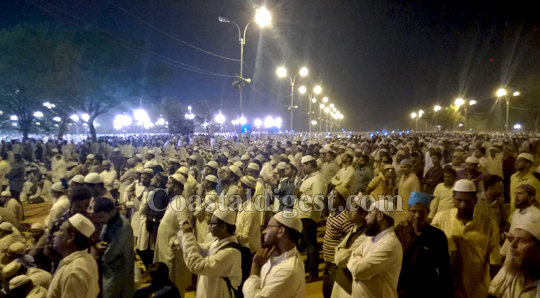
Makkah Imam pulls unprecedented crowds in Karnataka

[email protected] (CD Network)
April 10, 2016

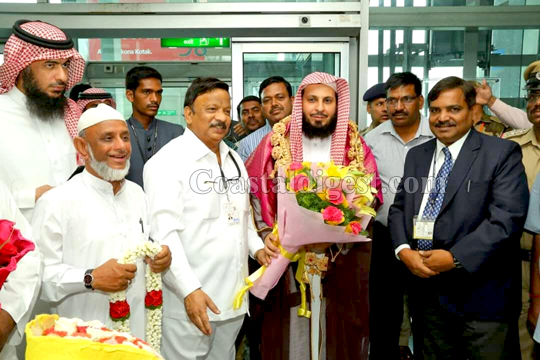
Bengaluru, Apr 10: The Imam of the grand mosque of Makkah, who is currently in India, has attracted unprecedented crowds in two prominent cities of Karnataka without much publicity.

imam1

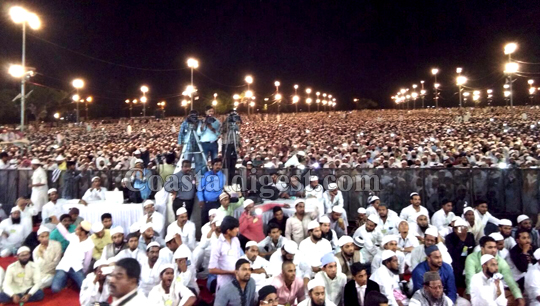
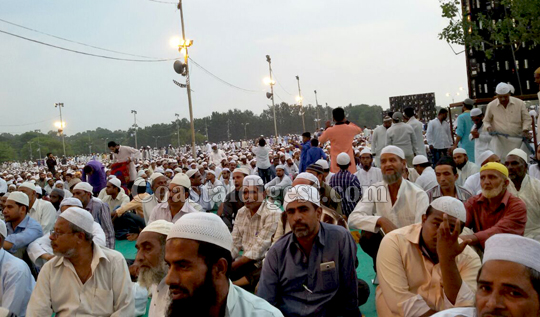
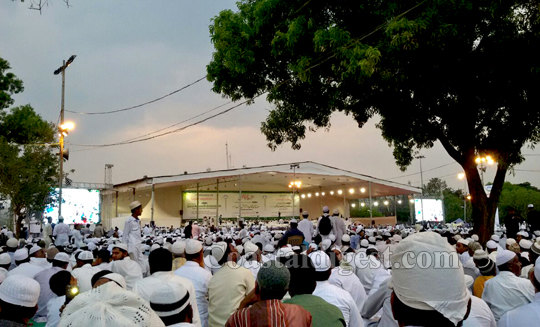
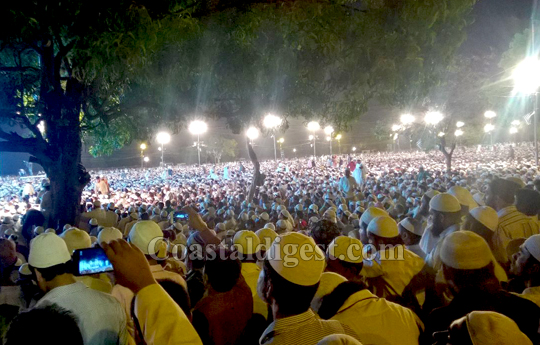
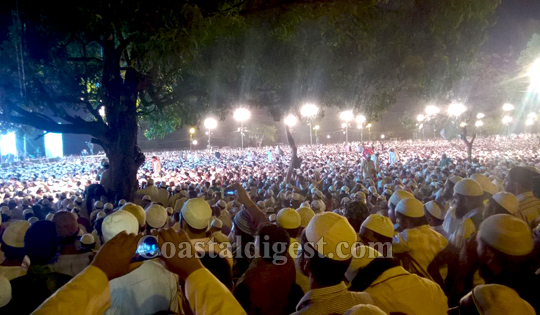
Sheikh Saleh bin Muhammad Al Taleb on Friday delivering the juma sermon before a mammoth gathering at the Eidgah in Rajiv Nagar in Mysuru and then addressed an Islamic conference at Palace Grounds in Bengaluru.

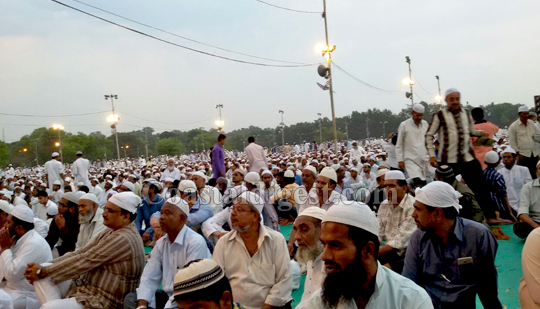
According to an estimate, nearly two lakh Muslims had converged at the ground to listen to the Imam in Mysuru. People started flocking the grounds from 10 a.m., ahead of the arrival of the Imam, who came at 1 pm.

The 10-minute discourse was followed by a mass prayer. When the prayer concluded, people vied with each other to touch the Imam.

In Bengaluru too the number of participates at the Imam's event was beyond expectation. This is the first time in the history of these two cities a foreign scholar attracting such large crowds, it is sad.

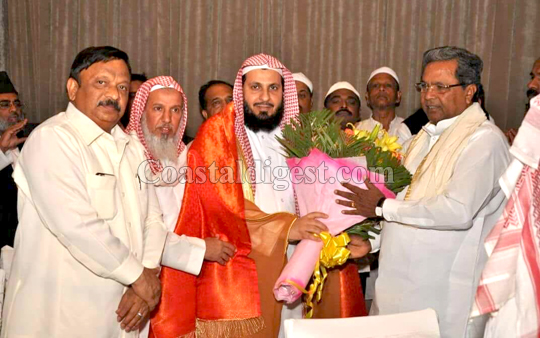
Karnataka chief minister Siddaramaiah welcomed the Imam to Karnataka.

On Sunday, the Imam launched the Peace Internet Radio set up by the Wisdom Global Islamic Mission at Mini Ooty, near Malappuram in Kerala. He also laid the foundation stone for the new academic block of Jamia Al Hind Al Islamia. The round-the-clock radio will have 52 programmes meant to propagate values and wisdom among adults and children.

Also Read: Mysuru: Makkah imam urges Muslims to love, help people of all religions

imam2

wtsp 1

wtsp 2

wtsp 4

wtsp 5

wtsp 6

wtsp 7

wtsp 8

wtsp 9

Comments

zameer
 - 
Monday, 11 Apr 2016

Mashallah -

People showed their love to Imam, Allah Bless All.

NOOR
 - 
Sunday, 10 Apr 2016

Masha ALLAH - A good message by the Imam -- Love people and help people of all religions....
A leader should be like this, who will call the followers to do GOOD and help the NEEDY... the irony is that he called to help all religions not just Muslim
A true message of ISLAM which is alwz BLINDED in the MEDIA...

Add new comment

  • Coastaldigest.com reserves the right to delete or block any comments.
  • Coastaldigset.com is not responsible for its readers’ comments.
  • Comments that are abusive, incendiary or irrelevant are strictly prohibited.
  • Please use a genuine email ID and provide your name to avoid reject.
Media Release
February 14,2020

Veteran journalist P. Sainath has said that the nation is in a crisis. And this crisis is not limited to just the rural area. It has become a national crisis at various areas such as agriculture, education, economy, job creation etc.

He was delivering the endowment lecture on the topic ‘Indian democracy at the post-liberalization and post-truth era’ at Media Manthan 2020 organized by the PG department of journalism and mass communication at St Aloysius College (Autonomous). 

Mr Sainath said that the many policies adopted in the 90s led to India becoming unusually unequal. Referring to the speech Ambedkar had made at the Constituent Assembly while handing over the draft of the Constitution, Mr Sainath said, “Ambedkar had warned about the weakness of Indian democracy that liberty without equality allows the supremacy of a few over the multitude. Liberty, equality and fraternity must be kept together as we cannot have one without the other.” 

Mr Sainath stated that the agrarian crisis was no longer about the loss of productivity, employment or about farmer suicide; it was a societal, civilizational crisis. Commenting on the lopsided policies such as cow-slaughter ban, he explained how cow slaughter ban had adversely affected many industries due to their interdependency. While Muslims who slaughtered cows were rendered helpless, the cattle traders who were mostly OBCs lost their earnings as the cattle prices crashed. An important industry like Kolhapur sandals industry in Maharashtra went bankrupt as a result of the cow slaughter ban in Maharashtra. He said the policymakers had no idea how the rural industries were interconnected. Demonetisation too devastated the rural economy as 98 percent of rural transactions happen through cash. 

Mr Sainath also spoke about the crisis of inequality which affects the Dalits and the Adivasis far more than anyone else as 90 percent of the rural households take home less than Rs 10,000/- per month. “Women are yet another group whose labour is never counted in the gross domestic product. Women and girls globally do unpaid work which amounts to about 12.5 billion working hours per year. Monetarily speaking, this is worth 10.8 trillion dollars,” Mr Sainath added. 

Speaking about the crisis of jobs Mr Sainath said that major companies were laying off employees just to create more profits for the investors and the adoption of artificial intelligence in the industry would further destroy millions of jobs.

Rector of St Aloysius College Institutions Fr Dionysius Vaz SJ, Principal Dr (Fr) Praveen Martis SJ, HOD of Journalism and Mass Communication department Dr (Fr) Melwyn Pinto SJ were present.

‘Veerappan and Vijay Mallya’s business models are interesting!’

Addressing the gathering during his endowment lecture on Friday, Mr Sainath made an interesting comment on the so called ‘revenue model’. “Whenever I visit IIMs and IITs for lectures on my PARI project, the students there ask me what my revenue model for my project is. I tell them that I do not have a revenue model. In fact, journalism does not begin with a revenue model. Gandhiji, Ambedkar, Bhagat Singh were all great journalists. But they did not have a revenue model,” Mr Sainath said.

On a lighter note, he said that the best revenue model that he liked was that of forest brigand Veerappan and liquor baron Vijay Mallya. “Veerappan ruled the forest for forty years and from the top ministers to the villagers he could dictate terms and liver royally. Similarly, Mallya’s revenue model was to steal the banks and run away abroad and live like a king,” Mr Sainath added.

Journalism is not and can never be a business. It is a calling, he opined. While newspaper can be a business, television can be a business, journalism per se cannot be reduced to a business. “Unfortunately today, journalists are recruited on a contract basis and they have no bargaining power; and there are no unions to fight for their cause. Hence, they are at the mercy of the corporate media houses for their survival and are made to write stories that cannot be called journalism,” Mr Sainath said.

Answering a question as to the pressures he faced as a journalist, he said that external pressures from the government or others could be very well handled. It is the internal pressures from once own media house that journalists find it difficult to manage.


 

Comments

Add new comment

  • Coastaldigest.com reserves the right to delete or block any comments.
  • Coastaldigset.com is not responsible for its readers’ comments.
  • Comments that are abusive, incendiary or irrelevant are strictly prohibited.
  • Please use a genuine email ID and provide your name to avoid reject.
News Network
April 28,2020

Bengaluru, Apr 28: A CRPF jawan has been arrested in Karnataka for allegedly defying the COVID-19 lockdown norms with the paramilitary force taking strong exception to his 'ill treatment', following which an inquiry has been ordered by the state police.

State DGP Praveen Sood has ordered inquiry into the incident, which has triggered a row after a video of it went viral.

In the clip, some police constables are purportedly seen hitting CRPF soldier Sachin Sawant with sticks in Belagavi.

According to the information shared on social media, Sawant was washing his bike when a police team reached the spot and started beating him up for not wearing a mask during the lockdown.

Taking a serious view of the 'ill-treatment' meted out to its Cobra Commando, the CRPF has written a letter to the Karnataka police demanding an investigation into the matter.

In a letter to the DGP of Karnataka, the additional Director general of police of CRPF Sanjay Arora said Sawant was cleaning his bike when a skirmish happened between him and the police over not wearing the mask.

Arora wrote, "Sawant was manhandled and ill-treated, before his family members and paraded to the police station barefoot, where he was kept in chains and handcuff.

From the scrutiny of a viral video on social media, it is apparent that the conduct of police personnel was not citizen centric."

The CRPF ADGP also said the 'unpleasant' situation could have been avoided if the Karnataka police had taken CRPF hierarchy into confidence before making the arrest.

In response, Sood ordered an inquiry into the matter.

He tweeted that IGP Belagavi has been asked to conduct a probe into the incident involving CRPF constable. Action will be taken against guilty after receipt of report, he said.

According to sources, Home Minister Basavaraj Bommai has directed the state police chief to conduct a detailed inquiry into the incident.

Denouncing the arrest, Karnataka Irrigation Minister Ramesh Jarkiholi has sought the release of the CRPF jawan.

"It was wrong on the part of the constables to ill treat CRPF jawan and an inquiry be conducted against the erring policemen," said jarkiholi in a press release.

However, Superintendent of Police of Belagavi district, Laxman Nimbargi defended the arrest of Sawant.

Comments

Add new comment

  • Coastaldigest.com reserves the right to delete or block any comments.
  • Coastaldigset.com is not responsible for its readers’ comments.
  • Comments that are abusive, incendiary or irrelevant are strictly prohibited.
  • Please use a genuine email ID and provide your name to avoid reject.
News Network
April 24,2020

Udupi, Apr 24: While several state governments and NGOs are actively working to provide essentials to the needy amid the COVID-19 lockdown, a fisherwoman in Karnataka's Udupi has proved that even a small gesture of help for others can make a huge difference in the society.
A fisherwoman, Sharadakka, distributed rice to 140 needy families in her neighbourhood during the ongoing lockdown. The contribution was made by spending all her life savings amounting to Rs 30,000. The amount was saved by her over a period of time in an effort to build a house for herself.
On Thursday Udupi Deputy Commissioner G. Jagadeesh visited her and ensured help to build her house.
"Spending her meagre earnings, Sharadakka generously filled many empty stomachs amid the nation-wide lockdown, which is a matter of pride," said the Deputy Commissioner.

Comments

Add new comment

  • Coastaldigest.com reserves the right to delete or block any comments.
  • Coastaldigset.com is not responsible for its readers’ comments.
  • Comments that are abusive, incendiary or irrelevant are strictly prohibited.
  • Please use a genuine email ID and provide your name to avoid reject.