Makkah residents to be trained to deal with heart attacks

June 7, 2017

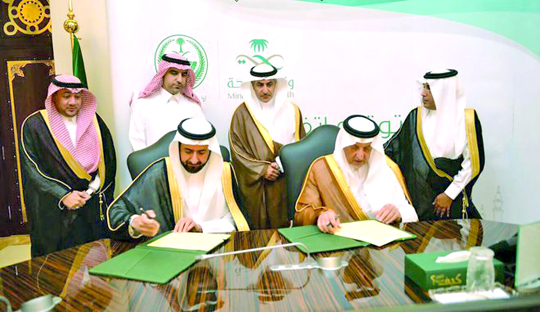
Jeddah, Jun 7: Prince Khaled Al-Faisal, Makkah governor and adviser to King Salman, on Tuesday signed a memorandum of understanding (MoU) with Health Minister Tawfiq Al-Rabiah in Jeddah to implement “Makkah, the City of Safe Heart,” an initiative to teach citizens outside the health sector to administer emergency care for people suffering a heart attack.

makkah

Prince Khaled said he valued the efforts of all agencies and parties involved in serving guests during the Haj and Umrah seasons, emphasizing the need to harness all health and therapeutic services for pilgrims.

In its first phase, the initiative will train some 5,000 people to deal with heart attacks in public.

Meanwhile, 1,000 automated external defibrillators (AED) have been distributed in various locations known to trainers and paramedics.

According to the MoU, the Health Ministry will supervise the training with participation from the Saudi Heart Association.

Fixed and movable AEDs will be available, especially in the Grand Mosque area, equipped with a GPS feature.

The initiative aims to train 20 percent of Makkah's population in three years, and raise awareness of the issue to 80 percent via the media, social media and other communication means.

The initiative involves four pillars: Training, specifying locations of AEDs, administering first aid and moving the patient, and the response of the command-and-control center.

Comments

Add new comment

  • Coastaldigest.com reserves the right to delete or block any comments.
  • Coastaldigset.com is not responsible for its readers’ comments.
  • Comments that are abusive, incendiary or irrelevant are strictly prohibited.
  • Please use a genuine email ID and provide your name to avoid reject.
Arab News
March 21,2020

Jeddah, Mar 21: Saudi government ministers on Friday announced a war chest of more than SR120 billion ($32 billion) to fight the “unprecedented” health and economic challenges facing the country as a result of the killer coronavirus pandemic.

During a press conference in Riyadh, finance minister and acting minister of economy and planning, Mohammed Al-Jadaan, unveiled a SR70 billion stimulus package to support the private sector, especially small- and medium-sized enterprises (SMEs) and businesses worst-hit by the virus outbreak.

And the Saudi Arabian Monetary Authority (SAMA) has also sidelined SR50 billion to help the Kingdom’s banking sector, financial institutions and SMEs.

Al-Jadaan said the government had introduced tough measures to protect the country’s citizens while immediately putting in place a financial safety net. He added that the Kingdom was moving decisively to address the global COVID-19 disease crisis and cushion the financial and economic impact of the outbreak on the country.

The SR70 billion package of initiatives revealed by the minister will include exemptions and postponement of some government dues to help provide liquidity for private-sector companies.

Minister of Health Dr. Tawfig Al-Rabiah noted the raft of precautionary measures that had been introduced by the Kingdom in cooperation with the private sector and government agencies to combat the spread of the coronavirus, highlighting the important contribution of the data communication services sector.

He reassured the Saudi public that the Kingdom would continue to do whatever was required to tackle the crisis.

“This pandemic has a lot of challenges. It’s difficult to make presumptions at this moment as we’ve seen; many developed countries did not expect the rate of transmission of this virus.

“We see that the reality of the situation is different from what many expected. The virus is still being studied and though we know the means of transmission, it is transmitted at a very fast rate, having spread to many countries faster than expected.

“We see that many countries have not taken the strong precautionary measures from the beginning of the crisis which led to the vast spread of the virus in these countries,” Al-Rabiah said.

He pointed out that social distancing would help slow the spread.

Al-Jadaan said the Saudi government had the financial and economic capacity to deal with the situation. “We have large reserves and large investments, but we do not want to withdraw from the reserves more than what was already announced in the budget. We do not want to liquidate any of the government’s investments so we will borrow.

“We have approval from the government after the finance committee raised its recommendations to increase the proportion of the domestic product borrowing from 30 percent to 50 percent. We do not expect to exceed 50 percent from now until the end of 2022,” he added.

The government would use all the tools available to it to finance the private sector, especially SMEs, and ensure its ongoing stability.

The finance minister said that at this stage it was difficult to predict the economic impact of the pandemic on the private sector, but he emphasized that international coordination, most notably through G20 countries and health organizations, was ongoing.

On recorded cases of the COVID-19 disease in the Kingdom, Al-Rabiah said: “Many of the confirmed cases are without symptoms, this is due to the precautionary measures being considered.

“As soon as a case is confirmed, we contact and examine anyone who was in direct contact with the patient. This epidemiological investigation, is conducted on a large scale to investigate any case that was in contact with the patient.”

Al-Jadaan also announced the formation of a committee made up of the ministers of finance, economy and planning, commerce, and industry and mineral resources, along with the vice chairman of the board of the Saudi National Development Fund, and its governor.

The committee will be responsible for identifying and reviewing incentives, facilities, and other initiatives led by the fund.

Committees had also been established, said Al-Jadaan, to study the impact and repercussions of the coronavirus crisis on all sectors and regions, and look at ways of overcoming them through subsidies or stimulus packages.


Comments

Add new comment

  • Coastaldigest.com reserves the right to delete or block any comments.
  • Coastaldigset.com is not responsible for its readers’ comments.
  • Comments that are abusive, incendiary or irrelevant are strictly prohibited.
  • Please use a genuine email ID and provide your name to avoid reject.
News Network
July 5,2020

Riyadh, Jul 5: Custodian of the Two Holy Mosques King Salman has approved the extension of the validity of the expired iqama (residency permit) and exit and reentry visas of expatriates who are outside the Kingdom for a period of three months without any fee.

The iqama of expatriates inside the Kingdom as well as the visa of visitors who are in the Kingdom of which the validity expires during the period of suspension of entry and exit from the Kingdom will also be extended for a period of three months without any charge.

The validity of final exit visas as well as exit and reentry visas issued for expatriates, who are in the Kingdom, but were not used during the lockdown period will be extended for a period of three months without any fee, the Saudi Press Agency reported quoting an official source at the Ministry of Interior.

The ministry source said that these measures were taken as part of the continuous efforts made by the government of King Salman to mitigate the effects of the coronavirus pandemic on individuals as well as on private sector establishments and investors, economic activities in the Kingdom, following the adoption of the preventive measures to stem the spread of the pandemic.

The beneficiaries of the King’s order include all expatriates who are outside the Kingdom on exit and reentry visas, which expired during the lockdown period and after lifting of the lockdown.

These expatriates are not in a position to return to the Kingdom due to the enforcement of suspension of international flight service and temporary ban on entry and exit from the Kingdom.

The beneficiaries also include those expatriates who are still in the Kingdom after issuance of final exit visas or exit and reentry visas but could not travel because of the suspension of entry and exit from the Kingdom.

Comments

Add new comment

  • Coastaldigest.com reserves the right to delete or block any comments.
  • Coastaldigset.com is not responsible for its readers’ comments.
  • Comments that are abusive, incendiary or irrelevant are strictly prohibited.
  • Please use a genuine email ID and provide your name to avoid reject.
Agencies
February 16,2020

Al-Jawf, Feb 16: At least 31 people were killed and 12 others were injured here in the al-Maslub district in airstrikes by the Saudi-UAE-led military coalition on Saturday.

"Preliminary field reports indicate that as many as 31 civilians were killed and 12 others injured in strikes that hit al-Hayjah area of the al-Maslub district in al-Jawf governorate," said a statement from the office of the UN resident coordinator and humanitarian coordinator for Yemen.

According to Al Jazeera, the airstrike was conducted hours after the Yemeni Houthis said that they downed a Saudi fighter jet in the same region.

Commenting on the air raids, Lise Grande, the UN's humanitarian coordinator for Yemen, said: "We share our deep condolences with the families of those killed and we pray for the speedy recovery of everyone who has been injured in these terrible strikes."

"So many people are being killed in Yemen - it's a tragedy and it's unjustified. Under international humanitarian law, parties that resort to force is obligated to protect civilians," Grande was quoted as saying.

Comments

Add new comment

  • Coastaldigest.com reserves the right to delete or block any comments.
  • Coastaldigset.com is not responsible for its readers’ comments.
  • Comments that are abusive, incendiary or irrelevant are strictly prohibited.
  • Please use a genuine email ID and provide your name to avoid reject.