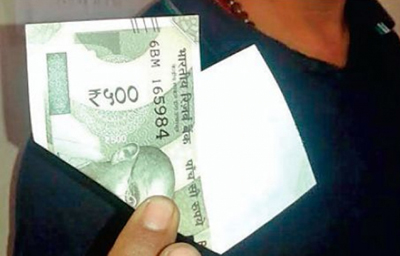
Man gets Rs 500 notes with one-side blank in MP

January 12, 2017

Khargone, Jan 12: Days after a farmer in Madhya Pradesh received Rs 2,000 notes from a bank without the image of Mahatma Gandhi, an ATM at a village in Khargone district dispensed two 'one-side blank' currency of the new Rs 500 denomination.

500notesHemant Soni on Tuesday night used his card to withdraw Rs 1,500 from a public sector bank's ATM at Segaon village, about 40 kms from Khargone district headquarters.

"Of the three Rs 500 notes, two were printed on one side while the other side was completely blank," Soni said.

He registered a complaint of the misprinted currency yesterday with the concerned bank officials, who subsequently replaced his notes with new ones.

The bank officials, however, said the misprinted notes were received as such from the Reserve Bank of India.

"We have changed these 'misprinted' currency notes after the consumer's complaint. We are now checking the currency notes before loading them into the ATMs," the deputy manager of the bank's Sabji Mandi main branch said.

"This is a printing mistake," he added.

Comments

Rikaz
 - 
Thursday, 12 Jan 2017

Modi was sleeping when he was printing.....

Add new comment

  • Coastaldigest.com reserves the right to delete or block any comments.
  • Coastaldigset.com is not responsible for its readers’ comments.
  • Comments that are abusive, incendiary or irrelevant are strictly prohibited.
  • Please use a genuine email ID and provide your name to avoid reject.
coastaldigest.com news network
May 14,2020

Bengaluru, May 14: As many as 22 new cases have been reported in Karnataka taking the total number of positive cases in the state to 981. 

The new cases include five in Bengaluru Urban - all with a contact history, four each in Gadag - with history of travel to Ahemadabad, Mandya with travel history to Mumbai, Maharashtra and Bidar - with three from containment zone and one with travel history to Mumbai, three from Davangere and one each from Belagavi and Bagalkote.

Meanwhile, two more deaths have been reported in the state on Thursday morning taking the total toll to 35. This is apart from a non-COVID-19 death.

An 80-year-old resident of Dakshina Kannada, got admitted at private hospital following a stroke. She was shifted to the icu on confirmation for Covid-19 at a designated hospital on April 26. She died on Thursday due to septic shock.

Another 60-year-old male, resident of Ananthapur in Andhra Pradesh, admitted at Victoria Hospital in Bengaluru with severe pneumonia and respiratory distress died due to cardiac arrest on Thursday morning. He had hypotension and Diabetes Mellitus, according to the morning health bulletin.

Sources in Victoria Hospital said this person was the first patient to undergo clinical trial for plasma therapy. He was infused plasma on Monday. However, his condition continued to remain the same.

Comments

Add new comment

  • Coastaldigest.com reserves the right to delete or block any comments.
  • Coastaldigset.com is not responsible for its readers’ comments.
  • Comments that are abusive, incendiary or irrelevant are strictly prohibited.
  • Please use a genuine email ID and provide your name to avoid reject.
News Network
May 5,2020

Mangaluru, May 5: The principal of St Agnes College, Mangaluru, Sr Dr Jeswina AC attained superannuation after 28 years of dedicated and fruitful service.

Sister Dr Venissa AC, the associate professor of the department of Economics, has been appointed by the Apostolic Carmel Educational Society Management as the principal of the college. Sister Roopa Rodrigues AC. has been appointed as the vice principal.

Sr Dr Venissa AC was earlier serving as the vice principal at St Agnes College.

The college and the management has thanked Sr Dr Jeswina AC for the dedicated services she has rendered to the college.

Comments

Add new comment

  • Coastaldigest.com reserves the right to delete or block any comments.
  • Coastaldigset.com is not responsible for its readers’ comments.
  • Comments that are abusive, incendiary or irrelevant are strictly prohibited.
  • Please use a genuine email ID and provide your name to avoid reject.
News Network
April 2,2020

The current physical distancing guidelines provided by the World Health Organisation (WHO) and by the US Centers for Disease Control and Prevention (CDC) may not be adequate to curb the coronavirus spread, according to a research which says the gas cloud from a cough or sneeze may help virus particles travel up to 8 metres. The research, published in the Journal of the American Medical Association, noted that the the current guidelines issued by the WHO and CDC are based on outdated models from the 1930s of how gas clouds from a cough, sneeze, or exhalation spread.

Study author, MIT associate professor Lydia Bourouiba, warned that droplets of all sizes can travel 23 to 27 feet, or 7-8 metres, carrying the pathogen.

According to Bourouiba, the current guidelines are based on "arbitrary" assumptions of droplet size, "overly simplified", and "may limit the effectiveness of the proposed interventions" against the deadly pandemic.

 She explained that the old guidelines assume droplets to be one of two categories, small or large, taking short-range semi-ballistic trajectories when a person exhales, coughs, or sneezes.

However based on more recent discoveries, the MIT scientist said, sneezes and coughs are made of a puff cloud that carries ambient air, transporting within it clusters of droplets of a wide range of sizes.

Bourouiba warned that this puff cloud, with ambient air entrapped in it, can offer the droplets moisture and warmth that can prevent it from evaporation in the outer environment.

"The locally moist and warm atmosphere within the turbulent gas cloud allows the contained droplets to evade evaporation for much longer than occurs with isolated droplets," she said.

"Under these conditions, the lifetime of a droplet could be considerably extended by a factor of up to 1000, from a fraction of a second to minutes," the researcher explained in the study.

The MIT scientist, who has researched the dynamics of coughs and sneezes for years, added that these droplets settle along the trajectory of a cough or sneeze contaminating surfaces, with their residues staying suspended in the air for hours.

"Even when maximum containment policies were enforced, the rapid international spread of COVID-19 suggests that using arbitrary droplet size cutoffs may not accurately reflect what actually occurs with respiratory emissions, possibly contributing to the ineffectiveness of some procedures used to limit the spread of respiratory disease," Bourouiba wrote in the study


Comments

Add new comment

  • Coastaldigest.com reserves the right to delete or block any comments.
  • Coastaldigset.com is not responsible for its readers’ comments.
  • Comments that are abusive, incendiary or irrelevant are strictly prohibited.
  • Please use a genuine email ID and provide your name to avoid reject.