Man killed in spat over dog barking during T20 match

March 29, 2016

Bengaluru, Mar 29: A petty argument over watching the World T20 match between India and Australia on Sunday night snowballed into an ugly fight, leaving a man dead and two others injured. The incident occurred at SK?Garden in JC Nagar, northcentral Bengaluru.

KennedyAvinash, 23, a resident of SK?Garden, was watching the match along with friends, David and Kenneth, at a large screen put up at 4th Cross in the locality.

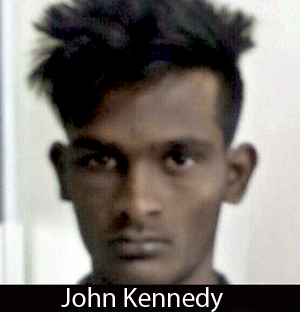
Around 10.30 pm as India were cruising to a famous win, John Kennedy, 24, a youth from the locality, took his dog for a walk. He came to the place where the match was being watched. The dog started barking. Avinash and his friends got annoyed and asked Kennedy to go away.

But he ignored them and stayed put, watching the match himself. The dog barked again, further irritating Avinash and his friends. They picked a fight with Kennedy and beat him up, forcing him to retreat.

Kennedy went home and told his mother and sister about what had happened. The women took him along and went to the spot. They scolded Avinash and his friends. But the men retaliated and thrashed Kennedy. His mother and sister also received some blows in the melee.

Kennedy got furious, picked a broken liquor bottle and pierced it into Avinash's abdomen. He also attacked David and Kenneth. Thereafter, he left the place along with his mother and sister.

Avinash collapsed and started bleeding. Local residents took all the three men to hospital. Avinash succumbed to his injuries while David and Kenneth are said to be out of danger. The jurisdictional JC Nagar rushed to the spot and arrested Kennedy from the terrace of a building where he was hiding.

Just after Avinash was attacked, his younger brother called up his mother and told her about the altercation. The parents rushed to the private hospital and thence to Bowring Hospital where Avinash was admitted. But he died before the parents could reach there.

Avinash was the eldest son of Shankar, a contract worker. He had dropped out of college and was jobless. Kennedy was working as a delivery body with a sales agency, the police aid.

Comments

manav
 - 
Tuesday, 29 Mar 2016

My dear brothers and sisters pls think a minute why people become so untolarrant and so egoist what's happening around us why we happened to read such news day by day as common what kind of society is this why our education system is not effective enough to form our youth with good maanersm and civilized?

manav
 - 
Tuesday, 29 Mar 2016

My dear brothers and sisters pls think a minute why people become so untolarrant and so egoist what's happening around us why we happened to read such news day by day as common what kind of society is this why our education system is not effective enough to form our youth with good maanersm and civilized?

manav
 - 
Tuesday, 29 Mar 2016

My dear brothers and sisters pls think a minute why people become so untolarrant and so egoist what's happening around us why we happened to read such news day by day as common what kind of society is this why our education system is not effective enough to form our youth with good maanersm and civilized?

SK
 - 
Tuesday, 29 Mar 2016

Why these cricket matches are played during Mar / April, spoiling the exams of the students...... All are idiots who are after these matches wasting their precious time and energy....

Satyameva jayate
 - 
Tuesday, 29 Mar 2016

Cricket fans in India are addicted as if it's a religion or worship. If a dog barked in front of a Mandir or masjid no one would be so serious..even god...haha .....cricket is adhukkum mele...ha haa...the people who made this game are not crazy as we are. Aisaa des hai meraa....cricketers paise kamaaye...bewakoof fans phookat me mare.....ha ha

Bhavya D costa
 - 
Tuesday, 29 Mar 2016

His dog and he should be hanged to death, worthless fellow.

IBRAHIM.HUSSAIN
 - 
Tuesday, 29 Mar 2016

Bengaluru become a crime city. Mumbai is better these days.

Add new comment

  • Coastaldigest.com reserves the right to delete or block any comments.
  • Coastaldigset.com is not responsible for its readers’ comments.
  • Comments that are abusive, incendiary or irrelevant are strictly prohibited.
  • Please use a genuine email ID and provide your name to avoid reject.
News Network
January 10,2020

Bengaluru, Jan 10: The Special Investigation Team (SIT), probing the murder case of journalist-activist Gauri, arrested absconding suspect Rushikesh Devdikar alias Murali (44) from Dhanbad district in Jharkhand on Thursday evening and is bringing him to the city.

Rushikesh is the 18th suspect arrested in the case, Chief Investigating Officer M N Anucheth said. The investigation has revealed that he was primarily involved in the conspiracy to murder Gauri.

Rushikesh, who was hiding in a house in Katras, Dhanbad, will be produced before the local Judicial Magistrate in Dhanbad on Friday, said Anucheth, adding that the SIT had searched his house for clues. "We will obtain a transit warrant from the court and then bring him to Bengaluru," the officer said.

Originally from Aurangabad in Maharashtra, Rushikesh's family still lives there.

Gauri Lankesh was shot dead near her residence at around 8.20 pm on September 5, 2017, by two bike-borne men.

Comments

Add new comment

  • Coastaldigest.com reserves the right to delete or block any comments.
  • Coastaldigset.com is not responsible for its readers’ comments.
  • Comments that are abusive, incendiary or irrelevant are strictly prohibited.
  • Please use a genuine email ID and provide your name to avoid reject.
News Network
April 29,2020

Washington, Apr 29: A US government panel on Tuesday called for India to be put on a religious freedom blacklist over a "drastic" downturn under Prime Minister Narendra Modi, triggering a sharp rebuttal from New Delhi.

The US Commission on International Religious Freedom recommends but does not set policy, and there is virtually no chance the State Department will follow its lead on India, an increasingly close US ally.

In an annual report, the bipartisan panel narrowly agreed that India should join the ranks of "countries of particular concern" that would be subject to sanctions if they do not improve their records.

"In 2019, religious freedom conditions in India experienced a drastic turn downward, with religious minorities under increasing assault," the report said.

It called on the United States to impose punitive measures, including visa bans, on Indian officials believed responsible and grant funding to civil society groups that monitor hate speech.

The commission said that Modi's Hindu nationalist government, which won a convincing election victory last year, "allowed violence against minorities and their houses of worship to continue with impunity, and also engaged in and tolerated hate speech and incitement to violence."

It pointed to comments by Home Minister Amit Shah, who notoriously referred to mostly Muslim migrants as "termites," and to a citizenship law that has triggered nationwide protests.

It also highlighted the revocation of the autonomy of Kashmir, which was India's only Muslim-majority state, and allegations that Delhi police turned a blind eye to mobs who attacked Muslim neighborhoods in February this year.

Coronavirus state-wise India update: Total number of confirmed cases, deaths on April 29

The Indian government, long irritated by the commission's comments, quickly rejected the report.

"Its biased and tendentious comments against India are not new. But on this occasion, its misrepresentation has reached new levels," foreign ministry spokesman Anurag Srivastava said.

"We regard it as an organization of particular concern and will treat it accordingly," he said in a statement.

The State Department designates nine "countries of particular concern" on religious freedom -- China, Eritrea, Iran, Myanmar, North Korea, Pakistan, Saudi Arabia, Tajikistan and Turkmenistan.

The commission asked that all nine countries remain on the list. In addition to India, it sought the inclusion of four more -- Nigeria, Russia, Syria and Vietnam.

Pakistan, India's historic rival, was added by the State Department in 2018 after years of appeals by the commission.

In its latest report, the commission said that Pakistan "continued to trend negatively," voicing alarm at forced conversions of Hindus and other minorities, abuse of blasphemy prosecutions and a ban on the Ahmadi sect calling itself Muslim.

India's citizenship law fast-tracks naturalization for minorities from neighbouring countries -- but not if they are Muslim.

Modi's government says it is not targeting Muslims but rather providing refuge to persecuted people and should be commended.

But critics consider it a watershed move by Modi to define the world's largest democracy as a Hindu nation and chip away at independent India's founding principle of secularism.

Tony Perkins, the commission's chair, called the law a "tipping point" and voiced concern about a registry in the northeastern state of Assam, under which 1.9 million people failed to produce documentation to prove that they were Indian citizens before 1971 when mostly Muslim migrants flowed in during Bangladesh's bloody war of independence.

"The intentions of the national leaders are to bring this about throughout the entire country," Perkins told an online news conference.

"You could potentially have 100 million people, mostly Muslims, left stateless because of their religion. That would be, obviously, an international issue," said Perkins, a Christian activist known for his opposition to gay rights who is close to President Donald Trump's administration.

Three of the nine commissioners dissented -- including another prominent Christian conservative, Gary Bauer, who voiced alarm about India's direction but said the ally could not be likened to non-democracies such as China.

"I am deeply concerned that this public denunciation risks exactly the opposite outcome than the one we all desire," Bauer said.

Trump, who called for a ban on Muslim immigration to the US when he ran for president, hailed Modi on a February visit to New Delhi.


Comments

Add new comment

  • Coastaldigest.com reserves the right to delete or block any comments.
  • Coastaldigset.com is not responsible for its readers’ comments.
  • Comments that are abusive, incendiary or irrelevant are strictly prohibited.
  • Please use a genuine email ID and provide your name to avoid reject.
Ram Puniyani
March 14,2020

In the wake of Citizenship Amendment Act (CAA) UN High Commissioner, Michele Bachelet, has filed an intervention in the Supreme Court petition challenging the constitutionality of the Citizenship Amendment Act, as she is critical of CAA. Responding to her, India’s Foreign Minister S. Jai Shanker strongly rebutted her criticism, saying that the body (UNHCR) has been wrong and is blind to the problem of cross border terrorism. The issue on hand is the possibility of scores of people, mainly Muslims, being declared as stateless. The problem at hand is the massive exercise of going through the responses/documents from over 120 crore of Indian population and screening documents, which as seen in Assam, yield result which are far from truthful or necessary.

The issue of CAA has been extensively debated and despite heavy critique of the same by large number of groups and despite the biggest mass opposition ever to any move in Independent India, the Government is determined on going ahead with an exercise which is reminiscent of the dreaded regimes which are sectarian and heartless to its citizens, which have indulged in extinction of large mass of people on grounds of citizenship, race etc. The Foreign minister’s assertion is that it is a matter internal to India, where India’s sovereignty is all that matters! As far as sovereignty is concerned we should be clear that in current times any sovereign power has to consider the need to uphold the citizenship as per the principle of non-discrimination which is stipulated in Art.26 of the International Covenant on Civil and Political (ICCPR) rights.

Can such policies, which affect large number of people and are likely to affect their citizenship be purely regarded as ‘internal’? With the World turning into a global village, some global norms have been formulated during last few decades. The norms relate to Human rights and migrations have been codified. India is also signatory to many such covenants in including ICCPR, which deals with the norms for dealing with refugees from other countries. One is not talking of Chicago speech of Swami Vivekanand, which said that India’s greatness has been in giving shelter to people from different parts of the World; one is also not talking of the Tattariaya Upanishad’s ‘Atithi Devovhav’ or ‘Vasudhaiva Kutumbkam’ from Mahaupanishad today.

What are being talked about are the values and opinions of organizations which want to ensure to preserve of Human rights of all people Worldwide. In this matter India is calling United Nations body as ‘foreign party’; having no locus standi in the case as it pertains to India’s sovereignty. The truth is that since various countries are signatories to UN covenants, UN bodies have been monitoring the moves of different states and intervening at legal level as Amicus (Friend of the Court) to the courts in different countries and different global bodies. Just to mention some of these, UN and High Commissioner for Human Rights has often submitted amicus briefs in different judicial platforms. Some examples are their intervention in US Supreme Court, European Court of Human Rights, International Criminal Court, and the Inter-American Court of Human Rights. These are meant to help the Courts in areas where UN bodies have expertise.

 Expertise on this has been jointly formulated by various nations. These interventions also remind the nations as to what global norms have been evolved and what are the obligations of individual states to the values which have evolved over a period of time. Arvind Narrain draws our attention to the fact that, “commission has intervened in the European Court of Human Rights in cases involving Spain and Italy to underscore the principle of non-refoulement, which bars compulsory expulsion of illegal migrants… Similarly, the UN has intervened in the International Criminal Court in a case against the Central African Republic to explicate on the international jurisprudence on rape as a war crime.”

From time to time organizations like Amnesty International and Human Rights Watch have been monitoring the status of Human rights of different countries. This puts those countries in uncomfortable situation and is not welcome by those establishments. How should this contradiction between ‘internal matter’, ‘sovereignty’ and the norms for Human rights be resolved? This is a tough question at the time when the freedom indices and democratic ethos are sliding downwards all over the world. In India too has slid down on the scale of these norms.

In India we can look at the intervention of UN body from the angle of equality and non discrimination. Democratic spirit should encourage us to have a rethink on the matters which have been decided by the state. In the face of the greatest mass movement of Shaheen bagh, the state does need to look inwards and give a thought to international morality, the spirit of global family to state the least.

The popular perception is that when Christians were being persecuted in Kandhmal the global Christian community’s voice was not strong enough. Currently in the face of Delhi carnage many a Muslim majority countries have spoken. While Mr. Modi claims that his good relations with Muslim countries are a matter of heartburn to the parties like Congress, he needs to relook at his self gloating. Currently Iran, Malaysia, Indonesia and many Muslim majority countries have spoken against what Modi regime is unleashing in India. Bangladesh, our neighbor, has also seen various protests against the plight of Muslims in India. More than the ‘internal matter’ etc. what needs to be thought out is the moral aspect of the whole issue. We pride ourselves in treading the path of morality. What does that say in present context when while large section of local media is servile to the state, section of global media has strongly brought forward what is happening to minorities in India.   

The hope is that Indian Government wakes up to its International obligations, to the worsening of India’s image in the World due to CAA and the horrific violence witnessed in Delhi.

Comments

Add new comment

  • Coastaldigest.com reserves the right to delete or block any comments.
  • Coastaldigset.com is not responsible for its readers’ comments.
  • Comments that are abusive, incendiary or irrelevant are strictly prohibited.
  • Please use a genuine email ID and provide your name to avoid reject.