Mangalore: ARMC IVF completes a year of functioning

[email protected] (CD Network)
January 24, 2014
ARMC_Press_24

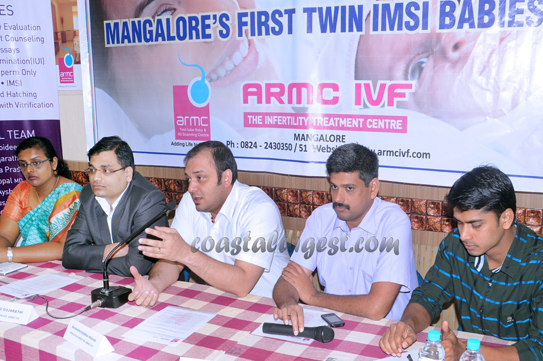
Mangalore, Jan 24: ARMC IVF, a unit of Repro Health Care Mangalore Pvt Ltd cpmpleted a year of functioning with the birth of first Intracytoplasmic Morphologically selected Sperm Injection (IMSI) baby in Dakshina Kannada on October 27 .

Addressing the media persons on Friday, Dr. Raghavendra Prasad, executive director of the centre said that the IMSI treatment by the organisation used for fertility in male and female in the district has seen success through its first baby.

“Treatment is a special practice in which the sperms are seen under a special microscope with a high magnification so that every part of sperm can be seen in detail. Also the best sperms are selected and injected inside the female ovaries. This gives a high fertilization rate and better quality of embryos, which results in chances of pregnancy rate,” he briefed.

The expenses of the treatment for couple would start from Rs 1.5 lakh. It provides every treatment for the couples who are unable to conceive by natural means. Centre has expert fertility consultants, embryologists, andrologists, counsellors and technicians, he said.

Dr. Gaurav Gujarathi, chief IVF specialist said the treatment has 30 to 40 per cent of success rate. Treatment will take minimum of 45 days of time duration, he said.

Comments

Best Fertility…
 - 
Tuesday, 19 Nov 2019

Thank you for the useful article. You have given very good information.

best fertility…
 - 
Monday, 5 Aug 2019

Very good information about the IVF. thank you.

treatment for …
 - 
Tuesday, 2 Jul 2019

Thank you for given information about the IVF. 

Add new comment

  • Coastaldigest.com reserves the right to delete or block any comments.
  • Coastaldigset.com is not responsible for its readers’ comments.
  • Comments that are abusive, incendiary or irrelevant are strictly prohibited.
  • Please use a genuine email ID and provide your name to avoid reject.
News Network
March 26,2020

Bengaluru,  Mar 26: The nationwide lockdown in the view of coronavirus outbreak has driven some people to the edge. In Karnataka, within less than 24 hours, two cases of people creating trouble for police personnel have come to light.

On Wednesday, a middle-aged man was shot in his leg by the police after he tried to assault two police constables of Sanjaynagar police station. The police constables were identified as Manjunatha and Basavararaju.
The accused reportedly breached the check post at Bhoopasandra. He and his friends were over-speeding and performing stunts on bikes. When the policemen tried to secure them after giving them a chase, they attacked the cops.

When they were taken into custody, one of them again tried to escape and hurled stones and bricks on the cops. In order to prevent further assault, the police then fired two rounds – one in the air and the second one on his left leg.

Comments

Add new comment

  • Coastaldigest.com reserves the right to delete or block any comments.
  • Coastaldigset.com is not responsible for its readers’ comments.
  • Comments that are abusive, incendiary or irrelevant are strictly prohibited.
  • Please use a genuine email ID and provide your name to avoid reject.
News Network
August 4,2020

Bengaluru, Aug 4: The heath condition of Karnataka Chief Minister B S Yediyurappa who had tested positive for Covid-19 continues to be stable and he is currently asymptomatic, hospital source said.

Congress leader and former chief minister Siddaramaiah who too has tested positive for Covid-19, is suffering from high fever and is currently receiving treatment. He has been admitted at the Manipal hospital in Bengaluru.

"I request all those who had come in contact with me to check out for symptoms and to quarantine themselves," Siddaramaiah had said in a tweet.

Yediyurappa, is in the same hospital for treatment along with his daughter B Y Padmavati, who too tested positive for the virus on Monday.

Yediyurappa on Sunday night (2 August) had tweeted that, "I have tested positive for coronavirus. Whilst I am fine, I am being hospitalised as a precaution on the recommendation of doctors. I request those who have come in contact with me recently to be observant and exercise self quarantine.”

Comments

Add new comment

  • Coastaldigest.com reserves the right to delete or block any comments.
  • Coastaldigset.com is not responsible for its readers’ comments.
  • Comments that are abusive, incendiary or irrelevant are strictly prohibited.
  • Please use a genuine email ID and provide your name to avoid reject.
Agencies
July 5,2020

The deadly coronavirus that entered India while there was still nip in the air has beaten rising mercury, humid conditions, unique Indian genome and has entered monsoon season with more potency as fresh cases are only breaking all records in the country.

India recorded a single-day spike of record 24,850 new coronavirus cases on Sunday, taking its total tally to 6.73 lakh corona-positive cases.

Top Indian microbiologists were hopeful in March that after the 21-day lockdown, as summer approaches, the rise in temperature would play an important role in preventing the drastic spread of COVID-19 virus in India.

Several virologists hinted that by June this year, the impact of COVID-19 would be less than what it appeared in March-April.

The claims have fallen flat as the virus is mutating fast, becoming more potent than ever.

According to experts, the novel coronavirus is a new virus whose seasonality and response to hot humid weather was never fully understood.

"The theory was based on the fact that high temperatures can kill the virus as in sterilisation techniques used in healthcare. But these are controlled environment conditions. There are many other factors besides temperature, humidity which influence the transmission rate among humans," Dr Anu Gupta, Head, Microbiologist and Infection Control, Fortis Escorts Heart Institute, told IANS.

There is no built-up immunity to COVID-19 in humans.

"Also, asymptomatic people might be passing it to many others unknowingly. New viruses tend not to follow the seasonal trend in their first year," Gupta emphasized.

Globally, as several countries are now experiencing hot weather, the World Health Organization (WHO) reported a record hike in the number of coronavirus cases, with the total rising by 2,12,326 in 24 hours in the highest single-day increase since COVID-19 broke out.

So far over 11 million people worldwide have tested positive for the disease which has led to over 5,25,000 deaths, according to data from Johns Hopkins University. The US remained the worst-hit country with over 28 lakh cases, followed by Brazil with 15.8 lakh.

According to Sandeep Nayar, Senior Consultant and HOD, Respiratory Medicine, Allergy & Sleep Disorders, BLK Super Speciality Hospital in New Delhi, whether temperature plays a role in COVID-19 infection is highly debated.

One school of thought said in the tropical regions of South Asia, the virus might not thrive longer.

"On the other hand, another school of thought has found that novel Coronavirus can survive in a hot and humid environment and tropical climate does not make a difference to the virus. According to them, this is what distinguishes the novel coronavirus from other common viruses, which usually wane in hot weather," stressed Nayar.

Not much has been studied in the past and no definite treatment or vaccine is available to date.

"Every day, new properties and manifestation of the disease come up. As of now, the only way to prevent this monster is by taking appropriate precautions. Hand hygiene, social distancing, cough etiquette and face masks definitely reduce spread of COVID-19 infection," Nayar told IANS.

Not just top Indian health experts, even Indian-American scientists had this theory in mind that sunshine and summer may ebb the spread of the coronavirus.

Ravi Godse, Director of Discharge Planning, UPMC Shadyside Pennsylvania in the US told IANS in April: "In the summer, the humidity can go up as well, meaning more water drops in the air. If the air is saturated with water and somebody sneezes virus droplets into such air, it is likely that the droplets will fall to the ground quicker, making them less infectious. So the short answer is yes, summer/sunshine could be bettera.

According to Dr Puneet Khanna, Head of Respiratory Medicine and Pulmonology, Manipal Hospital, Delhi, COVID-19 death rates are not too different in tropical countries but since the disease affected them late it was yet to show its peak in these areas.

"The virus can survive well in hot and humid countries and this is proven now," he stressed.

Comments

Add new comment

  • Coastaldigest.com reserves the right to delete or block any comments.
  • Coastaldigset.com is not responsible for its readers’ comments.
  • Comments that are abusive, incendiary or irrelevant are strictly prohibited.
  • Please use a genuine email ID and provide your name to avoid reject.