Mangalore: ARMC IVF completes a year of functioning

[email protected] (CD Network)
January 24, 2014
ARMC_Press_24

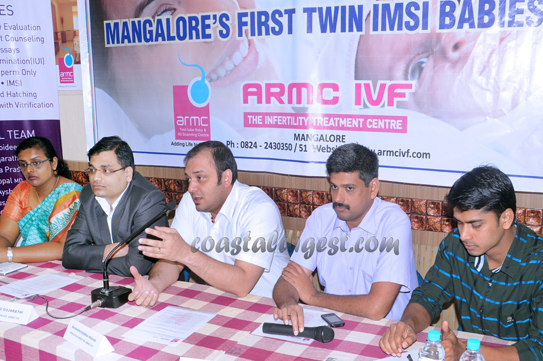
Mangalore, Jan 24: ARMC IVF, a unit of Repro Health Care Mangalore Pvt Ltd cpmpleted a year of functioning with the birth of first Intracytoplasmic Morphologically selected Sperm Injection (IMSI) baby in Dakshina Kannada on October 27 .

Addressing the media persons on Friday, Dr. Raghavendra Prasad, executive director of the centre said that the IMSI treatment by the organisation used for fertility in male and female in the district has seen success through its first baby.

“Treatment is a special practice in which the sperms are seen under a special microscope with a high magnification so that every part of sperm can be seen in detail. Also the best sperms are selected and injected inside the female ovaries. This gives a high fertilization rate and better quality of embryos, which results in chances of pregnancy rate,” he briefed.

The expenses of the treatment for couple would start from Rs 1.5 lakh. It provides every treatment for the couples who are unable to conceive by natural means. Centre has expert fertility consultants, embryologists, andrologists, counsellors and technicians, he said.

Dr. Gaurav Gujarathi, chief IVF specialist said the treatment has 30 to 40 per cent of success rate. Treatment will take minimum of 45 days of time duration, he said.

Comments

Best Fertility…
 - 
Tuesday, 19 Nov 2019

Thank you for the useful article. You have given very good information.

best fertility…
 - 
Monday, 5 Aug 2019

Very good information about the IVF. thank you.

treatment for …
 - 
Tuesday, 2 Jul 2019

Thank you for given information about the IVF. 

Add new comment

  • Coastaldigest.com reserves the right to delete or block any comments.
  • Coastaldigset.com is not responsible for its readers’ comments.
  • Comments that are abusive, incendiary or irrelevant are strictly prohibited.
  • Please use a genuine email ID and provide your name to avoid reject.
Shodhan Prasad
May 14,2020

Dubai: The father of a 16-year old girl who came on a visit visa to the UAE to visit him is desperate for help as she has been hospitalised, even as he has been rendered jobless.

On February 6, Amber D’Couto flew into Dubai from Mangaluru, India, along with her older sister, Alison, 19. The girls wanted to visit their dad Vivian D’Couto who was working in an automobile company at Jebel Ali.

The father was overjoyed to meet his girls until things took an ugly turn.

Two months into her stay, Amber fell seriously ill, even as D’Couto was served a termination letter by his company.

D’Couto said his daughter, a Grade 10 student, was perfectly healthly but suddenly developed high fever and began vomiting. She was rushed to a private hospital in Qusais which could not accommodate her because of the ongoing COVID-19 situation.

On April 30, she was admitted to another private hospital in the same area. After testing negative for COVID-19 thrice, she was diagnosed with acute pancreatis and Rheumatoid fever.

While the girl remains in hospital, the bill has spiralled to over Dh50,000, D’Couto said, adding that without a job now, he had no means to pay the huge amount.

“Amber is a very sweet child and a very bright student. She was living a very healthy life prior to coming to Dubai. But she is so ill now and under round-the-clock vigil in the ICU. The treatment for her condition is very specific and costly.”

A worried man, he said: “My daughter was on a visit visa and she had no insurance. We appeal to compassionate people to help us out in this difficult hour. Due to the current situation, I have lost my job and I am unable to pay for her medical expenses. Her condition has not stabilised yet and I am taking each day as it comes. I trust the doctors to help her recover, and we hope to be repatriated to India at the earliest so she can get further medical care.”

Comments

Add new comment

  • Coastaldigest.com reserves the right to delete or block any comments.
  • Coastaldigset.com is not responsible for its readers’ comments.
  • Comments that are abusive, incendiary or irrelevant are strictly prohibited.
  • Please use a genuine email ID and provide your name to avoid reject.
News Network
January 2,2020

Bengaluru, Jan 2: Accusing Prime Minister Narendra Modi of "neglecting" Karnataka ahead of his visit on Thursday, the state Congress questioned why he did not give adequate relief and pay a visit to the state, when most of its parts were affected by severe floods last year.

Modi will begin his two-day visit to the state on Thursday afternoon.

The Congress' Karnataka unit in a series of tweets also questioned the Prime Minister about not conferring the "Bharat Ratna" on Shivakumara Swamiji of Siddaganga Math, who passed away last year at the age of 111 years.

"Why you did not visit the state, when it was affected by floods? Despite the damage of over Rs 1 lakh crore why you did not declare it as a national disaster? Why you did not give interim relief? When the state government has given a report that the damage caused was to the tune of Rs 35,300 crore why did you sit quiet by giving just Rs 1,200 crore," the state Congress tweeted.

As many as 103 taluks in 22 districts of Karnataka were affected due to unprecedented floods in August, in which over 80 people were killed.

Around seven lakh people were shifted to safe areas during the deluge and thousands of houses were damaged.

In October, various parts of the state faced a deluge for the second time in two months, killing over 13 people and damaging thousands of houses.

Asking as to why the Centre was not giving the state's share of GST amount adequately, the Congress questioned as to why dues under MNREGA programme were not paid so far, and why Karnataka was being neglected while allocating grants.

Questioning Modi as to why he did not visit Tumakuru when Shivakumara Swamiji of Siddaganga Math passed away, the principal opposition party in the state Assembly, also sought to know why the seer was not conferred with the Bharat Ratna yet.

It also pointed out that former Chief Minister Siddaramaiah had written a letter in this regard in January 2018.

The Congress has also hit out at the BJP-led Central government over imposition of Hindi language by neglecting regional languages and mother tongue.

The Prime Minister will kickstart his visit to the state by paying tributes to the late pontiff's 'Gadduge' (final resting place) at the Math premises near Tumakuru.

Later, he will attend an event organised to give away Krishi Karman awards and to distribute fishing equipment at the government college ground in Tumakuru, before leaving for Bengaluru where he will be attending a DRDO event.

On Friday he will be inaugurating 107th Indian Science Congress here.

Comments

Add new comment

  • Coastaldigest.com reserves the right to delete or block any comments.
  • Coastaldigset.com is not responsible for its readers’ comments.
  • Comments that are abusive, incendiary or irrelevant are strictly prohibited.
  • Please use a genuine email ID and provide your name to avoid reject.
Ram Puniyani
February 10,2020

Noam Chomsky is one of the leading peace workers in the world. In the wake of America’s attack on Vietnam, he brought out his classic formulation, ‘manufacturing consent’. The phrase explains the state manipulating public opinion to have the public approve of it policies—in this case, the attack of the American state on Vietnam, which was then struggling to free itself from French colonial rule.

In India, we are witness to manufactured hate against religious minorities. This hatred serves to enhance polarisation in society, which undermines India’s democracy and Constitution and promotes support for a Hindu nation. Hate is being manufactured through multiple mechanisms. For example, it manifests in violence against religious minorities. Some recent ghastly expressions of this manufactured hate was the massive communal violence witnessed in Mumbai (1992-93), Gujarat (2002), Kandhamal (2008) and Muzaffarnagar (2013). Its other manifestation was in the form of lynching of those accused of having killed a cow or consumed beef. A parallel phenomenon is the brutal flogging, often to death, of Dalits who deal with animal carcasses or leather.

Yet another form of this was seen when Shambhulal Regar, indoctrinated by the propaganda of Hindu nationalists, burned alive Afrazul Khan and shot the video of the heinous act. For his brutality, he was praised by many. Regar was incited into the act by the propaganda around love jihad. Lately, we have the same phenomenon of manufactured hate taking on even more dastardly proportions as youth related to Hindu nationalist organisations have been caught using pistols, while police authorities look on.

Anurag Thakur, a BJP minster in the central government recently incited a crowd in Delhi to complete his chant of what should happen to ‘traitors of the country...” with a “they should be shot”. Just two days later, a youth brought a pistol to the site of a protest at Jamia Millia Islamia university and shouted “take Azaadi!” and fired it. One bullet hit a student of Jamia. This happened on 30 January, the day Nathuram Godse had shot Mahatma Gandhi in 1948. A few days later, another youth fired near the site of protests against the CAA and NRC at Shaheen Bagh. Soon after, he said that in India, “only Hindus will rule”.

What is very obvious is that the shootings by those associated with Hindu nationalist organisations are the culmination of a long campaign of spreading hate against religious minorities in India in general and against Muslims in particular. The present phase is the outcome of a long and sustained hate campaign, the beginning of which lies in nationalism in the name of religion; Muslim nationalism and Hindu nationalism. This sectarian nationalism picked up the communal view of history and the communal historiography which the British introduced in order to pursue their ‘divide and rule’ policy.

In India what became part of “social common sense” was that Muslim kings had destroyed Hindu temples, that Islam was spread by force, and that it is a foreign religion, and so on. Campaigns, such as the one for a temple dedicated to the Hindu god Rama to be built at the site where the Babri masjid once stood, further deepened the idea of a Muslim as a “temple-destroyer”. Aurangzeb, Tipu Sultan and other Muslim kings were tarnished as the ones who spread Islam by force in the subcontinent. The tragic Partition, which was primarily due to British policies, and was well-supported by communal streams also, was entirely attributed to Muslims. The Kashmir conflict, which is the outcome of regional, ethnic and other historical issues, coupled with the American policy of supporting Pakistan’s ambitions of regional hegemony, (which also fostered the birth of Al-Qaeda), was also attributed to the Muslims.

With recurring incidents of communal violence, these falsehoods went on going deeper into the social thinking. Violence itself led to ghettoisation of Muslims and further broke inter-community social bonds. On the one hand, a ghettoised community is cut off from others and on the other hand the victims come to be presented as culprits. The percolation of this hate through word-of-mouth propaganda, media and re-writing of school curricula, had a strong impact on social attitudes towards the minorities.

In the last couple of decades, the process of manufacturing hate has been intensified by the social media platforms which are being cleverly used by the communal forces. Swati Chaturvedi’s book, I Am a Troll: Inside the Secret World of the BJP’s Digital Army, tells us how the BJP used social media to spread hate. Whatapp University became the source of understanding for large sections of society and hate for the ‘Other’, went up by leaps and bounds. To add on to this process, the phenomenon of fake news was shrewdly deployed to intensify divisiveness.

Currently, the Shaheen Bagh movement is a big uniting force for the country; but it is being demonised as a gathering of ‘anti-nationals’. Another BJP leader has said that these protesters will indulge in crimes like rape. This has intensified the prevalent hate.

While there is a general dominance of hate, the likes of Shambhulal Regar and the Jamia shooter do get taken in by the incitement and act out the violence that is constantly hinted at. The deeper issue involved is the prevalence of hate, misconceptions and biases, which have become the part of social thinking.

These misconceptions are undoing the amity between different religious communities which was built during the freedom movement. They are undoing the fraternity which emerged with the process of India as a nation in the making. The processes which brought these communities together broadly drew from Gandhi, Bhagat Singh and Ambedkar. It is these values which need to be rooted again in the society. The communal forces have resorted to false propaganda against the minorities, and that needs to be undone with sincerity.

Combating those foundational misconceptions which create hatred is a massive task which needs to be taken up by the social organisations and political parties which have faith in the Indian Constitution and values of freedom movement. It needs to be done right away as a priority issue in with a focus on cultivating Indian fraternity yet again.


Comments

Add new comment

  • Coastaldigest.com reserves the right to delete or block any comments.
  • Coastaldigset.com is not responsible for its readers’ comments.
  • Comments that are abusive, incendiary or irrelevant are strictly prohibited.
  • Please use a genuine email ID and provide your name to avoid reject.