



Mangaluru: 16 Sri Ram Sena activists arrested for school raid

August 2, 2016

Mangaluru, Aug 2: As many as 16 activists (extremists) of Sri Ram Sena, a Hindutva outfit have been arrested by the Mangaluru police after an anti-Arabic raid on a school in the taluk.
bondanthile 8

Sleuths of Mangaluru Rural police station on Monday arrested 13 SRS activists on charge of trespass into a school on the city's outskirts. On Sunday three were arrested.

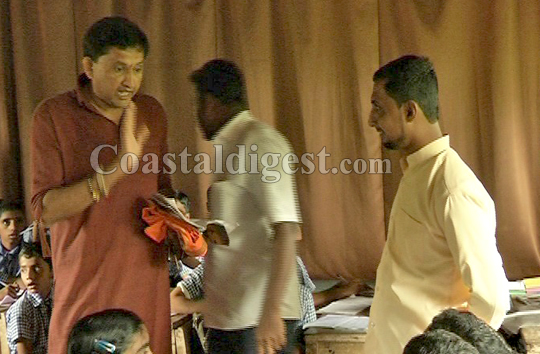
A group of Sri Ram Sena activists barged into a classroom of St. Thomas Aided Higher Primary School in Bondantila near Neermarga on Saturday.

While the activists alleged that students were forced to learn Arabic, the headmaster said that classes were being conducted for 40 students every Saturday on the request of parents. The headmaster had filed a complaint with the Mangaluru Rural police.

The police on Sunday arrested Nithin, Dinesh and Santhosh. On Monday they arrested Mukesh, Ravi, Chethan, Nithin, Kishore, Sunil, Nithin, Rajesh, Ravi, Raghavendra, Jayanth, Prakash, and Chandrahas. The police said a total of 17 persons had reportedly barged into the school and created a ruckus on Saturday.

Chief Whip of the Congress in the Legislative Council Ivan D'Souza condemned the act. In a statement, Mr. D'Souza said he has asked the city police to be tough against groups trying to disturb peace and tranquillity.

Mr. D'Souza visited the school and spoke to students and teachers. The Democratic Youth Federation of India and the Komu Souharda Vedike too have condemned the act.

Also Read:

Hindutva activists raid St Thomas school over Arabic class, videograph girls

Mangaluru: Three Sri Ram Sena activists arrested for attack on school

Comments

shaji
 - 
Tuesday, 2 Aug 2016

why only 15 terrorists arrested while 40 to 60 terrorists entered the school by force and threatened the teacher plus students. Let all be jailed under goonda act. Hate mongers should no sympathy. their place should be jail for ever. supporters of these terrorists should also be noted and arrested.

Rikaz
 - 
Tuesday, 2 Aug 2016

Learning Arabic is a best thing...I would request Hindu students too learn Arabic language, this will help them secure good job in Arab countries and its advantageous.

A. Mangalore
 - 
Tuesday, 2 Aug 2016

@ Kiran Rao, as you said they did not harm any one.
Just look at above picture. The tall SRS man entered class room while the teacher was teaching to his students. Is it right ?? 17 members ( not educated, illiterates) gang entering class room?

s
 - 
Tuesday, 2 Aug 2016

gonda act should be used against these anti-india elements.

Abdul Latif
 - 
Tuesday, 2 Aug 2016

anythng happend in India now this is very common

SYED
 - 
Tuesday, 2 Aug 2016

BELLARY IS THE RIGHT PLACE FOR THEM ....LET THEM ENJOY IN BELLARY JAIL WITH SPECIAL BEEF BIRIYANI....

Add new comment

  • Coastaldigest.com reserves the right to delete or block any comments.
  • Coastaldigset.com is not responsible for its readers’ comments.
  • Comments that are abusive, incendiary or irrelevant are strictly prohibited.
  • Please use a genuine email ID and provide your name to avoid reject.
coastaldigest.com news network
May 22,2020

It has been 33 years since the night of 22 May, 1987 when nearly 50 Muslim men from Hashimpura, a settlement in Meerut were rounded up and packed into the rear of a truck of the Provincial Armed Constabulary (PAC), an armed police of Uttar Pradesh. It was the blessed month of Ramadan and all the Muslims were fasting.

That night 42 of those on board the truck were killed in two massacres in neighbouring Ghaziabad district. One along the Upper Ganga canal near Muradnagar, the other along the Hindon canal in Makanpur, on the border with Delhi.

The cops had returned home after dumping the dead bodies into the canal. A few days later, the dead bodies were found floating in the canal and a case of murder was registered. 

Vir Bahadur Singh was the chief minister of Uttar Pradesh and Rajiv Gandhi was the prime minister of India when this incident took place. 

Not much has changed for the survivors and the relatives of the victims even today. The wounds are still fresh. Hashimpura remains devoid of basic municipal amenities, the erring silence on the narrow lanes of the locality amid the activities of a daily life speaks of the horror of the fateful day in 1987.

The massacre was the result of one among the many outcomes of the decision taken by the Rajiv Gandhi government to open the locks of Babri Masjid. After a month of rioting, the situation was tense in various parts of Meerut, and a lot spilled over in the nearby areas.

Timeline

May 22, 1987

Nearly 50 Muslims picked up by the PAC personnel from Hashimpura village in Meerut, Uttar Pradesh.
Victims later shot and bodies thrown into a canal. 42 persons declared dead.

1988

UP government orders CB-CID probe in the case.

February 1994

CB-CID submits inquiry report indicting over 60 PAC and police personnel of all ranks.

May 20, 1996

Charge sheet filed against 19 accused before Chief Judicial Magistrate, Ghaziabad by CB-CID of Uttar Pradesh police. 161 people listed as witnesses.

September 2002

Case transferred to Delhi by the Supreme Court on a petition by the families of victims and survivors.

July 2006

Delhi court frames charges of murder, attempt to murder, tampering with evidence and conspiracy under the IPC against 17 accused.

March 8, 2013

Trial court dismisses Subramanian Swamy's plea seeking probe into the alleged role of P Chidambaram, then Minister of State for Home, in the matter.

January 22, 2015

Trial court reserves judgement.

March 21, 2015

Court acquits 16 surviving accused giving them benefit of doubt regarding their identity.

May 18, 2015

Trial court decision challenged in the Delhi HC by the victims' families and eyewitnesses who survived the incident.

May 29, 2015

HC issues notice to the 16 PAC personnel on Uttar Pradesh government's appeal against the trial court verdict.

December 2015

National Human Rights Commission is impleaded in the matter. NHRC also seeks further probe into the massacre.

February 17, 2016

HC tags Swamy's appeal with the other petitions in the matter.

September 6, 2018

Delhi HC reserves verdict in the case.

October 31, 2018

Delhi HC convicts 16 former PAC personnel for life after finding them guilty of the murder of 42 people.

Comments

Add new comment

  • Coastaldigest.com reserves the right to delete or block any comments.
  • Coastaldigset.com is not responsible for its readers’ comments.
  • Comments that are abusive, incendiary or irrelevant are strictly prohibited.
  • Please use a genuine email ID and provide your name to avoid reject.
News Network
April 27,2020

Belgaum, Apr 27: A CRPF COBRA commando was thrashed and dragged to police station barefoot by police allegedly for violating lockdown norms here in Belgavi district.

Sachin Savant, the CRPF commando of 207 COBRA was arrested by police personnel of Sadalga Police Station on April 23 on the alleged charges of violating lockdown norms and assaulting/deterring public servant from discharging his duty. The incident took place when the commando was cleaning his motorcycle in front of his house at Examba.

Images of the jawan being tied up in chains and the video of the incident have created furore on social media.

Calling it an "unfortunate incident", CRPF Additional Director General (Operations) Sanjay Arora wrote to Karnataka DGP Praveen Sood.

"In an unfortunate incident, Ct Sachin Savant of 207 COBRA was arrested by police personnel of Sadalga Police Station, Distt Belagavi, on Apr 23, on the alleged charges of violating lockdown norms and assaulting/deterring public servant from discharging his duty. The individual was on extended leave and cleaning his motorcycle in front of his house, at Examba, when the incident took place," Arora said in a letter to DGP.

In the video of the incident, the commando is seen standing near a bike, while multiple police personnel indulge in a verbal spat with him. A police personnel can be seen repeatedly pushing and shoving the jawan. The commando retaliates after he was attacked with a lathi by the police.

"Reportedly, a skirmish had taken place between the COBRA commando and the Beat police personnel over wearing of a mask, following which he was manhandled and ill-treated, before his family members, and paraded to the police station barefoot, where he was kept in chains and handcuff," CRPF ADG said.

He said the viral video shows that police personnel's conduct was not "citizen-centric".
Stressing that this "unpleasant situation" could have been avoided, if the Karnataka police had taken CRPF hierarchy into confidence before making the arrest, he said: "CRPF is a very reputed force, with high standards of discipline, and we have the institutionalized mechanism for taking care of such situations."
Arora asked that Karnataka DGP to get the matter inquired and provide justice.

Meanwhile, CRPF spokesperson M Dhinakaran said the bail plea of the commando will be taken up in the court on Tuesday.

"We have taken up the case with State Police Chief of Karnataka. On Tuesday, his bail plea case is coming before the court. The CRPF will be in court through a local officer. Thereafter, an investigation into the matter shall be followed up to take it to the logical conclusion," said Dhinakaran.

Giving clarification on the matter, Belgavi Superintendent of Police told media that the CRPF jawan was found roaming with friends, who ran away on seeing police. However, the jawan was caught without a mask.

"The jawan was standing without wearing a mask. When policemen on duty asked him why he is not wearing a mask, he started arguing asking them who are you to ask and I am from CRPF, thereby violating the orders promulgated by DC," he said.

The SP also claimed that the jawan lost his cool and kicked the stomach of one of the constables.

"The jawan held the collar of the police constable and started pushing him aggressively. Another head constable, who is old, came to the rescue of his fellow colleague. Later the jawan was taken to the police station and a case was registered under various sections of IPC and Section 3 of Epidemic Disease Act against him," he said.

Comments

Add new comment

  • Coastaldigest.com reserves the right to delete or block any comments.
  • Coastaldigset.com is not responsible for its readers’ comments.
  • Comments that are abusive, incendiary or irrelevant are strictly prohibited.
  • Please use a genuine email ID and provide your name to avoid reject.
Ram Puniyani
February 4,2020

As democracy is seeping in slowly all over the world, there is an organization which is monitoring the degree of democracy in the individual countries, The Economist Intelligence Unit. As such in each country there are diverse factors which on one hand work to deepen it, while others weaken it. Overall there is a march from theoretical democracy to substantive one. The substantive democracy will herald not just the formal equality, freedom and community feeling in the country but will be founded on the substantive quality of these values. In India while the introduction of modern education, transport, communication laid the backdrop of beginning of the process, the direction towards deepening of the process begins with Mahatma Gandhi when he led the non-cooperation movement in 1920, in which average people participated. The movement of freedom for India went on to become the ‘greatest ever mass movement’ in the World.

The approval and standards for democracy were enshrined in Indian Constitution, which begins ‘We the people of India’, and was adopted on 26th January 1950. With this Constitution and the policies adopted by Nehru the process of democratization started seeping further, the dreaded Emergency in 1975, which was lifted later restored democratic freedoms in some degree. This process of democratisation is facing an opposition since the decade of 1990s after the launch of Ram Temple agitation, and has seen the further erosion with BJP led Government coming to power in 2014. The state has been proactively attacking civil liberties, pluralism and participative political culture with democracy becoming flawed in a serious way. And this is what got reflected in the slipping of India by ten places, to 51st, in 2019. On the index of democracy India slipped down from the score of 7.23 to 6.90. The impact of sectarian BJP politics is writ on the state of the nation, country.

Ironically this lowering of score has come at a time when the popular protests, the deepening of democracy has been given a boost and is picking up with the Shaheen Bagh protests. The protest which began in Shaheen Bagh, Delhi in the backdrop of this Government getting the Citizenship amendment Bill getting converted into an act and mercilessly attacking the students of Jamia Milia Islamia, Aligarh Muslim University along with high handed approach in Jamia Nagar and neighbouring areas.  From 15th December 2019, the laudable protest is on.

It is interesting to note that the lead in this protest has been taken by the Muslim women, from the Burqa-Hijab clad to ‘not looking Muslim’ women and was joined by students and youth from all the communities, and later by the people from all the communities. Interestingly this time around this Muslim women initiated protest has contrast from all the protests which earlier had begun by Muslims. The protests opposing Shah Bano Judgment, the protests opposing entry of women in Haji Ali, the protests opposing the Government move to abolish triple Talaq. So far the maulanas from top were initiating the protests, with beard and skull cap dominating the marches and protests. The protests were by and large for protecting Sharia, Islam and were restricted to Muslim community participating.

This time around while Narendra Modi pronounced that ‘protesters can be identified by their clothes’, those who can be identified by their external appearance are greatly outnumbered by all those identified or not identified by their appearance.

The protests are not to save Islam or any other religion but to protect Indian Constitution. The slogans are structured around ‘Defence of democracy and Indian Constitution’. The theme slogans are not Allahu Akbar’ or Nara-E-Tadbeer’ but around preamble of Indian Constitution. The lead songs have come to be Faiz Ahmad Faiz’s ‘Hum Dekhenge’, a protest against Zia Ul Haq’s attempts to crush democracy in the name of religion. Another leading protest song is from Varun Grover, ‘Tanashah Aayenge…Hum Kagaz nahin Dikhayenge’, a call to civil disobedience against the CAA-NRC exercise and characterising the dictatorial nature of the current ruling regime.

While BJP was telling us that primary problem of Muslim women is Triple talaq, the Muslim women led movements has articulated that primary problem is the very threat to Muslim community. All other communities, cutting across religious lines, those below poverty line, those landless and shelter less people also see that if the citizenship of Muslims can be threatened because of lack of some papers, they will be not far behind in the victimization process being unleashed by this Government.

While CAA-NRC has acted as the precipitating factor, the policies of Modi regime, starting from failure to fulfil the tall promises of bringing back black money, the cruel impact of demonetisation, the rising process of commodities, the rising unemployment, the divisive policies of the ruling dispensation are the base on which these protest movements are standing. The spread of the protest movement, spontaneous but having similar message is remarkable. Shaheen Bagh is no more just a physical space; it’s a symbol of resistance against the divisive policies, against the policies which are increasing the sufferings of poor workers, the farmers and the average sections of society.

What is clear is that as identity issues, emotive issues like Ram Temple, Cow Beef, Love Jihad and Ghar Wapasi aimed to divide the society, Shaheen Bagh is uniting the society like never before. The democratisation process which faced erosion is getting a boost through people coming together around the Preamble of Indian Constitution, singing of Jan Gan Man, waving of tricolour and upholding the national icons like Gandhi, Bhagat Singh, Ambedkar and Maulana Azad. One can feel the sentiments which built India; one can see the courage of people to protect what India’s freedom movement and Indian Constitution gave them.

Surely the communal forces are spreading canards and falsehood against the protests. As such these protests which is a solid foundation of our democracy. The spontaneity of the movement is a strength which needs to be channelized to uphold Indian Constitution and democratic ethos of our beloved country.

Comments

Add new comment

  • Coastaldigest.com reserves the right to delete or block any comments.
  • Coastaldigset.com is not responsible for its readers’ comments.
  • Comments that are abusive, incendiary or irrelevant are strictly prohibited.
  • Please use a genuine email ID and provide your name to avoid reject.