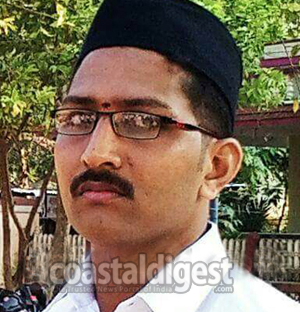
Mangaluru: 3 days after attack RSS activist loses fight for his life

CD Network
July 7, 2017

Mangaluru, Jul 7: Young activist of Rashtriya Swayamsevak Sangh, Sharat Madivala, who was brutally stabbed by unidentified miscreants last Tuesday, at B C Road in Bantwal taluk, breathed his last at a private hospital in Mangaluru on Friday evening after losing his nearly three-day long fight for life.sharath

The death came just hours after hundreds of Sangh Parivar activists staged a massive protest violating the prohibitory orders at BC Road to denounce the Tuesday’s attack. The saffron groups have now reportedly decided to hold a funeral rally on Saturday.

On Tuesday around 9.30pm, 28-year-old Sharat was attacked by a group of unidentified assailants when he was leaving for home after closing his shop.

The victim, a resident of Kandur, was operating a laundry service at BC Road. Police said that bike-borne miscreants assaulted him with lethal weapons between Kaikamba and BC Road Police Checkpoint. The victim had suffered serious injuries on head and neck.

Abdul Ravoof, a local resident with the help of another youth, had immediately taken the victim to a private hospital in Thumbey and later shifted to A J Hospital in Mangaluru. However, the victim did not respond to any treatment and died on Friday evening. More details are awaited.

stab3

Also Read: Another stabbing at B C Road sparks fresh tension in Bantwal taluk

Comments

Shahin
 - 
Monday, 10 Jul 2017

Alhamdulillah.. very fortune for mangaloreans, what I see is not many muslims make use of Islamic banks as may be it bacame a habit of using interest banks though they never take interests .. or these banks aren't reaching them .. or any other issue .. recently we planned to buy a flat with a interest loan of 10lakhs , but somewhere we felt like war against Allah ..We dropped it as it involved interest loan .. then suddenly it stroke to my head I can opt for an loan from Islamic bank.. was looking for interest free bank and I found this and same in bangalore as well... In shaa Allah..I hope these bank benefits people like me ..And all Muslims as well..Keeps them away from dealing with interest. May Allah safeguard us from this kind of grave sins

AK
 - 
Monday, 10 Jul 2017

ARE the Cheddi members so WEAK, that they need to be informed that Human life is more valuable than the COW?

Cheddi foot soldiers should use their intellect rather than depending on Cheddi orders and make cow as mother or not.

AK
 - 
Monday, 10 Jul 2017

SEE How Cheddi Foot Soldiers are used by the Cheddis... When they want, they make the CoW the mother. and foot soldiers are used to do violent in the society to protect cow.. and now they even cant control what they sow ...

When PUBLIC Wake up in the society even the cheddis who have 60% will also bow down to PUBLIC... People should note this stand and whenever someone trying to disrupt the society ... The whole like minded society should come together and speak for the truth and give justice...

Arshi
 - 
Monday, 10 Jul 2017

Spying, cheating, terrorism, looting is their RSS goons birth rights Kurshidji. Nothing can be done and they are digging their own grave.

Arshi
 - 
Monday, 10 Jul 2017

Simply spoiling their future along with others.. parents all efforts to bring them up went in vain because of the RSS terrorist activities.

Kannadiga
 - 
Monday, 10 Jul 2017

bol bachan by yaddi keep. . . lol

Holy cow
 - 
Sunday, 9 Jul 2017

Muslims must increase their eemaan to get the help of Allah. Remember 310 Muslims won war against thousands of kafirs. This is the type of help Allah will provide if we become mu'min. Forget this kafirs because Allah has given them the strength inorder to test us. That's it.

Holy cow
 - 
Sunday, 9 Jul 2017

This RSS is a real anti human group. Send all those chaddis to andaman nicobar islands

Kudla guy
 - 
Sunday, 9 Jul 2017

They all belongs to sri rama sene and all from criminal background, put them behind bar for 2 years

Mohd umair
 - 
Sunday, 9 Jul 2017

Ek baar haji walo ki khidmat ke liye hame bhi mauka diya jaye aur isi bhane allah ke ghar ki ziyarat bhi ho jayegi

Add new comment

  • Coastaldigest.com reserves the right to delete or block any comments.
  • Coastaldigset.com is not responsible for its readers’ comments.
  • Comments that are abusive, incendiary or irrelevant are strictly prohibited.
  • Please use a genuine email ID and provide your name to avoid reject.
News Network
January 14,2020

Bengaluru, Jan 14: A woman has sustained burns on the left hand and the left chest in a vicious acid attack that occurred as she walked home in Mallappa Layout, Seegehalli, near KR Puram in Bengaluru.

Prabhavathi, the victim, and her husband, Radhakrishna Reddy, own an acre and six guntas of land in Seegehalli. They had constructed 20 houses on the parcel and rented them while keeping the rest of the land empty and building a boundary wall around it, according to a senior police officer. 

Four men named Ravi, Kumar, Ashirvadam and Shekar laid claim to the land and demolished the boundary wall two years ago. When the couple approached the cops, Manjunath, a sub-inspector from KR Puram police station, visited the spot along with other officers and allegedly abused Reddy and his family. 

Reddy then approached a senior police officer who suggested that he file a complaint against the sub-inspector as well as his rivals for threatening the family. The case is pending in a case. 

On January 7, Ravi, along with four others — Raghu, Kabalan, Ashrivadam and Munireddy — mocked Prabhavathi as she walked home. They asked her to withdraw the complaint. When she ignored them, one of the men motioned to another person. In a flash, a man in the group threw acid on Prabhavathi. The liquid fell on her left hand and left chest, gashing them. Her screams drew her family who rushed her to a hospital. 

Reddy said the suspects had been intimidating them to sell the remaining land. He accused the KR Puram sub-inspector of “threatening” the family.

According to Reddy, following their complaint, a departmental enquiry was launched against the sub-inspector and his promotion was stalled. He suggested that the suspects had used the acid attack as a weapon to “silence” and force them into withdrawing the complaints. 

Following the acid attack, KR Puram police booked eight people — Ravi, Raghu, Kabalan, Ashirvadam, Munireddy, Sachin, Rahul, and Kumareshan — under IPC sections 326 (a) (acid attack) and 506 (criminal intimidation). Efforts are on to track them down. 

Comments

Add new comment

  • Coastaldigest.com reserves the right to delete or block any comments.
  • Coastaldigset.com is not responsible for its readers’ comments.
  • Comments that are abusive, incendiary or irrelevant are strictly prohibited.
  • Please use a genuine email ID and provide your name to avoid reject.
News Network
April 2,2020

The current physical distancing guidelines provided by the World Health Organisation (WHO) and by the US Centers for Disease Control and Prevention (CDC) may not be adequate to curb the coronavirus spread, according to a research which says the gas cloud from a cough or sneeze may help virus particles travel up to 8 metres. The research, published in the Journal of the American Medical Association, noted that the the current guidelines issued by the WHO and CDC are based on outdated models from the 1930s of how gas clouds from a cough, sneeze, or exhalation spread.

Study author, MIT associate professor Lydia Bourouiba, warned that droplets of all sizes can travel 23 to 27 feet, or 7-8 metres, carrying the pathogen.

According to Bourouiba, the current guidelines are based on "arbitrary" assumptions of droplet size, "overly simplified", and "may limit the effectiveness of the proposed interventions" against the deadly pandemic.

 She explained that the old guidelines assume droplets to be one of two categories, small or large, taking short-range semi-ballistic trajectories when a person exhales, coughs, or sneezes.

However based on more recent discoveries, the MIT scientist said, sneezes and coughs are made of a puff cloud that carries ambient air, transporting within it clusters of droplets of a wide range of sizes.

Bourouiba warned that this puff cloud, with ambient air entrapped in it, can offer the droplets moisture and warmth that can prevent it from evaporation in the outer environment.

"The locally moist and warm atmosphere within the turbulent gas cloud allows the contained droplets to evade evaporation for much longer than occurs with isolated droplets," she said.

"Under these conditions, the lifetime of a droplet could be considerably extended by a factor of up to 1000, from a fraction of a second to minutes," the researcher explained in the study.

The MIT scientist, who has researched the dynamics of coughs and sneezes for years, added that these droplets settle along the trajectory of a cough or sneeze contaminating surfaces, with their residues staying suspended in the air for hours.

"Even when maximum containment policies were enforced, the rapid international spread of COVID-19 suggests that using arbitrary droplet size cutoffs may not accurately reflect what actually occurs with respiratory emissions, possibly contributing to the ineffectiveness of some procedures used to limit the spread of respiratory disease," Bourouiba wrote in the study

Comments

Add new comment

  • Coastaldigest.com reserves the right to delete or block any comments.
  • Coastaldigset.com is not responsible for its readers’ comments.
  • Comments that are abusive, incendiary or irrelevant are strictly prohibited.
  • Please use a genuine email ID and provide your name to avoid reject.
Agencies
May 8,2020

Washington D.C., May 8: The prime time for brain development in a child's life is the first year, where the infant spends most of the time asleep. It is the time when neural connections form and sensory memories are encoded.

However, when sleep is disrupted, as occurs more often among children with autism, brain development may be affected, too.

New research led by the University of Washington finds that sleep problems in a baby's first 12 months may not only precede an autism diagnosis but also may be associated with altered growth trajectory in a key part of the brain, the hippocampus.

The study, which was published in the American Journal of Psychiatry, researchers report that in a sample of more than 400 taken of 6- to 12-month-old infants, those who were later diagnosed with autism were more likely to have had difficulty falling asleep.

It also states that this sleep difficulty was associated with altered growth trajectories in the hippocampus.

"The hippocampus is critical for learning and memory, and changes in the size of the hippocampus have been associated with poor sleep in adults and older children.

As many as 80 per cent of the children with autism spectrum disorder have sleep problems," said Annette Estes, director of the UW Autism Center and senior author of the study.

"In our clinical experience, parents have a lot of concerns about their children's sleep, and in our work on early autism intervention, we observed that sleep problems were holding children and families back," added Estes, who is also a UW professor of speech and hearing sciences.

"It could be that altered sleep is part-and-parcel of autism for some children. One clue is that behavioural interventions to improve sleep don't work for all children with autism, even when their parents are doing everything just right. This suggests that there may be a biological component to sleep problems for some children with autism," said Estes.

To consider links among sleep, brain development, and autism, researchers at the IBIS Network looked at MRI scans of 432 infants, surveyed parents about sleep patterns, and measured cognitive functioning using a standardized assessment.

At the outset of the study, infants were classified according to their risk for developing autism: Those who were at higher risk of developing autism -- about two-thirds of the study sample -- had an older sibling who had already been diagnosed.

Infant siblings of children with autism have a 20 per cent chance of developing autism spectrum disorder -- a much higher risk than children in the general population.

In the current study, 127 of the 432 infants were identified as "low risk" at the time the MRI scans were taken because they had no family history of autism.

They later evaluated all the participants at 24 months of age to determine whether they had developed autism. Of the roughly 300 children originally considered "high familial risk," 71 were diagnosed with autism spectrum disorder at that age.

Problems with sleep were more common among the infants later diagnosed with an autism spectrum disorder, as were larger hippocampi. No other subcortical brain structures were affected, including the amygdala, which is responsible for certain emotions and aspects of memory, or the thalamus, a signal transmitter from the spinal cord to the cerebral cortex.

The authors note that while parents reported more sleep difficulties among infants who developed autism compared to those who did not, the differences were very subtle and only observed when looking at group averages across hundreds of infants.

Sleep patterns in the first years of life change rapidly as infants transition from sleeping around the clock to a more adult-like sleep/wake cycle. Until further research is completed, Estes said, it is not possible to interpret challenges with sleep as an early sign of increased risk for autism.


Comments

Add new comment

  • Coastaldigest.com reserves the right to delete or block any comments.
  • Coastaldigset.com is not responsible for its readers’ comments.
  • Comments that are abusive, incendiary or irrelevant are strictly prohibited.
  • Please use a genuine email ID and provide your name to avoid reject.