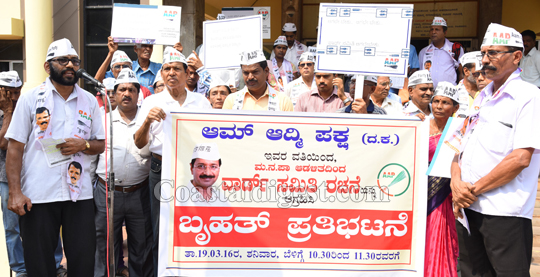
Mangaluru: AAP protesters ask MCC to form ward committees

[email protected] (CD Network | Photos by Suresh, Chakravarthi)
March 19, 2016

Mangaluru, Mar 19: Reminding the Mangaluru City Corporation office on its obligation to form ward committees, activists of the Aam Aadmi Party (AAP) staged a protest outside its office on Saturday.

AAP 2

They shouted slogans against the civic body for failing to constitute the committees.

They questioned the intention of the corporation and councillors who were hesitating to form the committees as required by the law.

They said that probably the councillors were scared that the formation of the committees would take away their importance and it would strengthen the civil society members in wards.

The activists said that though the council secretary of the corporation in a letter to the party mentioned that a three-member House committee with Lancelo Pinto (chairman), A.C. Vinayraj and Naveenchandra K. (members) had been constituted to take a decision, the letter did not mention anything about the decision taken by the committee.

The party on October 7, 2014, submitted a memorandum to the Urban Development Minister Vinay Kumar Sorake to constitute the committees.

AAP 1

aam admi

Comments

Add new comment

  • Coastaldigest.com reserves the right to delete or block any comments.
  • Coastaldigset.com is not responsible for its readers’ comments.
  • Comments that are abusive, incendiary or irrelevant are strictly prohibited.
  • Please use a genuine email ID and provide your name to avoid reject.
Agencies
May 8,2020

Washington D.C., May 8: The prime time for brain development in a child's life is the first year, where the infant spends most of the time asleep. It is the time when neural connections form and sensory memories are encoded.

However, when sleep is disrupted, as occurs more often among children with autism, brain development may be affected, too.

New research led by the University of Washington finds that sleep problems in a baby's first 12 months may not only precede an autism diagnosis but also may be associated with altered growth trajectory in a key part of the brain, the hippocampus.

The study, which was published in the American Journal of Psychiatry, researchers report that in a sample of more than 400 taken of 6- to 12-month-old infants, those who were later diagnosed with autism were more likely to have had difficulty falling asleep.

It also states that this sleep difficulty was associated with altered growth trajectories in the hippocampus.

"The hippocampus is critical for learning and memory, and changes in the size of the hippocampus have been associated with poor sleep in adults and older children.

As many as 80 per cent of the children with autism spectrum disorder have sleep problems," said Annette Estes, director of the UW Autism Center and senior author of the study.

"In our clinical experience, parents have a lot of concerns about their children's sleep, and in our work on early autism intervention, we observed that sleep problems were holding children and families back," added Estes, who is also a UW professor of speech and hearing sciences.

"It could be that altered sleep is part-and-parcel of autism for some children. One clue is that behavioural interventions to improve sleep don't work for all children with autism, even when their parents are doing everything just right. This suggests that there may be a biological component to sleep problems for some children with autism," said Estes.

To consider links among sleep, brain development, and autism, researchers at the IBIS Network looked at MRI scans of 432 infants, surveyed parents about sleep patterns, and measured cognitive functioning using a standardized assessment.

At the outset of the study, infants were classified according to their risk for developing autism: Those who were at higher risk of developing autism -- about two-thirds of the study sample -- had an older sibling who had already been diagnosed.

Infant siblings of children with autism have a 20 per cent chance of developing autism spectrum disorder -- a much higher risk than children in the general population.

In the current study, 127 of the 432 infants were identified as "low risk" at the time the MRI scans were taken because they had no family history of autism.

They later evaluated all the participants at 24 months of age to determine whether they had developed autism. Of the roughly 300 children originally considered "high familial risk," 71 were diagnosed with autism spectrum disorder at that age.

Problems with sleep were more common among the infants later diagnosed with an autism spectrum disorder, as were larger hippocampi. No other subcortical brain structures were affected, including the amygdala, which is responsible for certain emotions and aspects of memory, or the thalamus, a signal transmitter from the spinal cord to the cerebral cortex.

The authors note that while parents reported more sleep difficulties among infants who developed autism compared to those who did not, the differences were very subtle and only observed when looking at group averages across hundreds of infants.

Sleep patterns in the first years of life change rapidly as infants transition from sleeping around the clock to a more adult-like sleep/wake cycle. Until further research is completed, Estes said, it is not possible to interpret challenges with sleep as an early sign of increased risk for autism.


Comments

Add new comment

  • Coastaldigest.com reserves the right to delete or block any comments.
  • Coastaldigset.com is not responsible for its readers’ comments.
  • Comments that are abusive, incendiary or irrelevant are strictly prohibited.
  • Please use a genuine email ID and provide your name to avoid reject.
News Network
March 19,2020

Bengaluru, Mar 19: To better enforce social distancing and prevent further spread of Covid-19, the Karnataka health and family welfare department on Wednesday said it will "stamp the back of the palm" of international passengers advised to be on home quarantine, along with the date they are allowed to get out of home. The stamping process began at 12am Thursday.

Pankaj Kumar Pandey, commissioner, health and family welfare, said: "It is noted that a few passengers under home quarantine are not following the instructions. Therefore, it has been decided to stamp the back of the palm of their left hand with a specially designed stamp which will indicate the last day of quarantine."

He said the special stamp will use an indelible ink and "airports in Karnataka have been instructed to follow this without fail". On average, about 3,000 people are arriving in Bengaluru on international flights every day.

The department said social distancing is the only known method of combating the spread of Covid-19 and added, "International passengers are segregated as symptomatic and asymptomatic."

High-risk flyers kept at mass quarantine unit

The symptomatic passengers (Group-A) are taken to designated hospitals; asymptomatic ones, depending on the port of origin, are taken to the quarantine centre or permitted to go on home quarantine.

At the mass quarantine centre, the asymptomatic passengers are divided into moderate-risk (Group-B) and high-risk (Group-C) categories.

“The high-risk passengers are kept at a mass quarantine centre for medical observation. The moderate-risk passengers are being sent for home quarantine where they need to spend 14 days,” the statement added.

Pandey said: “International passengers changing flights within the country cannot be stopped. Ideally, they should be stamped at the first port of entry when they arrive from a foreign country which is not happening.” He said this issue will be brought to the notice of the Directorate-General of Civil Aviation.

Comments

Add new comment

  • Coastaldigest.com reserves the right to delete or block any comments.
  • Coastaldigset.com is not responsible for its readers’ comments.
  • Comments that are abusive, incendiary or irrelevant are strictly prohibited.
  • Please use a genuine email ID and provide your name to avoid reject.
News Network
February 2,2020

Thrissur, Feb 2: The Kerala government on Saturday said the condition of the medical student, kept in an isolation ward in Thrissur after testing positive for the novel coronavirus is satisfactory and that three people have been arrested for spreading false information on social media about the disease.

The woman, who tested positive, is a student of Wuhan university and is undergoing treatment at the Thrissur Medical College Hospital.

"The health status of the student who tested positive for coronavirus remains satisfactory.

The hospital authorities have confirmed that the health condition of all symptomatic persons under isolation in hospitals are "stable", a bulletin said.

Health Minister K K Shailaja said Kerala has strengthened surveillance and control measures against the epidemic, which has been declared by WHO as a global emergency,

She told reporters here that three people have been arrested for spreading false information about those who had arrived in the state from coronavirusa affected countries and are under home surveillance.

Six others had forwarded the posts and the cyber cell was probing the matter, Shailaja said.

The minister had earlier warned that strong action would be taken against those putting out false news on the disease.

Police said Sabari was arrested on Friday and released on bail, while two others-- Shafi and Siraj were arrested on Saturday.

Two cases have been registered in two police stations in Thrissur in this connection, they said.

A medical bulletin said that till date, 1793 people who travelled from coronavirus affected countries have been identified and placed under surveillance.

Comments

Add new comment

  • Coastaldigest.com reserves the right to delete or block any comments.
  • Coastaldigset.com is not responsible for its readers’ comments.
  • Comments that are abusive, incendiary or irrelevant are strictly prohibited.
  • Please use a genuine email ID and provide your name to avoid reject.