Mangaluru: ABVP agitators slam govt; demand action against anti-nationals'

[email protected] (CD Network | Chakravarthi, Suresh)
August 17, 2016

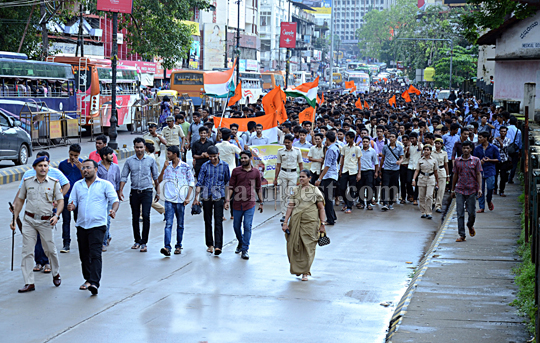
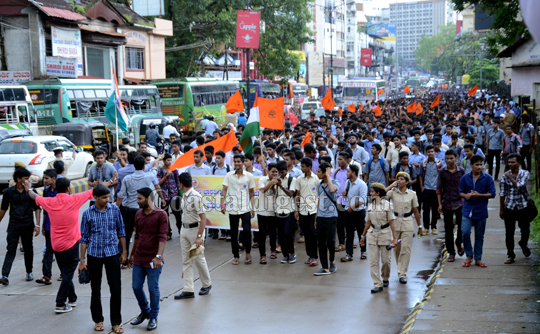
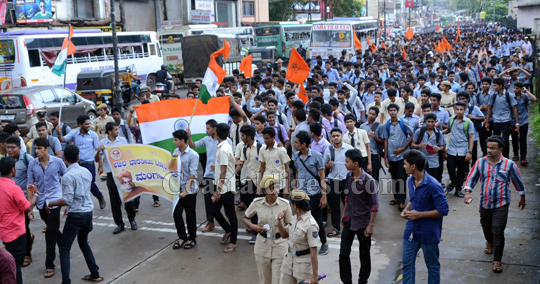
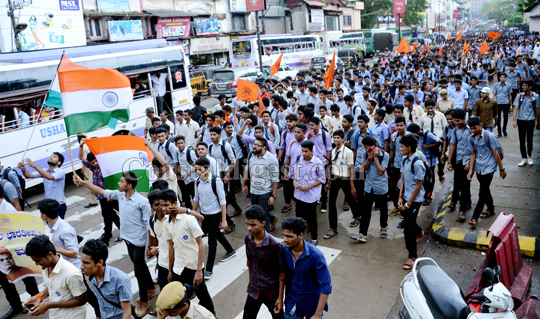
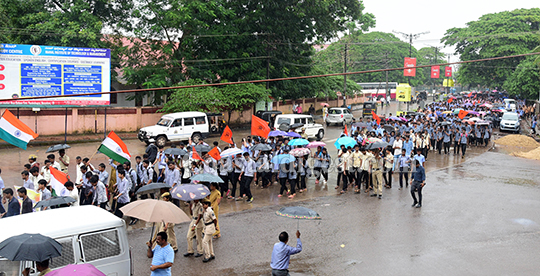
Mangaluru, Aug 17: Hundreds of ABVP activists on Wednesday staged a demonstration in the city in protest against alleged anti-India slogans raised at a function in Bengaluru last week.

abvp 2

Slogans were allegedly raised at a programme organized at the United Theosophical College where action of Indian Army in the Kashmir valley was criticized, especially the killing of Burhan Wani, who allegedly had links with the Hizbul Mujahideen.

Students from different colleges in Mangaluru gathered at Ambedkar Circle and then marched towards Hamilton Circle near state bank bus terminus were a protest meeting was held.

Speaking on the occasion, ABVP District Convenor Naveen said that by hailing Burhan Wani as martyr the organisers of the event insulted the soldiers of the Indian Army who laid down the lives fighting for the nation.

The state government must derecognize both Amnesty International (AI), organisers of the programme and United Theosophical College for allowing AI to hold such a program under Sedition laws, he said.

He also condemned the State government for the baton charge against ABVP agitators in Bengaluru. “Instead of inquiring into the complaint of raising anti-national slogans, the State government allowed police to chase away protesting ABVP activists in Bengaluru,” he said.

ABVP Mangaluru Taluk Convenor Sudhip Shetty said State government has to be cautious of groups in Bengaluru that are speaking against the nation and the Army.

He alleged that by trying to project the Indian Army, which according to him was trying to curb terror activities in Jammu and Kashmir, in bad light, the organisers had indulged in anti-national activities.

They sought the immediate arrest of those who reportedly raised Pro-Pakistan slogans' during the programme.

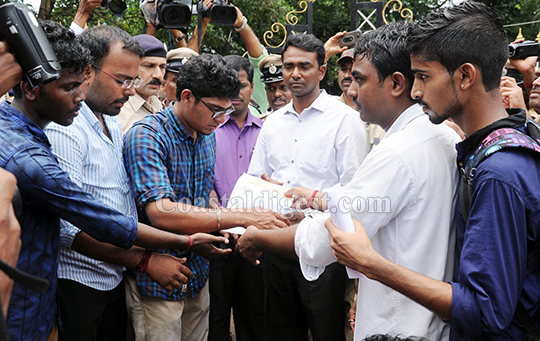
The agitators warned that they would not disperse until the Deputy Commissioner K.G. Jagadeesha personally receive their memorandum. Around noon, Mr. Jagadeesha received the memorandum and said it will be forwarded to Governor Vajubhai Vala.


abvp 1

abvp 3

ABVP 1

ABVP 2

ABVP 3

ABVP 4

ABVP 5

ABVP 6

abvp protest 5

abvp protest 3

AbvpP 1

AbvpP 2

Comments

ahmed
 - 
Thursday, 18 Aug 2016

BANN ABVP from college campus..student coming for education purpose not to learn chaddisim ...

Rikaz
 - 
Wednesday, 17 Aug 2016

Joke of the day......anti nationals calling for action....

SYED
 - 
Wednesday, 17 Aug 2016

STUDENT WING LIKE ABVP IS VERY DANGEROUS TO THIS COUNTRY....

Natasha
 - 
Wednesday, 17 Aug 2016

WTF!
Biggest anti-nationals are the members of monkey brigade.

Viren Kotian
 - 
Wednesday, 17 Aug 2016

Good coverage by CD. Thanks for supporting in the cause of nationalism. Keep it up.

Add new comment

  • Coastaldigest.com reserves the right to delete or block any comments.
  • Coastaldigset.com is not responsible for its readers’ comments.
  • Comments that are abusive, incendiary or irrelevant are strictly prohibited.
  • Please use a genuine email ID and provide your name to avoid reject.
coastaldigest.com news network
May 30,2020

Mangaluru, May 30: Accusing the chief minister B S Yediyurappa led Karnataka government of ignoring frontline warriors against covid-19, Mangaluru MLA U T Khader has demanded immediate release of pending salaries of doctors, lab technicians and nurses hired under the National Health Mission.

Addressing a press conference in the city today, the former minister said that Congress would launch an agitation if the government fails to release the amount immediately.

The non-payment of salaries clearly shows that the government has no concern for the COVID-19 warriors who are serving on a contract basis for two months, he said.

Mr Khader said there are 23,000 personnel hired under the National Health Mission in Karnataka including 600 in Dakshina Kannada district alone.  All of them are waiting for their salaries for the last two months.

“Asha workers were also partially paid for the month of April. If the government had concern towards COVID-19 warriors, they would have paid extra for the doctors, nurses, and other workers who are working tirelessly in the fight against COVID-19 at the grassroots level,” he added.

Comments

Add new comment

  • Coastaldigest.com reserves the right to delete or block any comments.
  • Coastaldigset.com is not responsible for its readers’ comments.
  • Comments that are abusive, incendiary or irrelevant are strictly prohibited.
  • Please use a genuine email ID and provide your name to avoid reject.
coastaldigest.com news network
July 20,2020

Lucknow, Jul 20: Dr Azizuddin Sheikh, who was fighting COVID-19 as a front line worker, passed away after contracting coronavirus in Uttar Pradesh. He is survived by a wife and three small children. 

40-year-old Dr Azizuddin, who hailed from Rajasthan, was serving as a paediatrician at Avanti Bai Hospital and Duffein Hospital, Lucknow for past few years. He had also worked in the Middle Eastern countries. 

When a large number of doctors preferred to stay home following the covid-19 outbreak, Dr Azizudin was working 16 to 17 hours battling the pandemic. 

According to sources, he tested positive for the covid-19 last month. “After the reports came positive, he had to call the concerned authorities many times to take him to the hospital,” recalled his family members.

He was first admitted to Lok Bandhu Hospital and was later shifted to KGMU after his condition deteriorated. Later he was taken to SGPGIMS.
 
“Despite following all the guidelines and taking every precaution while treating coronavirus patients, he tested positive for the covid-19. It’s a shock for all of us,” he said.

He used to console his family members and instill confidence among them, said one of his relatives. 

A local newspaper quoted his friends as saying that he was very dedicated in serving people that he used to take minimal possible fees from his patients. When the family asked him to increase consultation fees his reply would be, “They are poor people, how will they afford”?

After his death, one of his patients Alok Singh wrote about an incident. “When I asked doctor Sahib why he charges so less, his answer was I have to answer Allah. The truth that he has left us will always be the reason for our grief.”

Comments

Add new comment

  • Coastaldigest.com reserves the right to delete or block any comments.
  • Coastaldigset.com is not responsible for its readers’ comments.
  • Comments that are abusive, incendiary or irrelevant are strictly prohibited.
  • Please use a genuine email ID and provide your name to avoid reject.
Agencies
May 8,2020

Washington D.C., May 8: The prime time for brain development in a child's life is the first year, where the infant spends most of the time asleep. It is the time when neural connections form and sensory memories are encoded.

However, when sleep is disrupted, as occurs more often among children with autism, brain development may be affected, too.

New research led by the University of Washington finds that sleep problems in a baby's first 12 months may not only precede an autism diagnosis but also may be associated with altered growth trajectory in a key part of the brain, the hippocampus.

The study, which was published in the American Journal of Psychiatry, researchers report that in a sample of more than 400 taken of 6- to 12-month-old infants, those who were later diagnosed with autism were more likely to have had difficulty falling asleep.

It also states that this sleep difficulty was associated with altered growth trajectories in the hippocampus.

"The hippocampus is critical for learning and memory, and changes in the size of the hippocampus have been associated with poor sleep in adults and older children.

As many as 80 per cent of the children with autism spectrum disorder have sleep problems," said Annette Estes, director of the UW Autism Center and senior author of the study.

"In our clinical experience, parents have a lot of concerns about their children's sleep, and in our work on early autism intervention, we observed that sleep problems were holding children and families back," added Estes, who is also a UW professor of speech and hearing sciences.

"It could be that altered sleep is part-and-parcel of autism for some children. One clue is that behavioural interventions to improve sleep don't work for all children with autism, even when their parents are doing everything just right. This suggests that there may be a biological component to sleep problems for some children with autism," said Estes.

To consider links among sleep, brain development, and autism, researchers at the IBIS Network looked at MRI scans of 432 infants, surveyed parents about sleep patterns, and measured cognitive functioning using a standardized assessment.

At the outset of the study, infants were classified according to their risk for developing autism: Those who were at higher risk of developing autism -- about two-thirds of the study sample -- had an older sibling who had already been diagnosed.

Infant siblings of children with autism have a 20 per cent chance of developing autism spectrum disorder -- a much higher risk than children in the general population.

In the current study, 127 of the 432 infants were identified as "low risk" at the time the MRI scans were taken because they had no family history of autism.

They later evaluated all the participants at 24 months of age to determine whether they had developed autism. Of the roughly 300 children originally considered "high familial risk," 71 were diagnosed with autism spectrum disorder at that age.

Problems with sleep were more common among the infants later diagnosed with an autism spectrum disorder, as were larger hippocampi. No other subcortical brain structures were affected, including the amygdala, which is responsible for certain emotions and aspects of memory, or the thalamus, a signal transmitter from the spinal cord to the cerebral cortex.

The authors note that while parents reported more sleep difficulties among infants who developed autism compared to those who did not, the differences were very subtle and only observed when looking at group averages across hundreds of infants.

Sleep patterns in the first years of life change rapidly as infants transition from sleeping around the clock to a more adult-like sleep/wake cycle. Until further research is completed, Estes said, it is not possible to interpret challenges with sleep as an early sign of increased risk for autism.

Comments

Add new comment

  • Coastaldigest.com reserves the right to delete or block any comments.
  • Coastaldigset.com is not responsible for its readers’ comments.
  • Comments that are abusive, incendiary or irrelevant are strictly prohibited.
  • Please use a genuine email ID and provide your name to avoid reject.