Mangaluru to be open defecation free city by October 2

[email protected] (CD Network | Suresh)
July 20, 2016

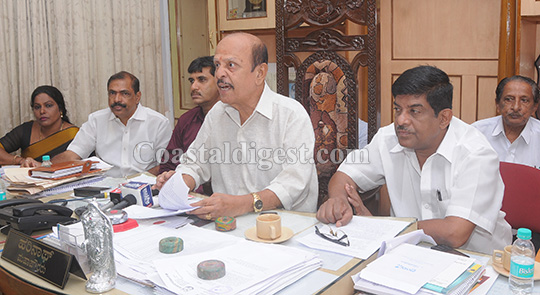
Mangaluru, Jul 20: The Mangaluru City Corporation (MCC) is moving towards declaring the city open defecation. According to Mayor Harinath all houses in the city will have toilets and new public toilets will come up in 34 locations by October 2 when the city will be formally declared open-defecation free.

meyar pm 2

Mr Harinath told presspersons here on Wednesday that as per a survey carried out in May 2015, there were 339 houses in the city which did not have toilets.

Grants were being given to these residents to construct toilets under the Swachh Bharath Mission. While around 10 wards would be declared open-defecation free on August 15, the whole city would be declared so on October 2, he said.

Mr. Harinath asked people, who did not have toilets for their houses, to approach the Mangaluru City Corporation for grants by August 13. He said they were yet to decide on the penal action to be taken against those seen defecating in the open after October 2.

Chairman of Standing Committee on Health, Kavita Sanil, said that corporation had identified places such as the City Central Market, Pumpwell Junction, Morgan's Gate, Urwa Stores, Kadri Junction and 29 other locations where new toilets would be constructed.

These toilets would be built and operated by private agencies and it would be in addition to the 21 existing ones. Those operating the existing pubic toilets had been directed to maintain them in a proper manner, she said.

Mr. Harinath said that Urban Development Minister R. Roshan Baig would lay the foundation stone for construction of a dining hall for the Town Hall on Sunday.

Mr. Baig would also launch the first phase of building market complexes in Alake and Kavoor. The Minister would inaugurate the work on improving Kavoor Junction.

He would inaugurate the new night shelter in Bunder area, which had been built at a cost of Rs. 99.8 lakh, Mr. Harinath said.

Comments

Ahmed
 - 
Thursday, 21 Jul 2016

Defecation ? First you build some toilets for urination please,

Add new comment

  • Coastaldigest.com reserves the right to delete or block any comments.
  • Coastaldigset.com is not responsible for its readers’ comments.
  • Comments that are abusive, incendiary or irrelevant are strictly prohibited.
  • Please use a genuine email ID and provide your name to avoid reject.
Agencies
January 26,2020

Thiruvananthapuram, Jan 26: Sister Lucy Kalappura, one of the nuns who protested against rape accused Bishop Franco Mulakkal, on Saturday claimed that she is being targeted at the convent and not being provided food.

Sister Lucy was dismissed from Franciscan Clarist congregation for supporting sisters protesting against the Bishop.

"I am being targeted at the convent and not being provided food. When I asked the reason, I was told I have been dismissed from the convent and they are not responsible for feeding me," said Sister Lucy while speaking to the reporters.

She has alleged that all this began after the release of her autobiography "Karthavinte Namathil" which means 'In the name of God'. In her book she had alleged sexual misconduct among priests and nuns.

"They prepare food and after having it they lock it in the cupboard. When I asked the reason behind this, they told me that I have been dismissed," said Sister Lucy.

"Now I am managing it all by myself with egg and tapioca that grows in the convent compound. Earlier they used to keep the leftover lunch and I used to adjust with that, but after my book was released, they started to lock the food in the cupboard," she added.

Sister Lucy also claimed that she had filed three complaints with the police on August 19, August 20 and on December 13. They had taken her statement but no action was taken.

"If the police would have taken some action against the convent authorities, they would not have behaved this way. An FIR was registered based on the three complaints but no action was taken. This gives them more power to act against me. I have drafted a letter to the Chief Minister to raise my complaint," said Sister Lucy.

Bishop Mulakkal, a senior member of the Roman Catholic clergy in India, was arrested in 2018 following allegations by a nun that he repeatedly raped and sexually assaulted her at Kuravilangad convent between 2014 and 2016, a charge that he denies.

Comments

Add new comment

  • Coastaldigest.com reserves the right to delete or block any comments.
  • Coastaldigset.com is not responsible for its readers’ comments.
  • Comments that are abusive, incendiary or irrelevant are strictly prohibited.
  • Please use a genuine email ID and provide your name to avoid reject.
Ram Puniyani
February 4,2020

As democracy is seeping in slowly all over the world, there is an organization which is monitoring the degree of democracy in the individual countries, The Economist Intelligence Unit. As such in each country there are diverse factors which on one hand work to deepen it, while others weaken it. Overall there is a march from theoretical democracy to substantive one. The substantive democracy will herald not just the formal equality, freedom and community feeling in the country but will be founded on the substantive quality of these values. In India while the introduction of modern education, transport, communication laid the backdrop of beginning of the process, the direction towards deepening of the process begins with Mahatma Gandhi when he led the non-cooperation movement in 1920, in which average people participated. The movement of freedom for India went on to become the ‘greatest ever mass movement’ in the World.

The approval and standards for democracy were enshrined in Indian Constitution, which begins ‘We the people of India’, and was adopted on 26th January 1950. With this Constitution and the policies adopted by Nehru the process of democratization started seeping further, the dreaded Emergency in 1975, which was lifted later restored democratic freedoms in some degree. This process of democratisation is facing an opposition since the decade of 1990s after the launch of Ram Temple agitation, and has seen the further erosion with BJP led Government coming to power in 2014. The state has been proactively attacking civil liberties, pluralism and participative political culture with democracy becoming flawed in a serious way. And this is what got reflected in the slipping of India by ten places, to 51st, in 2019. On the index of democracy India slipped down from the score of 7.23 to 6.90. The impact of sectarian BJP politics is writ on the state of the nation, country.

Ironically this lowering of score has come at a time when the popular protests, the deepening of democracy has been given a boost and is picking up with the Shaheen Bagh protests. The protest which began in Shaheen Bagh, Delhi in the backdrop of this Government getting the Citizenship amendment Bill getting converted into an act and mercilessly attacking the students of Jamia Milia Islamia, Aligarh Muslim University along with high handed approach in Jamia Nagar and neighbouring areas.  From 15th December 2019, the laudable protest is on.

It is interesting to note that the lead in this protest has been taken by the Muslim women, from the Burqa-Hijab clad to ‘not looking Muslim’ women and was joined by students and youth from all the communities, and later by the people from all the communities. Interestingly this time around this Muslim women initiated protest has contrast from all the protests which earlier had begun by Muslims. The protests opposing Shah Bano Judgment, the protests opposing entry of women in Haji Ali, the protests opposing the Government move to abolish triple Talaq. So far the maulanas from top were initiating the protests, with beard and skull cap dominating the marches and protests. The protests were by and large for protecting Sharia, Islam and were restricted to Muslim community participating.

This time around while Narendra Modi pronounced that ‘protesters can be identified by their clothes’, those who can be identified by their external appearance are greatly outnumbered by all those identified or not identified by their appearance.

The protests are not to save Islam or any other religion but to protect Indian Constitution. The slogans are structured around ‘Defence of democracy and Indian Constitution’. The theme slogans are not Allahu Akbar’ or Nara-E-Tadbeer’ but around preamble of Indian Constitution. The lead songs have come to be Faiz Ahmad Faiz’s ‘Hum Dekhenge’, a protest against Zia Ul Haq’s attempts to crush democracy in the name of religion. Another leading protest song is from Varun Grover, ‘Tanashah Aayenge…Hum Kagaz nahin Dikhayenge’, a call to civil disobedience against the CAA-NRC exercise and characterising the dictatorial nature of the current ruling regime.

While BJP was telling us that primary problem of Muslim women is Triple talaq, the Muslim women led movements has articulated that primary problem is the very threat to Muslim community. All other communities, cutting across religious lines, those below poverty line, those landless and shelter less people also see that if the citizenship of Muslims can be threatened because of lack of some papers, they will be not far behind in the victimization process being unleashed by this Government.

While CAA-NRC has acted as the precipitating factor, the policies of Modi regime, starting from failure to fulfil the tall promises of bringing back black money, the cruel impact of demonetisation, the rising process of commodities, the rising unemployment, the divisive policies of the ruling dispensation are the base on which these protest movements are standing. The spread of the protest movement, spontaneous but having similar message is remarkable. Shaheen Bagh is no more just a physical space; it’s a symbol of resistance against the divisive policies, against the policies which are increasing the sufferings of poor workers, the farmers and the average sections of society.

What is clear is that as identity issues, emotive issues like Ram Temple, Cow Beef, Love Jihad and Ghar Wapasi aimed to divide the society, Shaheen Bagh is uniting the society like never before. The democratisation process which faced erosion is getting a boost through people coming together around the Preamble of Indian Constitution, singing of Jan Gan Man, waving of tricolour and upholding the national icons like Gandhi, Bhagat Singh, Ambedkar and Maulana Azad. One can feel the sentiments which built India; one can see the courage of people to protect what India’s freedom movement and Indian Constitution gave them.

Surely the communal forces are spreading canards and falsehood against the protests. As such these protests which is a solid foundation of our democracy. The spontaneity of the movement is a strength which needs to be channelized to uphold Indian Constitution and democratic ethos of our beloved country.


Comments

Add new comment

  • Coastaldigest.com reserves the right to delete or block any comments.
  • Coastaldigset.com is not responsible for its readers’ comments.
  • Comments that are abusive, incendiary or irrelevant are strictly prohibited.
  • Please use a genuine email ID and provide your name to avoid reject.
News Network
March 12,2020

Bengaluru, Mar 12: Karnataka government on Wednesday issued a temporary regulation -- Karnataka Epidemic Diseases, COVID-19 Regulations, 2020 -- which aims to prevent the spread of the disease.

According to the regulation, all government and private hospitals should have flu corners for the screening of suspected cases of COVID-19.

All hospitals during the screening of such cases shall record the history of travel of the person if he or she has travelled to any country or area where COVID-19 has been reported in addition to the history of coming in contact with a suspected or confirmed case of COVID-19 shall be recorded.

Any person with a history of travel in the last 14 days to a country or area from where COVID-19 has been reported must report to the nearest government hospital or call at toll-free helpline number 104 so that necessary measures if required, may be initiated by the Department of Health and Family Welfare.

If a suspected case of COVID-19 refuses admission or isolation, the offices authorised under Section 3 of the regulation shall have powers to forcefully admit and isolate such case of a period of 14 days from the onset of symptoms or till the reports of lab tests are received, or such period as may be necessary.

No person, institution or organisation shall use print or electronic media to spread misinformation on COVID19. If a person is found indulging in any such activity, they will be punished.

If the cases of COVID-19 are reported from a defined geographic area, the district administration of the concerned district shall have the right to implement the following containment measures but not limited to these in order to prevent the spread of diseases:

* Sealing of geographic

* Barring of entry and exit of the population from the containment area

* Closure of schools, offices and banning public gathering

* Banning vehicular movement in the area

* Designating any government or private building as a containment unit for the isolation of cases

* The staff of all govt departments shall be at the disposal of the concerned district administration of the concerned area for discharging the duty of containment measures

Any person, institution or organisation found violating any of these regulations, shall be deemed to have committed an offence punishable under section 188 of the Indian Penal Code (IPC).

Comments

Add new comment

  • Coastaldigest.com reserves the right to delete or block any comments.
  • Coastaldigset.com is not responsible for its readers’ comments.
  • Comments that are abusive, incendiary or irrelevant are strictly prohibited.
  • Please use a genuine email ID and provide your name to avoid reject.