Mangaluru to be open defecation free city by October 2

[email protected] (CD Network | Suresh)
July 20, 2016

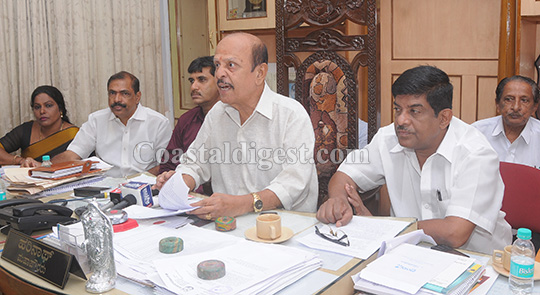
Mangaluru, Jul 20: The Mangaluru City Corporation (MCC) is moving towards declaring the city open defecation. According to Mayor Harinath all houses in the city will have toilets and new public toilets will come up in 34 locations by October 2 when the city will be formally declared open-defecation free.

meyar pm 2

Mr Harinath told presspersons here on Wednesday that as per a survey carried out in May 2015, there were 339 houses in the city which did not have toilets.

Grants were being given to these residents to construct toilets under the Swachh Bharath Mission. While around 10 wards would be declared open-defecation free on August 15, the whole city would be declared so on October 2, he said.

Mr. Harinath asked people, who did not have toilets for their houses, to approach the Mangaluru City Corporation for grants by August 13. He said they were yet to decide on the penal action to be taken against those seen defecating in the open after October 2.

Chairman of Standing Committee on Health, Kavita Sanil, said that corporation had identified places such as the City Central Market, Pumpwell Junction, Morgan's Gate, Urwa Stores, Kadri Junction and 29 other locations where new toilets would be constructed.

These toilets would be built and operated by private agencies and it would be in addition to the 21 existing ones. Those operating the existing pubic toilets had been directed to maintain them in a proper manner, she said.

Mr. Harinath said that Urban Development Minister R. Roshan Baig would lay the foundation stone for construction of a dining hall for the Town Hall on Sunday.

Mr. Baig would also launch the first phase of building market complexes in Alake and Kavoor. The Minister would inaugurate the work on improving Kavoor Junction.

He would inaugurate the new night shelter in Bunder area, which had been built at a cost of Rs. 99.8 lakh, Mr. Harinath said.

Comments

Ahmed
 - 
Thursday, 21 Jul 2016

Defecation ? First you build some toilets for urination please,

Add new comment

  • Coastaldigest.com reserves the right to delete or block any comments.
  • Coastaldigset.com is not responsible for its readers’ comments.
  • Comments that are abusive, incendiary or irrelevant are strictly prohibited.
  • Please use a genuine email ID and provide your name to avoid reject.
Agencies
May 8,2020

Washington D.C., May 8: The prime time for brain development in a child's life is the first year, where the infant spends most of the time asleep. It is the time when neural connections form and sensory memories are encoded.

However, when sleep is disrupted, as occurs more often among children with autism, brain development may be affected, too.

New research led by the University of Washington finds that sleep problems in a baby's first 12 months may not only precede an autism diagnosis but also may be associated with altered growth trajectory in a key part of the brain, the hippocampus.

The study, which was published in the American Journal of Psychiatry, researchers report that in a sample of more than 400 taken of 6- to 12-month-old infants, those who were later diagnosed with autism were more likely to have had difficulty falling asleep.

It also states that this sleep difficulty was associated with altered growth trajectories in the hippocampus.

"The hippocampus is critical for learning and memory, and changes in the size of the hippocampus have been associated with poor sleep in adults and older children.

As many as 80 per cent of the children with autism spectrum disorder have sleep problems," said Annette Estes, director of the UW Autism Center and senior author of the study.

"In our clinical experience, parents have a lot of concerns about their children's sleep, and in our work on early autism intervention, we observed that sleep problems were holding children and families back," added Estes, who is also a UW professor of speech and hearing sciences.

"It could be that altered sleep is part-and-parcel of autism for some children. One clue is that behavioural interventions to improve sleep don't work for all children with autism, even when their parents are doing everything just right. This suggests that there may be a biological component to sleep problems for some children with autism," said Estes.

To consider links among sleep, brain development, and autism, researchers at the IBIS Network looked at MRI scans of 432 infants, surveyed parents about sleep patterns, and measured cognitive functioning using a standardized assessment.

At the outset of the study, infants were classified according to their risk for developing autism: Those who were at higher risk of developing autism -- about two-thirds of the study sample -- had an older sibling who had already been diagnosed.

Infant siblings of children with autism have a 20 per cent chance of developing autism spectrum disorder -- a much higher risk than children in the general population.

In the current study, 127 of the 432 infants were identified as "low risk" at the time the MRI scans were taken because they had no family history of autism.

They later evaluated all the participants at 24 months of age to determine whether they had developed autism. Of the roughly 300 children originally considered "high familial risk," 71 were diagnosed with autism spectrum disorder at that age.

Problems with sleep were more common among the infants later diagnosed with an autism spectrum disorder, as were larger hippocampi. No other subcortical brain structures were affected, including the amygdala, which is responsible for certain emotions and aspects of memory, or the thalamus, a signal transmitter from the spinal cord to the cerebral cortex.

The authors note that while parents reported more sleep difficulties among infants who developed autism compared to those who did not, the differences were very subtle and only observed when looking at group averages across hundreds of infants.

Sleep patterns in the first years of life change rapidly as infants transition from sleeping around the clock to a more adult-like sleep/wake cycle. Until further research is completed, Estes said, it is not possible to interpret challenges with sleep as an early sign of increased risk for autism.


Comments

Add new comment

  • Coastaldigest.com reserves the right to delete or block any comments.
  • Coastaldigset.com is not responsible for its readers’ comments.
  • Comments that are abusive, incendiary or irrelevant are strictly prohibited.
  • Please use a genuine email ID and provide your name to avoid reject.
News Network
March 13,2020

Bengaluru, Mar 13: Google said on Friday that an employee at its Bengaluru office has tested positive for the COVID-19 coronavirus and the firm has directed all its employees in that office to work from home today as a precautionary measure.

"We can confirm that an employee from our Bangalore office has been diagnosed with COVID-19. They were in one of our Bangalore offices for a few hours before developing any symptoms. The employee has been on quarantine since then," Google said in a statement.

The firm has asked colleagues who were in close contact with the employee to quarantine themselves and monitor their health.

"Out of an abundance of caution, we are asking employees in that Bangalore office to work from home on Friday. We have taken and will continue to take all necessary precautionary measures, following the advice of public health officials, as we prioritize everyone's health and safety," it added.

The World Health Organisation (WHO) has declared the coronavirus outbreak a pandemic.

Coronavirus, which originated in the Wuhan city of China, has so far spread to more than 100 countries infecting over 1,20,000 people. India has confirmed 73 cases of the lethal infection.

Comments

Add new comment

  • Coastaldigest.com reserves the right to delete or block any comments.
  • Coastaldigset.com is not responsible for its readers’ comments.
  • Comments that are abusive, incendiary or irrelevant are strictly prohibited.
  • Please use a genuine email ID and provide your name to avoid reject.
News Network
January 31,2020

Jan 31: A bunch of fishermen in Kerala is being praised for releasing an endangered shark back into water. A video posted on Twitter shows the fishermen releasing the whale shark that was trapped in their nets back into the sea.

The video was posted on Twitter by InSeason Fish - a group working towards environmental conservation, sustainable fisheries and healthy oceans. Filmed in Kerala's Kozhikode, it shows fishermen on a fishing vessel with the huge whale shark.

Whale sharks are the largest fish in the ocean and can reach up to 40 feet in length. Distinguished by their white spots, this shark is on International Union for Conservation of Nature's list of endangered species.

In the video, at least seven fishermen are seen working together to lift the thrashing whale shark up with the help of ropes and releasing it into the water.

Watch the video below:

Comments

Add new comment

  • Coastaldigest.com reserves the right to delete or block any comments.
  • Coastaldigset.com is not responsible for its readers’ comments.
  • Comments that are abusive, incendiary or irrelevant are strictly prohibited.
  • Please use a genuine email ID and provide your name to avoid reject.