Mangaluru: Billava Sangha Kuwait holds scholarship and motivation programme

[email protected] (CD Network)
August 31, 2016

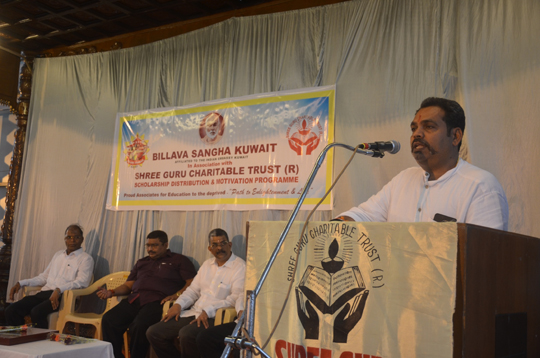
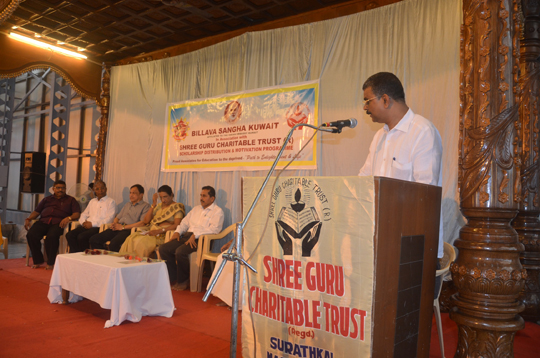
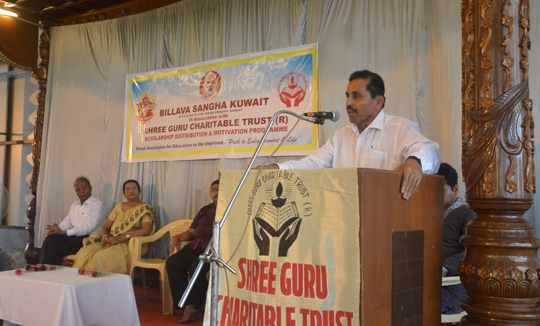
Mangaluru, Aug 31: Billava Sangha Kuwait in association with Shree Guru Charitable Trust, Mangaluru initiated Education Programme' from this year with scholarship distribution and motivation event held recently at Shri Vishvanatha Kalyana Mantapa (Glass House), Shri GokarnanathaKshetra, Kudroli, here.
bsk 4

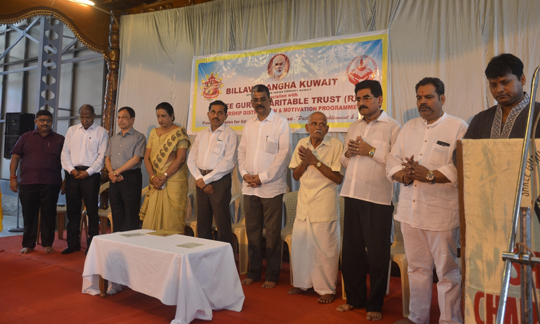
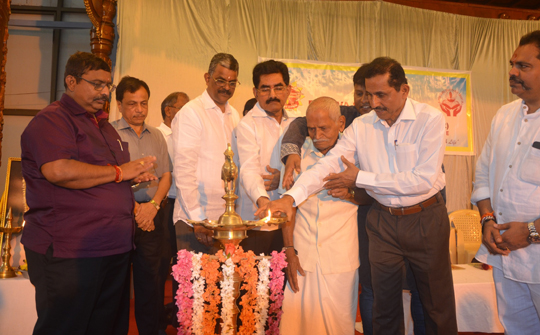
H. S. Sairam, President of the Shri Gokarnanatha Kshetra inaugurated the programme by lighting the lamp. Ganesh A Bangera, President of Shree Guru Charitable Trust presided over the function. Chandrasekhar Nanil, Vice President of Guru Charitable Trust welcomed the distinguished guests and the gathering. Greetings from JanardhanaPoojary and Sri Jaya Suvarnawas conveyed to the gathering and blessings to the students.

Sri Satish Kunder on behalf of the Billava Sangha Kuwait gave the insight of the activities of Billava Sangha Kuwait and how the motivated members of BSK worked hard to make this Education Programme a reality even though the organization is only 3 years into its inception. With the creation of strong base of associates and the univocal support, this programmecan continue to serve the community in a bigger way year after year. He also briefed though the Billava history and how the strong Billava community has become weak due to not involvement with the changes in the society and only education can take the community to their earlier status again.

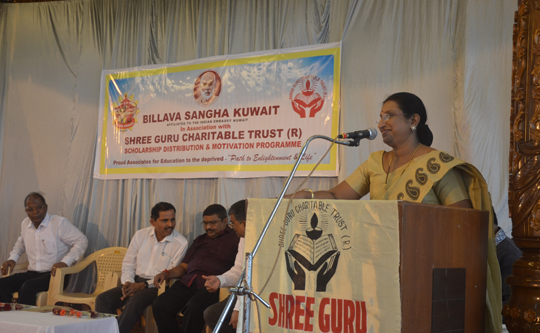
Dr Ramila Shekhar, Dean PG Department, Roshni Nilaya delivered the motivation speech for the students. She stressed the need for the children to be disciplined in their way of life and the motivation can come only from within. She asked the children to focused on their goal and evaluate their actions on day to day basis. She said the children are full of energy and needs to put it into action in shaping their life.

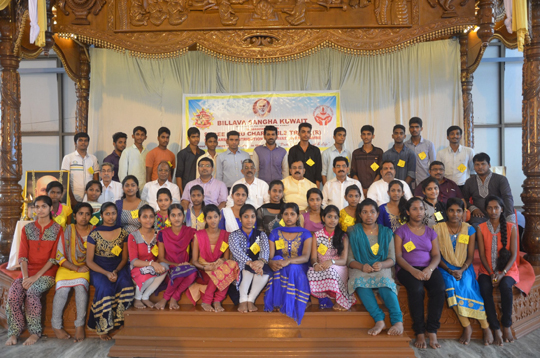
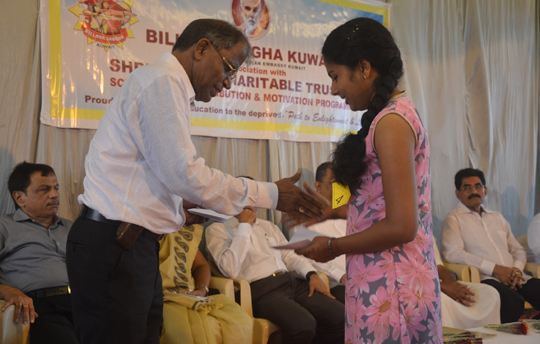
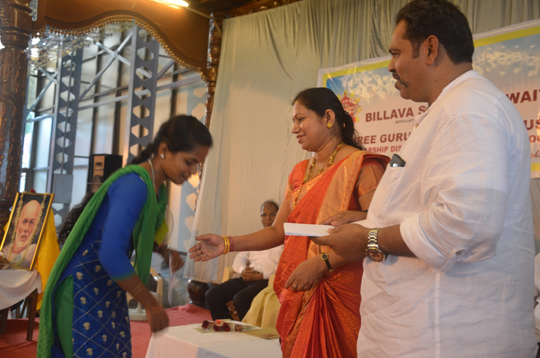
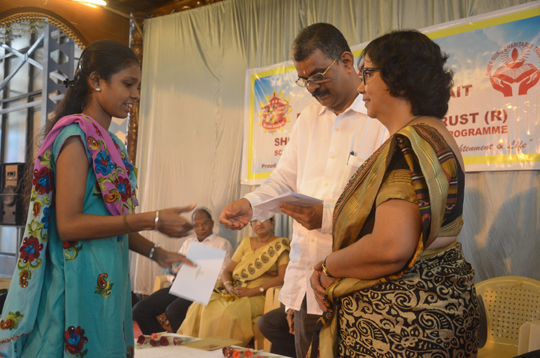
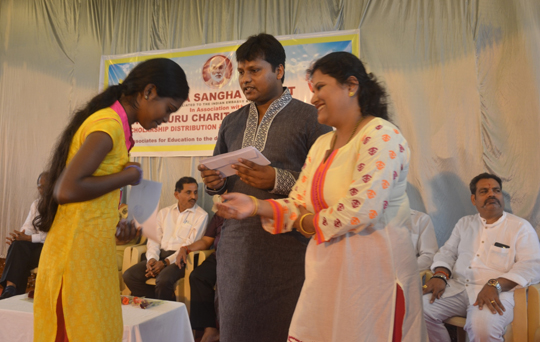
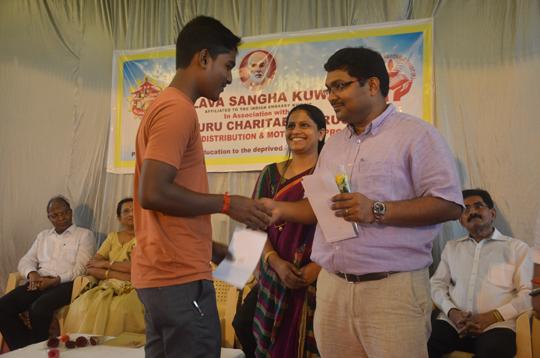
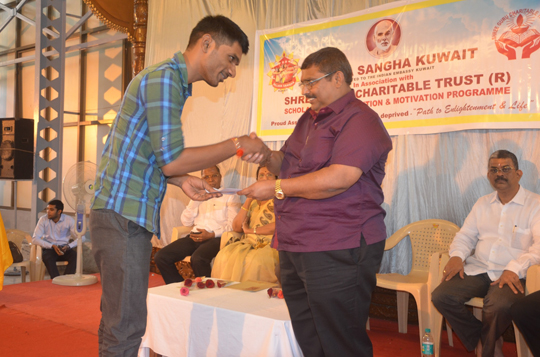
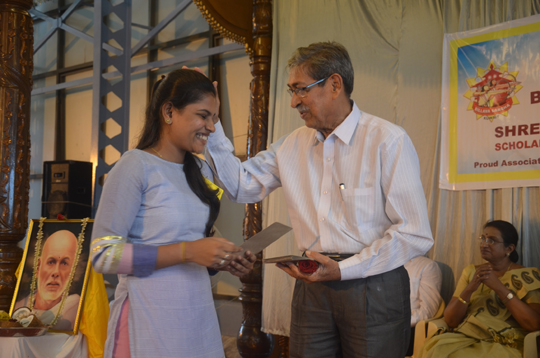
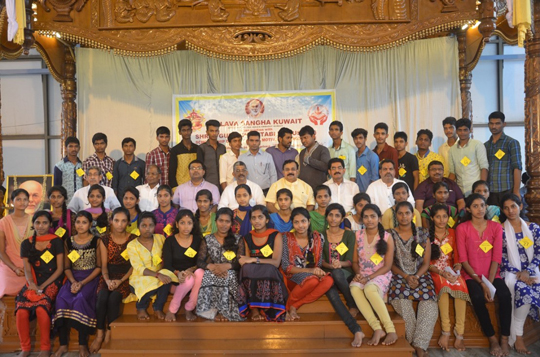
It was august occasion where 89 less privileged deserving students pursuing Post graduation, Engineering, Diploma, Law, Degree, Pre-University and Trade courseswere provided with Scholarships. Total of Rupees 5 lakhs and 40 thousands was distributed as Scholarship among these students. Scholarships were distributed by the guests and Rohith Sanil, Raghav, Vivek Rao, Sri A. K. Ravindra, Sri Manoj Bangera, Ramanath Kotekar and others.

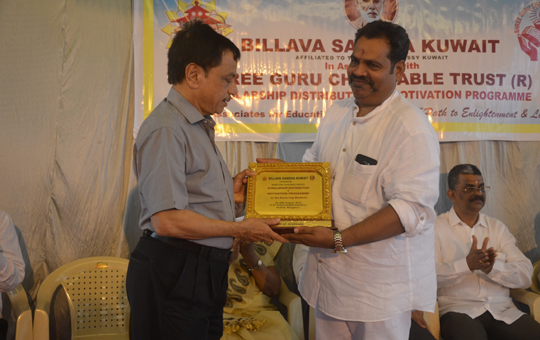
Chief Guest, Shylendra Y. Suvarna, Managing Director Of SRR Industries asked the children to utilize the opportunity with the helping hand from BSK who have done so with all the odds of working with extreme temperature in Kuwait. He wished all the children to excel in their studies and reach the goal.

Harikrishna Bantwal, spokesperson of the Billava Mahamandal, in his keynote speech asked the children to emulate the life and preaching of Swami Vivekanada and Sri Narayana Guru. He said that the backward tag of the community needs to be removed and we have to make ourselves strong with quality education and unity.

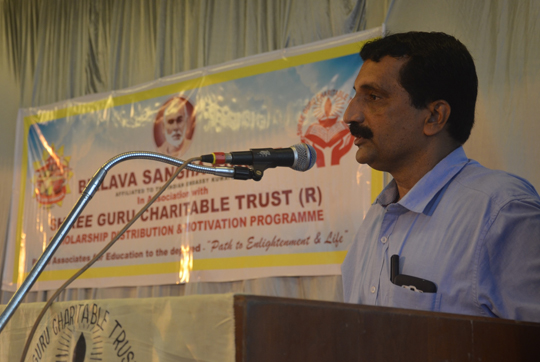
Raghu Poojary, Vice Prsident of Billava Sangha Kuwait also spoke on the occasion and thanked Sri Guru Charitable Trust for making this Education Programme a reality with their extensive Survey work. Jayanada, Secretary of Sri Guru Charitable Trust in his emotional speech explained how some of the less privileged students with all hardships and even without proper place to live have excelled in their studies. Sri YogishKotian also spoke on the occasion.

Ganesh Bangera in his presidential address briefed how the difficult work of survey was conducted and how these children were motivated from time to time. Senior Billava leader M Seetharam, and former President Mohandas Poojary were also present at the dais.

Earlier in the day Dr Ashith M.V. motivated the students and Pratibha Kulai spoke on “Stress Management” Education programme -2016 was concluded with Vote of thanks by Sri Govind Belchada of Billava Sangha Kuwait.

Billava Sangha Kuwait slogan – “Proud Associates for Education to the deprived, Path to Enlightenment and Life” is there to remain and BSK pledged to carry on with more enthusiasm year after year.
bsk 1

bsk 2

bsk 3

bsk 5

bsk 6

bsk 7

bsk 8

bsk 9

bsk 10

bsk 11

bsk 12

bsk 13

bsk 14

bsk 15

bsk 16

bsk 17

Comments

B. M. Iqbal
 - 
Thursday, 1 Sep 2016

good job Billawa Sangha Kuwait

Add new comment

  • Coastaldigest.com reserves the right to delete or block any comments.
  • Coastaldigset.com is not responsible for its readers’ comments.
  • Comments that are abusive, incendiary or irrelevant are strictly prohibited.
  • Please use a genuine email ID and provide your name to avoid reject.
Ram Puniyani
January 14,2020

In the beginning of January 2020 two very disturbing events were reported from Pakistan. One was the attack on Nankana Sahib, the holy shrine where Sant Guru Nanak was born. While one report said that the place has been desecrated, the other stated that it was a fight between two Muslim groups. Prime Minister of Pakistan Imran Khan condemned the incident and the main accused Imran Chisti was arrested. The matter related to abduction and conversion of a Sikh girl Jagjit Kaur, daughter of Pathi (One who reads Holy Guru Granth Sahib in Gurudwara) of the Gurudwara. In another incident one Sikh youth Ravinder Singh, who was out on shopping for his marriage, was shot dead in Peshawar.

While these condemnable attacks took place on the Sikh minority in Pakistan, BJP was quick enough to jump to state that it is events like this which justify the Citizenship Amendment Act (CAA). Incidentally CAA is the Act which is discriminatory and relates to citizenship with Religion, which is not as per the norms of Indian constitution. There are constant debates and propaganda that population of Hindus has come down drastically in Pakistan and Bangla Desh. Amit Shah, the Home minister stated that in Pakistan the population of Hindus has come down from 23% at the time of partition to 3.7% at present. And in Bangla Desh it has come down from 22% to present 8%.

While not denying the fact that the religious minorities are getting a rough deal in both these countries, the figures which are presented are totally off the mark. These figures don’t take into consideration the painful migrations, which took place at the time of partition and formation of Bangla Desh later. Pakistan census figures tell a different tale. Their first census was held in 1951. As per this census the overall percentage of Non Muslim in Pakistan (East and West together) was 14.2%, of this in West Pakistan (Now Pakistan) it was 3.44 and in Eat Pakistan it was 23.2. In the census held in Pakistan 1998 it became 3.72%. As far as Bangla Desh is concerned the share of Non Muslims has gone down from 23.2 (1951) to 9.6% in 2011.

The largest minority of Pakistan is Ahmadis, (https://minorityrights.org/country/pakistan/) who are close to 4 Million and are not recognised as Muslims in Pakistan. In Bangla Desh the major migrations of Hindus from Bangla Desh took place in the backdrop of Pakistan army’s atrocities in the then East Pakistan.

As far as UN data on refugees in India it went up by 17% between 2016-2019 and largest numbers were from Tibet and Sri Lanka.  (https://www.un.org/en/development/desa/population/migration/publication…)

The state of minorities is in a way the index of strength of democracy. Most South Asian Countries have not been able to sustain democratic values properly. In Pakistan, the Republic began with Jinnah’s classic speech where secularism was to be central credo of Pakistan. This 11th August speech was in a way what the state policy should be, as per which people of all faiths are free to practice their religion. Soon enough the logic of ‘Two Nation theory” and formation of Pakistan, a separate state for Muslim took over. Army stepped in and dictatorship was to reign there intermittently. Democratic elements were suppressed and the worst came when Zia Ul Haq Islamized the state in collusion with Maulanas. The army was already a strong presence in Pakistan. The popular formulation for Pakistan was that it is ruled by three A’s, Army, America and Allah (Mullah).

Bangla Desh had a different trajectory. Its very formation was a nail in the coffin of ‘two nation theory’; that religion can be the basis of a state. Bangla Desh did begin as a secular republic but communal forces and secular forces kept struggling for their dominance and in 1988 it also became Islamic republic. At another level Myanmar, in the grip of military dictatorship, with democratic elements trying to retain their presence is also seeing a hard battle. Democracy or not, the army and Sanghas (Buddhist Sang has) are strong, in Myanmar as well. The most visible result is persecution of Rohingya Muslims.

Similar phenomenon is dominating in Sri Lanka also where Budhhist Sanghas and army have strong say in the political affairs, irrespective of which Government is ruling. Muslim and Christian minorities are a big victim there, while Tamils (Hindus, Christians etc.) suffered the biggest damage as ethnic and religious minorities. India had the best prospect of democracy, pluralism and secularism flourishing here. The secular constitution, the outcome of India’s freedom struggle, the leadership of Gandhi and Nehru did ensure the rooting of democracy and secularism in a strong way.

India so far had best democratic credentials amongst all the south Asian countries. Despite that though the population of minorities rose mainly due to poverty and illiteracy, their overall marginalisation was order of the day, it went on worsening with the rise of communal forces, with communal forces resorting to identity issues, and indulging in propaganda against minorities.

While other South Asian countries should had followed India to focus more on infrastructure and political culture of liberalism, today India is following the footsteps of Pakistan. The retrograde march of India is most visible in the issues which have dominated the political space during last few years. Issues like Ram Temple, Ghar Wapasi, Love Jihad, Beef-Cow are now finding their peak in CAA.

India’s reversal towards a polity with religion’s identity dominating the political scene was nicely presented by the late Pakistani poetess Fahmida Riaz in her poem, Tum bhi Hum Jaise Nikle (You also turned out to be like us). While trying to resist communal forces has been an arduous task, it is becoming more difficult by the day. This phenomenon has been variously called, Fundamentalism, Communalism or religious nationalism among others. Surely it has nothing to do with the religion as practiced by the great Saint and Sufi traditions of India; it resorts mainly to political mobilization by using religion as a tool.

Comments

Ashi
 - 
Tuesday, 14 Jan 2020

If Malaysia implement similar NRC/CAA, India and China are the loser.

Add new comment

  • Coastaldigest.com reserves the right to delete or block any comments.
  • Coastaldigset.com is not responsible for its readers’ comments.
  • Comments that are abusive, incendiary or irrelevant are strictly prohibited.
  • Please use a genuine email ID and provide your name to avoid reject.
News Network
June 11,2020

Bengaluru, Jun 11: Within hours after claiming that it has decided to prohibit schools from schools from conducting online classes till Class 7, the Karnataka government has taken a U-turn and said that currently than ban is only till Class 5.

“Karnataka Govt has decided to stop all online classes for LKG, UKG & classes up to 5th std. To extend this up to 7th std is only a suggestion from few cabinet ministers as expressed in an informal discussion and NOT a decision,” tweeted Prime and Secondary Minister Suresh Kumar.

Law Minister J C Madhuswamy earlier today had stated that the decision to ban online classes till 7th standard was taken by the government.  "All of us were of the opinion that there were challenges faced by students studying in rural areas. Hence, we urged the government to extend the ban on online classes till 7 standard," he said

Comments

Add new comment

  • Coastaldigest.com reserves the right to delete or block any comments.
  • Coastaldigset.com is not responsible for its readers’ comments.
  • Comments that are abusive, incendiary or irrelevant are strictly prohibited.
  • Please use a genuine email ID and provide your name to avoid reject.
News Network
May 10,2020

Gadag, May 9: It is the month of April, and the season of mangoes is very much here. However, the mango farmers of Gadag are suffering huge losses amid the coronavirus lockdown due to the absence of transportation facilities along with several other issues that have been impacting their business adversely.

Speaking to media persons, Vishwanath Odugowdar, a mango farmer said, "Due to transportation problems we are not being able to export mangoes to different countries. We are trying to sell them in nearby markets."

"We are not in a situation to pack, transport and export the mangoes to different countries as we did earlier especially 
when it comes to Alphonso mangoes which is one of the most loved varieties. So, we are packing mangoes at our place. Somehow this year we have got very good quality of mangoes," he added.

Farmers here are incurring huge losses as mandis and markets across the country are shut while the transport of Alphonso mangoes has also come to a halt owing to the lockdown.

The small and medium scale farmers in places like Gadag, Dharwad, Bagalkote in north Karnataka have started packing the mangoes themselves in their farms in a bid to sell the fruit themselves.

Comments

Add new comment

  • Coastaldigest.com reserves the right to delete or block any comments.
  • Coastaldigset.com is not responsible for its readers’ comments.
  • Comments that are abusive, incendiary or irrelevant are strictly prohibited.
  • Please use a genuine email ID and provide your name to avoid reject.