Mangaluru: Billava Sangha Kuwait holds scholarship and motivation programme

[email protected] (CD Network)
August 31, 2016

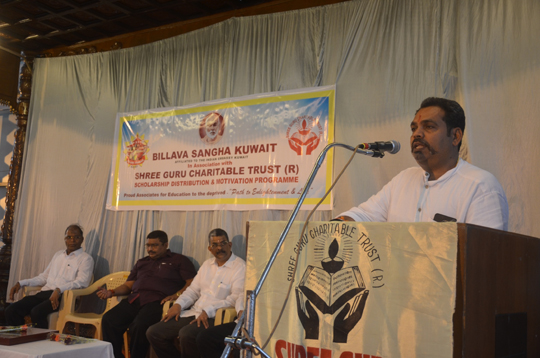
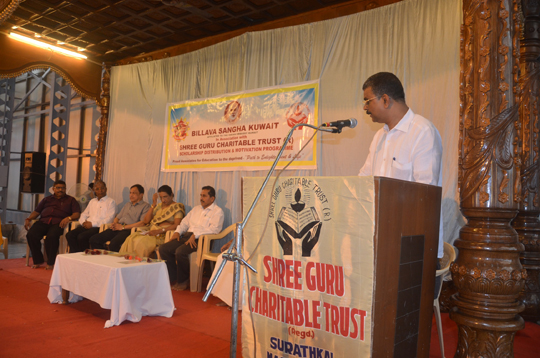
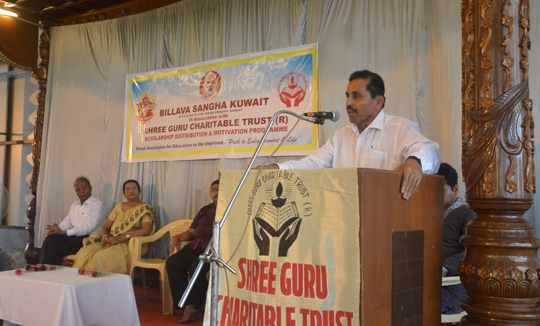
Mangaluru, Aug 31: Billava Sangha Kuwait in association with Shree Guru Charitable Trust, Mangaluru initiated Education Programme' from this year with scholarship distribution and motivation event held recently at Shri Vishvanatha Kalyana Mantapa (Glass House), Shri GokarnanathaKshetra, Kudroli, here.
bsk 4

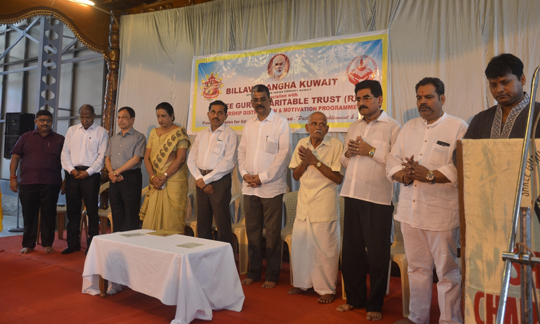
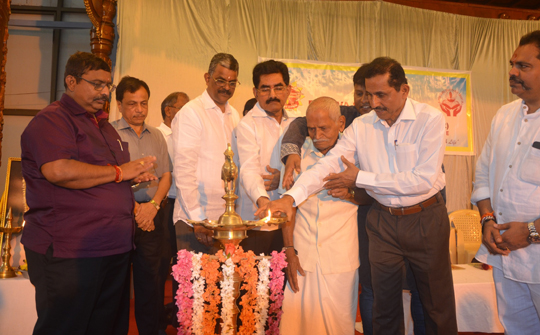
H. S. Sairam, President of the Shri Gokarnanatha Kshetra inaugurated the programme by lighting the lamp. Ganesh A Bangera, President of Shree Guru Charitable Trust presided over the function. Chandrasekhar Nanil, Vice President of Guru Charitable Trust welcomed the distinguished guests and the gathering. Greetings from JanardhanaPoojary and Sri Jaya Suvarnawas conveyed to the gathering and blessings to the students.

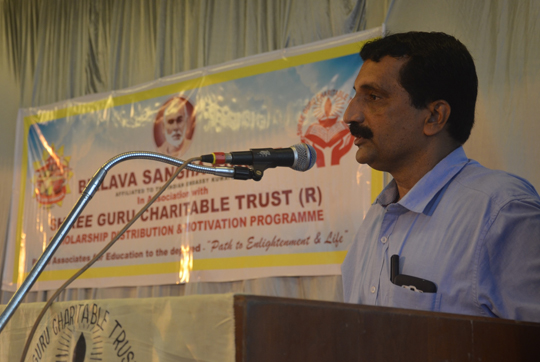
Sri Satish Kunder on behalf of the Billava Sangha Kuwait gave the insight of the activities of Billava Sangha Kuwait and how the motivated members of BSK worked hard to make this Education Programme a reality even though the organization is only 3 years into its inception. With the creation of strong base of associates and the univocal support, this programmecan continue to serve the community in a bigger way year after year. He also briefed though the Billava history and how the strong Billava community has become weak due to not involvement with the changes in the society and only education can take the community to their earlier status again.

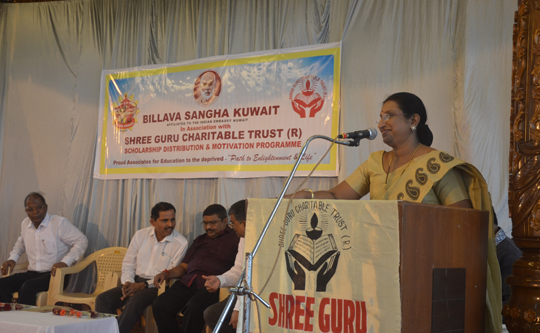
Dr Ramila Shekhar, Dean PG Department, Roshni Nilaya delivered the motivation speech for the students. She stressed the need for the children to be disciplined in their way of life and the motivation can come only from within. She asked the children to focused on their goal and evaluate their actions on day to day basis. She said the children are full of energy and needs to put it into action in shaping their life.

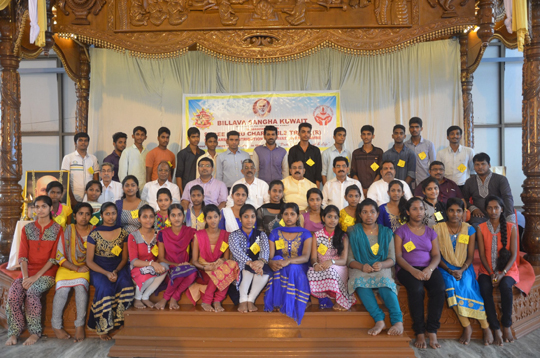
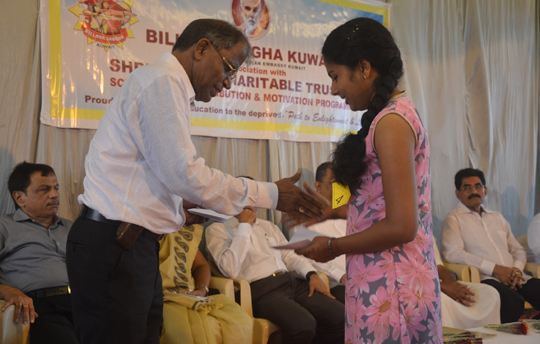
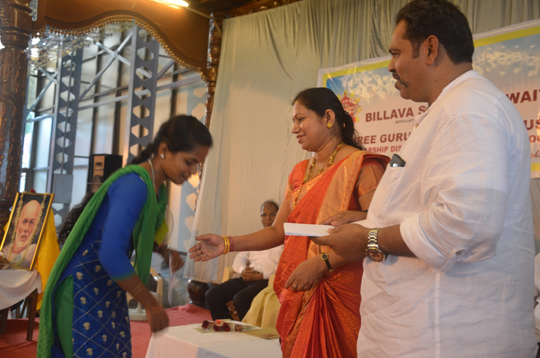
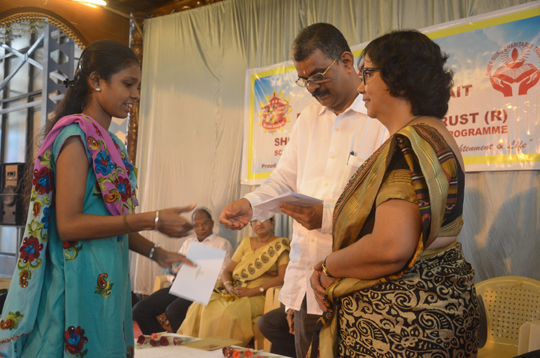
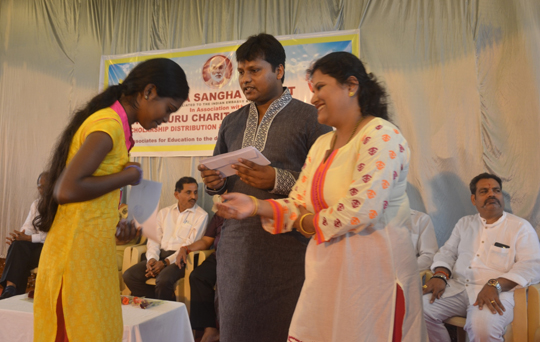
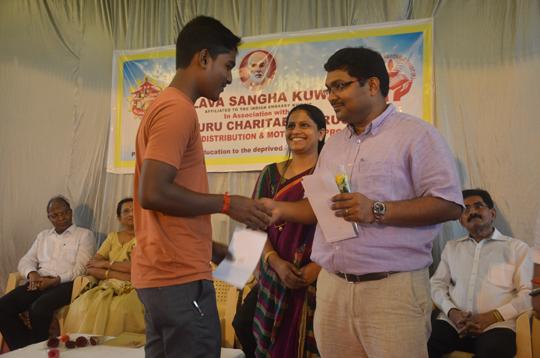
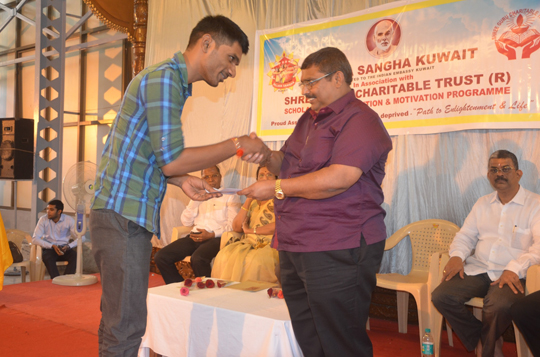
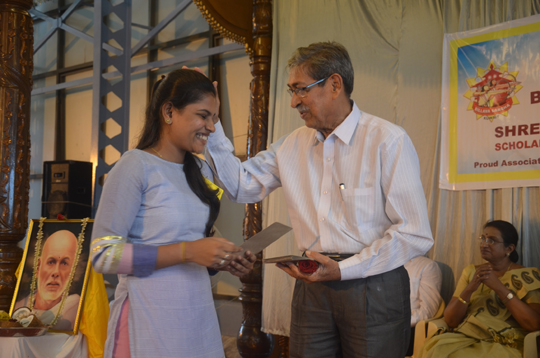
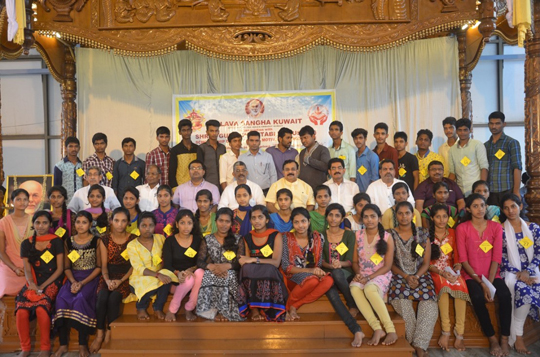
It was august occasion where 89 less privileged deserving students pursuing Post graduation, Engineering, Diploma, Law, Degree, Pre-University and Trade courseswere provided with Scholarships. Total of Rupees 5 lakhs and 40 thousands was distributed as Scholarship among these students. Scholarships were distributed by the guests and Rohith Sanil, Raghav, Vivek Rao, Sri A. K. Ravindra, Sri Manoj Bangera, Ramanath Kotekar and others.

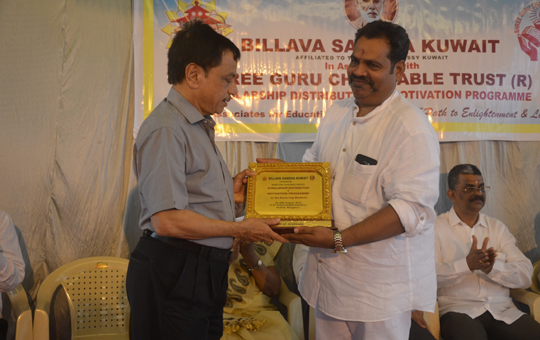
Chief Guest, Shylendra Y. Suvarna, Managing Director Of SRR Industries asked the children to utilize the opportunity with the helping hand from BSK who have done so with all the odds of working with extreme temperature in Kuwait. He wished all the children to excel in their studies and reach the goal.

Harikrishna Bantwal, spokesperson of the Billava Mahamandal, in his keynote speech asked the children to emulate the life and preaching of Swami Vivekanada and Sri Narayana Guru. He said that the backward tag of the community needs to be removed and we have to make ourselves strong with quality education and unity.

Raghu Poojary, Vice Prsident of Billava Sangha Kuwait also spoke on the occasion and thanked Sri Guru Charitable Trust for making this Education Programme a reality with their extensive Survey work. Jayanada, Secretary of Sri Guru Charitable Trust in his emotional speech explained how some of the less privileged students with all hardships and even without proper place to live have excelled in their studies. Sri YogishKotian also spoke on the occasion.

Ganesh Bangera in his presidential address briefed how the difficult work of survey was conducted and how these children were motivated from time to time. Senior Billava leader M Seetharam, and former President Mohandas Poojary were also present at the dais.

Earlier in the day Dr Ashith M.V. motivated the students and Pratibha Kulai spoke on “Stress Management” Education programme -2016 was concluded with Vote of thanks by Sri Govind Belchada of Billava Sangha Kuwait.

Billava Sangha Kuwait slogan – “Proud Associates for Education to the deprived, Path to Enlightenment and Life” is there to remain and BSK pledged to carry on with more enthusiasm year after year.
bsk 1

bsk 2

bsk 3

bsk 5

bsk 6

bsk 7

bsk 8

bsk 9

bsk 10

bsk 11

bsk 12

bsk 13

bsk 14

bsk 15

bsk 16

bsk 17

Comments

B. M. Iqbal
 - 
Thursday, 1 Sep 2016

good job Billawa Sangha Kuwait

Add new comment

  • Coastaldigest.com reserves the right to delete or block any comments.
  • Coastaldigset.com is not responsible for its readers’ comments.
  • Comments that are abusive, incendiary or irrelevant are strictly prohibited.
  • Please use a genuine email ID and provide your name to avoid reject.
News Network
May 26,2020

Bengaluru, May 26: Unknown miscreants have set ablaze 30-40 migrant labourers hutments in Bengaluru east, prompting police to take suo motu cognizance, an official said on Tuesday.

"As many as 30-40 migrant labourers' hutments have been set ablaze by unknown miscreants at Kacharakanahallin in KG Halli, we have taken suo motu cognizance of the crime," said a police official to media.

Police are investigating the arson invoking IPC Sections 143, 147, 188, 436, 123, 504, 506 and others.

"There was no loss of life in the arson as the migrant labourers were away at their hometowns because of COVID lockdown," said the official.

The labourers came from different parts of Karnataka to eke out a living and were living in those huts near the Rama Temple in KG Halli.

Comments

Add new comment

  • Coastaldigest.com reserves the right to delete or block any comments.
  • Coastaldigset.com is not responsible for its readers’ comments.
  • Comments that are abusive, incendiary or irrelevant are strictly prohibited.
  • Please use a genuine email ID and provide your name to avoid reject.
Media Release
March 12,2020

Manipal, Mar 12: Team WGSHA is proud to announce that the culinary museum in WGSHA has been listed in Limca Book of Records as India's First Living Culinary Arts Museum.

Limca Book of Records (LBR) is a catalogue of achievements made by Indians, at home and abroad in diverse fields of human endeavour. LBR is a celebration of exemplary exploits and recognizes accomplishments such as firsts, inventions, discoveries, honours, awards and the truly extraordinary.

Chef Thirugnanasambantham, Principal of WGSHA, while thanking MAHE and ITC Leadership for extending all support towards instituting this museum in Manipal and WGSHA, also appreciated and thanked all those who have directly or indirectly helped towards setting up this museum in Manipal.

"The process for WGSHA's culinary museum to make an entry into the popular Limca Book of Records started almost six months back and after validation by LBR recently, has been listed in the book of records. We are glad that we could be the first of its kind in such endeavour and we also hope to be in Guinness World Records soon", said Chef Thiru.

"We are indeed grateful to Michelin-starred Indian celebrity Chef Vikas Khanna, the founder and curator of this museum, who had this idea of establishing a culinary museum and donated thousands of kitchen tools and equipment worth millions of dollars to this museum for preserving the history of India's rich tradition of culinary arts and to educate the future generations. Chef Vikas Khanna, 'Distinguished Alumnus' of WGSHA, being very desirous of making such a museum in India, what better place it would be than in his own Alma Mater!", he said on the background of having the museum.

Chef Thiru mentioned that Udupi, popular for the famous 'Udupi Cuisine', and being a temple town, is adjacent to International University Town of Manipal Academy of Higher Education (MAHE).

MAHE is home to thousands of international students and visitors. With a great heritage of Udupi, combined with the large number of Indian and International students residing in and around Manipal, it was very apt for the college to create a museum for today's Indian youth and the International visitors to understand the rich culinary heritage of India, through the priceless kitchen tools and equipment donated by Chef Vikas Khanna.

"Has placed WGSHA in the global culinary map and we are proud to have joined all such efforts to preserve the history of cuisines and cultures across the world", said Chef Thiru.

The culinary art academic block housing the museum was opened in April 2018, spread approximately over 25,000 sq ft and is shaped in the form of a giant pot very similar to the ones found in Harappa.

There are historical as well as regular household items such as plates made by the Portuguese in India, a 100-year-old ladle used to dole out food at temples and bowls dating to the Harappan era, an old seed sprinkler, an ancient Kashmiri tea brewer known as 'samovar', vessels from the Konkan, Udupi and Chettinad regions, apart from a large collection of rolling pins, utensils of all shapes and sizes, tea strainers of different types etc.

Comments

Add new comment

  • Coastaldigest.com reserves the right to delete or block any comments.
  • Coastaldigset.com is not responsible for its readers’ comments.
  • Comments that are abusive, incendiary or irrelevant are strictly prohibited.
  • Please use a genuine email ID and provide your name to avoid reject.
News Network
July 28,2020

Hounde, Jul 28: Coronavirus and its restrictions are pushing already hungry communities over the edge, killing an estimated 10,000 more young children a month as meager farms are cut off from markets and villages are isolated from food and medical aid, the United Nations warned Monday.

In the call to action shared with The Associated Press ahead of publication, four UN agencies warned that growing malnutrition would have long-term consequences, transforming individual tragedies into a generational catastrophe.

Hunger is already stalking Haboue Solange Boue, an infant from Burkina Faso who lost half her former body weight of 5.5 pounds (2.5 kilograms) in just a month. Coronavirus restrictions closed the markets, and her family sold fewer vegetables. Her mother was too malnourished to nurse.

“My child,” Danssanin Lanizou whispered, choking back tears as she unwrapped a blanket to reveal her baby's protruding ribs.

More than 550,000 additional children each month are being struck by what is called wasting, according to the UN — malnutrition that manifests in spindly limbs and distended bellies. Over a year, that's up 6.7 million from last year's total of 47 million. Wasting and stunting can permanently damage children physically and mentally.

“The food security effects of the COVID crisis are going to reflect many years from now,” said Dr. Francesco Branca, the WHO head of nutrition. “There is going to be a societal effect.”

From Latin America to South Asia to sub-Saharan Africa, more poor families than ever are staring down a future without enough food.

In April, World Food Program head David Beasley warned that the coronavirus economy would cause global famines “of biblical proportions” this year. There are different stages of what is known as food insecurity; famine is officially declared when, along with other measures, 30% of the population suffers from wasting.

The World Food Program estimated in February that one Venezuelan in three was already going hungry, as inflation rendered salaries nearly worthless and forced millions to flee abroad. Then the virus arrived.

“Every day we receive a malnourished child,” said Dr. Francisco Nieto, who works in a hospital in the border state of Tachira.

In May, Nieto recalled, after two months of quarantine, 18-month-old twins arrived with bodies bloated from malnutrition. The children's mother was jobless and living with her own mother. She told the doctor she fed them only a simple drink made with boiled bananas.

“Not even a cracker? Some chicken?” he asked.

“Nothing,” the children's grandmother responded. By the time the doctor saw them, it was too late: One boy died eight days later.

The leaders of four international agencies — the World Health Organization, UNICEF, the World Food Program and the Food and Agriculture Organization — have called for at least dollar 2.4 billion immediately to address global hunger.

But even more than lack of money, restrictions on movement have prevented families from seeking treatment, said Victor Aguayo, the head of UNICEF's nutrition program.

“By having schools closed, by having primary health care services disrupted, by having nutritional programs dysfunctional, we are also creating harm,” Aguayo said. He cited as an example the near-global suspension of Vitamin A supplements, which are a crucial way to bolster developing immune systems.

In Afghanistan, movement restrictions prevent families from bringing their malnourished children to hospitals for food and aid just when they need it most. The Indira Gandhi hospital in the capital, Kabul, has seen only three or four malnourished children, said specialist Nematullah Amiri. Last year, there were 10 times as many.

Because the children don't come in, there's no way to know for certain the scale of the problem, but a recent study by Johns Hopkins University indicated an additional 13,000 Afghans younger than 5 could die.

Afghanistan is now in a red zone of hunger, with severe childhood malnutrition spiking from 690,000 in January to 780,000 — a 13% increase, according to UNICEF.

In Yemen, restrictions on movement have blocked aid distribution, along with the stalling of salaries and price hikes. The Arab world's poorest country is suffering further from a fall in remittances and a drop in funding from humanitarian agencies.

Yemen is now on the brink of famine, according to the Famine Early Warning Systems Network, which uses surveys, satellite data and weather mapping to pinpoint places most in need.

Some of the worst hunger still occurs in sub-Saharan Africa. In Sudan, 9.6 million people live from one meal to the next — a 65% increase from the same time last year.

Lockdowns across Sudanese provinces, as around the world, have dried up work and incomes for millions. With inflation hitting 136%, prices for basic goods have more than tripled.

“It has never been easy but now we are starving, eating grass, weeds, just plants from the earth,” said Ibrahim Youssef, director of the Kalma camp for internally displaced people in war-ravaged south Darfur.

Adam Haroun, an official in the Krinding camp in west Darfur, recorded nine deaths linked with malnutrition, otherwise a rare occurrence, over the past two months — five newborns and four older adults, he said.

Before the pandemic and lockdown, the Abdullah family ate three meals a day, sometimes with bread, or they'd add butter to porridge. Now they are down to just one meal of “millet porridge” — water mixed with grain. Zakaria Yehia Abdullah, a farmer now at Krinding, said the hunger is showing “in my children's faces.”

“I don't have the basics I need to survive,” said the 67-year-old, who who hasn't worked the fields since April. “That means the 10 people counting on me can't survive either.”

Comments

Add new comment

  • Coastaldigest.com reserves the right to delete or block any comments.
  • Coastaldigset.com is not responsible for its readers’ comments.
  • Comments that are abusive, incendiary or irrelevant are strictly prohibited.
  • Please use a genuine email ID and provide your name to avoid reject.