Mangaluru: CET topper Ananth says, he avoided mobile phone for 2 years

[email protected] (CD Network)
May 29, 2016

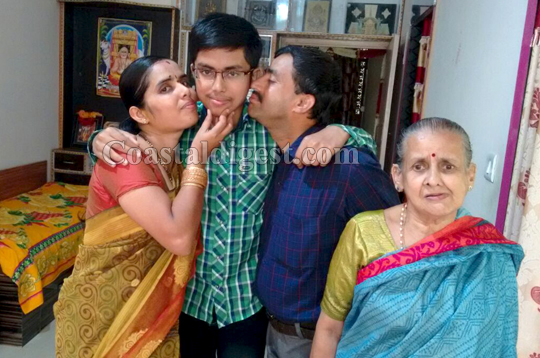
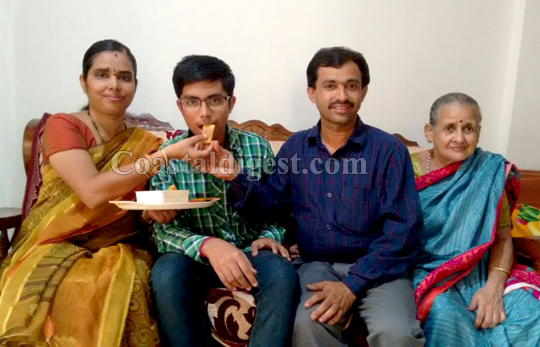
Mangaluru, May 29: Mohan Alva, chairman of Alva's Education Foundation, Mohan Alva, has announced a cash prize money of Rs. 5 lakh for Ananth G, student of Alva's PU College, for topping the medical/dental stream in the Common Entrance Test.

ananthtop 1

Ananth, who hails from bengaluru, had come to Dakshina Kannada for education. “Coaching in the college, night special classes and support of teachers, parents and Alva's College chairperson helped me to achieve the feat,” he said.

“I used to study for six to seven hours a day. The atmosphere in the hostel was also very conducive for learning. The doubts were cleared by the teachers daily which helped us,” he said.

He also said that he was totally disconnected from TV and mobile phone for the last two years, which helped him to concentrate on his studies.

Explaining his choice of Medicine, Ananth said, “I want to serve the people, so I am choosing a noble profession. I want to pursue my studies in Bangalore Medical College.”

ananthtop 3

ananthtop 4

Comments

yaseen baig
 - 
Sunday, 29 May 2016

Excellent performance, all the best.

Pramod
 - 
Sunday, 29 May 2016

all the best and keep the good performance in next stage.

Add new comment

  • Coastaldigest.com reserves the right to delete or block any comments.
  • Coastaldigset.com is not responsible for its readers’ comments.
  • Comments that are abusive, incendiary or irrelevant are strictly prohibited.
  • Please use a genuine email ID and provide your name to avoid reject.
News Network
April 23,2020

Mangaluru, Apr 23: An astronomical phenomenon, ‘Zero Shadow Day', will be observed in Mangaluru on April 24 and in Udupi on April 25. 

According to a press release from Poornaprajna Amateur Astronomers’ Club, the wonder will commence and people will see their shadows disappear for a few moments at 12:28 pm.

The phenomenon is called as Zero Shadow Day. If a person takes a candle in a dark room and use it to create a shadow of one’s palm on the wall, the hand will cast shadow on the wall as one moves the hand. But when one places the palm on the wall, there will be no shadow.

In the phenomenon, the sun at these times shines exactly above the heads on these days. In astronomy, this point is called as Zenith. The point in the sky directly above an observer at any given location. So it is quite clear now that on Zero Shadow Day, the sun passes through the Zenith as a result of which, all objects will have minimal or no shadow if they are on the ground.

The reason for this happens on some specific days is concerned with astronomy. The earth spins around on its own axis and causes days and nights. It also revolves around the sun causing a year. But the seasons are caused because the axis is tilted at an angle of 23.5 degrees. It is because of this tilt that the sun rises every day in the east gradually moving towards the north till June 21st and then slowly proceeding towards the south till December 21st every year. “We call these days solstice. This means the sun shines between the Tropic of Cancer and Tropic of Capricorn every day passing by the equator on the days we call equinox,” the release stated.

As the earth moves around the sun and revolves on its own axis, for all the people between Tropic of Cancer and Tropic of Capricorn, the Sun at noon moves father and closer to the zenith passing through zenith twice causing two Zero Shadow Days per year. People at Mangaluru will observe this on April 24 and August 18 every year and People in Udupi will observe this on April 25 and August 17 every year.

Places with same latitudes will observe the same days of Zero Shadow but the time would vary with longitude. For example, people of Bengaluru as they share the latitude with Mangaluru will also observe it on April 24. While the people of Mangaluru will observe their shadows disappear at 12.28pm, people of Bengaluru will observe this at 12:17pm. Places like Moodabidri, Bantwal, Sakleshpur and Hassan will also observe Zero Shadow on April 24.

Places like Brahmavar, Karkala, Sringeri, Kudremukha, Chikkamagaluru will observe the Zero Shadow Day on the same day as Udupi on April 25.

Comments

Add new comment

  • Coastaldigest.com reserves the right to delete or block any comments.
  • Coastaldigset.com is not responsible for its readers’ comments.
  • Comments that are abusive, incendiary or irrelevant are strictly prohibited.
  • Please use a genuine email ID and provide your name to avoid reject.
Ram Puniyani
February 10,2020

Noam Chomsky is one of the leading peace workers in the world. In the wake of America’s attack on Vietnam, he brought out his classic formulation, ‘manufacturing consent’. The phrase explains the state manipulating public opinion to have the public approve of it policies—in this case, the attack of the American state on Vietnam, which was then struggling to free itself from French colonial rule.

In India, we are witness to manufactured hate against religious minorities. This hatred serves to enhance polarisation in society, which undermines India’s democracy and Constitution and promotes support for a Hindu nation. Hate is being manufactured through multiple mechanisms. For example, it manifests in violence against religious minorities. Some recent ghastly expressions of this manufactured hate was the massive communal violence witnessed in Mumbai (1992-93), Gujarat (2002), Kandhamal (2008) and Muzaffarnagar (2013). Its other manifestation was in the form of lynching of those accused of having killed a cow or consumed beef. A parallel phenomenon is the brutal flogging, often to death, of Dalits who deal with animal carcasses or leather.

Yet another form of this was seen when Shambhulal Regar, indoctrinated by the propaganda of Hindu nationalists, burned alive Afrazul Khan and shot the video of the heinous act. For his brutality, he was praised by many. Regar was incited into the act by the propaganda around love jihad. Lately, we have the same phenomenon of manufactured hate taking on even more dastardly proportions as youth related to Hindu nationalist organisations have been caught using pistols, while police authorities look on.

Anurag Thakur, a BJP minster in the central government recently incited a crowd in Delhi to complete his chant of what should happen to ‘traitors of the country...” with a “they should be shot”. Just two days later, a youth brought a pistol to the site of a protest at Jamia Millia Islamia university and shouted “take Azaadi!” and fired it. One bullet hit a student of Jamia. This happened on 30 January, the day Nathuram Godse had shot Mahatma Gandhi in 1948. A few days later, another youth fired near the site of protests against the CAA and NRC at Shaheen Bagh. Soon after, he said that in India, “only Hindus will rule”.

What is very obvious is that the shootings by those associated with Hindu nationalist organisations are the culmination of a long campaign of spreading hate against religious minorities in India in general and against Muslims in particular. The present phase is the outcome of a long and sustained hate campaign, the beginning of which lies in nationalism in the name of religion; Muslim nationalism and Hindu nationalism. This sectarian nationalism picked up the communal view of history and the communal historiography which the British introduced in order to pursue their ‘divide and rule’ policy.

In India what became part of “social common sense” was that Muslim kings had destroyed Hindu temples, that Islam was spread by force, and that it is a foreign religion, and so on. Campaigns, such as the one for a temple dedicated to the Hindu god Rama to be built at the site where the Babri masjid once stood, further deepened the idea of a Muslim as a “temple-destroyer”. Aurangzeb, Tipu Sultan and other Muslim kings were tarnished as the ones who spread Islam by force in the subcontinent. The tragic Partition, which was primarily due to British policies, and was well-supported by communal streams also, was entirely attributed to Muslims. The Kashmir conflict, which is the outcome of regional, ethnic and other historical issues, coupled with the American policy of supporting Pakistan’s ambitions of regional hegemony, (which also fostered the birth of Al-Qaeda), was also attributed to the Muslims.

With recurring incidents of communal violence, these falsehoods went on going deeper into the social thinking. Violence itself led to ghettoisation of Muslims and further broke inter-community social bonds. On the one hand, a ghettoised community is cut off from others and on the other hand the victims come to be presented as culprits. The percolation of this hate through word-of-mouth propaganda, media and re-writing of school curricula, had a strong impact on social attitudes towards the minorities.

In the last couple of decades, the process of manufacturing hate has been intensified by the social media platforms which are being cleverly used by the communal forces. Swati Chaturvedi’s book, I Am a Troll: Inside the Secret World of the BJP’s Digital Army, tells us how the BJP used social media to spread hate. Whatapp University became the source of understanding for large sections of society and hate for the ‘Other’, went up by leaps and bounds. To add on to this process, the phenomenon of fake news was shrewdly deployed to intensify divisiveness.

Currently, the Shaheen Bagh movement is a big uniting force for the country; but it is being demonised as a gathering of ‘anti-nationals’. Another BJP leader has said that these protesters will indulge in crimes like rape. This has intensified the prevalent hate.

While there is a general dominance of hate, the likes of Shambhulal Regar and the Jamia shooter do get taken in by the incitement and act out the violence that is constantly hinted at. The deeper issue involved is the prevalence of hate, misconceptions and biases, which have become the part of social thinking.

These misconceptions are undoing the amity between different religious communities which was built during the freedom movement. They are undoing the fraternity which emerged with the process of India as a nation in the making. The processes which brought these communities together broadly drew from Gandhi, Bhagat Singh and Ambedkar. It is these values which need to be rooted again in the society. The communal forces have resorted to false propaganda against the minorities, and that needs to be undone with sincerity.

Combating those foundational misconceptions which create hatred is a massive task which needs to be taken up by the social organisations and political parties which have faith in the Indian Constitution and values of freedom movement. It needs to be done right away as a priority issue in with a focus on cultivating Indian fraternity yet again.


Comments

Add new comment

  • Coastaldigest.com reserves the right to delete or block any comments.
  • Coastaldigset.com is not responsible for its readers’ comments.
  • Comments that are abusive, incendiary or irrelevant are strictly prohibited.
  • Please use a genuine email ID and provide your name to avoid reject.
News Network
February 26,2020

Mumbai, Feb 26: Targetting Shiv Sena's silence over the recent controversial remark by AIMIM leader Waris Pathan, former Maharashtra Chief Minister Devendra Fadnavis on Tuesday said the Uddhav Thackeray-led party might be "wearing bangles" but the BJP was not and knew how to retaliate in the same manner.

"Shiv Sena might be wearing bangles but we are not. If someone says something then he will be given an answer in the same way. BJP has this much power," said Fadnavis while launching a scathing attack on ruling-Shiv Sena in Maharashtra for not taking strict action against Pathan.

Fadnavis was addressing protestors at Azad Maidan where BJP launched a protest against Maharashtra government over issues related to farmers and women.

On February 20, while addressing an anti-CAA rally, at Kalaburagi in Karnataka, Pathan had said, "time has now come for us to unite and achieve freedom. Remember we are 15 crore but can dominate over 100 crores."

"They tell us that we have kept our women in the front - only the lionesses have come out and you are already sweating. You can understand what would happen if all of us come together," he had said.

Facing flak over his remarks Pathan later took back his words and had said he had not targeted any community but had spoken against members of some organisations.

"If any of my words have hurt someone, I take them back as I am a true Indian," Pathan said at a press conference here.

The AIMIM leader said that he was being portrayed as being anti-Indian and anti-Hindu for the past couple of days.

"I want to say that my earlier statement was basically against people who are members of organisations like RSS, BJP, Bajrang Dal, etc. These 100 are those people who want to divide this beautiful nation," he added.

Comments

Add new comment

  • Coastaldigest.com reserves the right to delete or block any comments.
  • Coastaldigset.com is not responsible for its readers’ comments.
  • Comments that are abusive, incendiary or irrelevant are strictly prohibited.
  • Please use a genuine email ID and provide your name to avoid reject.