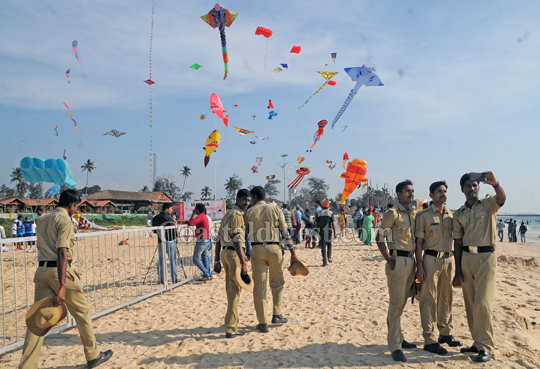
Mangaluru: Colourful kites paint the sky at Panambur beach

[email protected] (CD Network | Suresh, Chakravarthi)
January 16, 2016

Mangaluru: Jan 16: Hundreds of colourful kites adored the skies of Panambur beach at the International Kite Festival organised by Rotary International in the city on Saturday.

kitss 1

Kite flyers from various countries took part in the fest and variety of uniquely-shaped kites reflected the theme ‘One kite, one earth, one family’.

Speaking to Deccan Herald, Michael Alwares from Australia said that he has been flying the box kite, which is a typical Australian kite. He said the 15 metre long kite has 20 box shaped kites attached to it symmetrically. Alwares, who has been nurturing this hobby for the last 32 last years, has been teaching children kite-flying at various places. Alwares said it is his first time in an International Kite Festival.

Ashok H Shah from Dahane, Maharastra, said he is represents his professional kite flyers group, Ashok Designer Kite and had brought 30 kites. He said he is taking part in the kite festival for the fourth time in Mangaluru. The 300-feet bird train kite and 3D tiger kite were among the kites flown by him. He has won several prizes in Gujarat Kite Festival and holds a Limca Record for conducting workshop for 1,100 children at a time on kite flying in Sholapur. He added the crowd in Mangaluru is disciplined and the wind is excellent.

The traditional Cambodian kite, which creates musical sounds when it flies, stickless balloon-like kites and turbine shaped rotating kite attracted attention. Kites designed in the form of octopus, fish, cow and such other kites in different shapes and sizes amused the crowd.

Ariel photography, based on picavet lacing technique, carried out by NITK?team led by Dr Prithviraj, Assistant Professor, department of Applied Mechanics and Hydraullics, were among the highlights of the fest.

Kite photography competition was also held on the occasion. Participants from Australia, Cambodia, France, Germany, India, Italy, Kuwait, Netherlands, Nigeria, Singapore, Thailand, Turkey, Ukraine and United Kingdom took part. Rotary International District Governor Dr Bharatesh inaugurated the fest. Ramakrishna Kamath and Team Mangalore Founder Sarvesh Rao were present among others.

kitenight 1

kitenight 2

kitenight 3

kitenight 4

kitenight 5

kitenight 6

kitenight 7

kitenight 8

kitenight 9

kitenight 10

kitenight 11

kitenight 12

kitenight 13

kitenight 14

kitenight 15

kites 1

kites 2

kites 3

kites 4

kites 5

kites 6

kites 7

kites 8

kites 9

kitesFest 2

kitesFest 3

kitesFest 4

kitss 2

kitss 3

Comments

Add new comment

  • Coastaldigest.com reserves the right to delete or block any comments.
  • Coastaldigset.com is not responsible for its readers’ comments.
  • Comments that are abusive, incendiary or irrelevant are strictly prohibited.
  • Please use a genuine email ID and provide your name to avoid reject.
News Network
March 26,2020

Hubballi, Mar 25: The people living in rural areas of North-Karnataka region have become more aware about deadly Corona virus as they are leaving no stone unturned to prevent people of Bengaluru and other metropolitan cities from entering into their villages. People have put thorny plants on all roads at the outskirts connecting their villages and deployed youths to conduct patrolling round the clock till next 21 days.

Their motto is to prevent their own villagers getting infected from the outsiders especially from cities like Bengaluru and other two-tier cities where positive virus cases are on the rise. They have also take precautionary measures in the wake of Chief Minister B S Yediyurappa's call to the people to return to their native places.

Several people have also dug up the roads leading to their villages to block the entry of outside vehicles. They have put a condition to the outsiders to enter into their villages only after proper health check-up to confirm that they are not infected with Corona positive.

"We don't have access to the proper medical care if Corona virus is entered into our village. The Primary Health Centres are not functioning properly and these centers are facing lack of adequate staff and medical equipments unlike in big cities.Therefore, those who have deserted our village to employ in various jobs in Bengaluru and other cities should confirm that they are tested negative for the virus", said Mallikarjun Patil of Kudal village in Hangal taluk of Haveri district. The village has totally banned the outsiders into their village and warned their fellow villagers to return immediately if they have visited to their relatives' homes in neighboring villages to observe 21-day lockdown.

Hundreds of youths in Itanal village of Chikkodi taluk of Belagavi have also resorted to similar tactics and patrolling in all roads at the outskirts by holding sticks to prevent outsiders from entering into their village until April 14.

People of Hunagunti village in Ron taluk and Kotamuchagi village in Gadag taluk have also adopted similar plan by parking tractors at th outskirts to prohibit the entry of outsiders. They have also created awareness in their villages by beating drums urging the people not to venture outside village for next three weeks.

The police officials have resorted to lati-charge at various places in urban areas when people gathered in large numbers to buy essential commodities.

Comments

Add new comment

  • Coastaldigest.com reserves the right to delete or block any comments.
  • Coastaldigset.com is not responsible for its readers’ comments.
  • Comments that are abusive, incendiary or irrelevant are strictly prohibited.
  • Please use a genuine email ID and provide your name to avoid reject.
News Network
July 15,2020

Bengaluru, Jul 15: With the state capital along with a few districts under lockdown to control the spread of Covid-19, Karnataka Home Minister Basavaraj Bommai on Wednesday said the measure was important to break the chain and people seem to have understood its importance.

Appealing for cooperation from the people, he asked them not to make it inevitable for police to use force in implementing the lockdown. "Traffic movement is less, there is a lockdown atmosphere everywhere, I feel that people have understood the importance... cooperation is required. I appeal to the people, if this lockdown has to be effective it has to be voluntary, only then we can control the rapid spread of coronavirus," Bommai said.

Speaking to reporters here, he said this lockdown is important, last time the infection was not up to this level. "This time areas that have a high number of infections- about five districts and Bengaluru city are going for lockdown. People have understood that this lockdown is to break the chain," he said. "Please don't make it inevitable for police to use force," he added.

Bengaluru urban and rural areas are under "complete lockdown" since last night at 8 pm and it will be effective till 5 am on July 22.

Following Bengaluru urban and rural, administrations in several districts like Dharwad, Dakshina Kannada, Kalaburagi (only in Urban areas), Bidar, Raichur (in Raichur city and Sindhanur) and Yadgir too have announced lockdown.

Noting that Police have taken all necessary strict measures to enforce lockdown in Bengaluru urban and rural districts by restricting the movement of vehicles and people, Bommai said barricades have been erected at various places and flyovers have been shut. People have been allowed to purchase vegetables and groceries till 12 noon, he said.

The government has warned of action in case of any violation of the lockdown rules. As of July 14 evening, cumulatively 44,077 Covid-19 positive cases have been confirmed in the state, which includes 842 deaths and 17,390 discharges. Bengaluru Urban district tops the list of positive cases, with a total of 20,969 infections.

Comments

Add new comment

  • Coastaldigest.com reserves the right to delete or block any comments.
  • Coastaldigset.com is not responsible for its readers’ comments.
  • Comments that are abusive, incendiary or irrelevant are strictly prohibited.
  • Please use a genuine email ID and provide your name to avoid reject.
Agencies
February 20,2020

India ranked 77th on a sustainability index that takes into account per capita carbon emissions and ability of children in a nation to live healthy lives and secures 131st spot on a flourishing ranking that measures the best chance at survival and well-being for children, according to a UN-backed report.

The report was released on Wednesday by a commission of over 40 child and adolescent health experts from around the world. It was commissioned by the World Health Organization (WHO), UN Children's Fund (UNICEF) and The Lancet medical journal.

In the report assessing the capacity of 180 countries to ensure that their youngsters can survive and thrive, India ranks 77th on the Sustainability Index and 131 on the Flourishing Index, it said.

Flourishing is the geometric mean of Surviving and Thriving. For Surviving, the authors selected maternal survival, survival in children younger than 5 years old, suicide, access to maternal and child health services, basic hygiene and sanitation, and lack of extreme poverty.

For Thriving, the domains were educational achievement, growth and nutrition, reproductive freedom, and protection from violence.

Under the Sustainability Index, the authors noted that promoting today's national conditions for children to survive and thrive must not come at the cost of eroding future global conditions for children's ability to flourish.

The Sustainability Index ranks countries on excess carbon emissions compared with the 2030 target. This provides a convenient and available proxy for a country's contribution to sustainability in future.

The report noted that under realistic assumptions about possible trajectories towards sustainable greenhouse gas emissions, models predict that global carbon emissions need to be reduced from 39·7 giga­ tonnes to 22·8 gigatonnes per year by 2030 to maintain even a 66 per cent chance of keeping global warming below 1·5°C.

It said that the world's survival depended on children being able to flourish, but no country is doing enough to give them a sustainable future.

"No country in the world is currently providing the conditions we need to support every child to grow up and have a healthy future," said Anthony Costello, Professor of Global Health and Sustainability at University College London, one of the lead authors of the report.

"Especially, they're under immediate threat from climate change and from commercial marketing, which has grown hugely in the last decade," said Costello – former WHO Director of Mother, Child and Adolescent health.

Norway leads the table for survival, health, education and nutrition rates - followed by South Korea and the Netherlands. Central African Republic, Chad and Somalia come at the bottom.

However, when taking into account per capita CO2 emissions, these top countries trail behind, with Norway 156th, the Republic of Korea 166th and the Netherlands 160th.

Each of the three emits 210 per cent more CO2 per capita than their 2030 target, the data shows, while the US, Australia, and Saudi Arabia are among the 10 worst emitters. The lowest emitters are Burundi, Chad and Somalia.

According to the report, the only countries on track to beat CO2 emission per capita targets by 2030, while also performing fairly – within the top 70 – on child flourishing measures are: Albania, Armenia, Grenada, Jordan, Moldova, Sri Lanka, Tunisia, Uruguay and Vietnam.

"More than 2 billion people live in countries where development is hampered by humanitarian crises, conflicts, and natural disasters, problems increasingly linked with climate change," said Minister Awa Coll-Seck from Senegal, Co-Chair of the commission.

The report also highlights the distinct threat posed to children from harmful marketing.

Evidence suggests that children in some countries see as many as 30,000 advertisements on television alone in a single year, while youth exposure to vaping (e-cigarettes) advertisements increased by more than 250 per cent in the US over two years, reaching more than 24 million young people.

Studies in Australia, Canada, Mexico, New Zealand and the US – among many others – have shown that self-regulation has not hampered commercial ability to advertise to children.

Children's exposure to commercial marketing of junk food and sugary beverages is associated with purchase of unhealthy foods and overweight and obesity, linking predatory marketing to the alarming rise in childhood obesity, it said.

The number of obese children and adolescents increased from 11 million in 1975 to 124 million in 2016 – an 11-fold increase, with dire individual and societal costs, the report said.

To protect children, the authors call for a new global movement driven by and for children.

Specific recommendations include stopping CO2 emissions with the utmost urgency, to ensure children have a future on this planet; placing children and adolescents at the centre of global efforts to achieve sustainable development, the report said.

New policies and investment in all sectors to work towards child health and rights; incorporating children's voices into policy decisions and tightening national regulation of harmful commercial marketing, supported by a new Optional Protocol to the UN Convention on the Rights of the Child, it said.


Comments

Add new comment

  • Coastaldigest.com reserves the right to delete or block any comments.
  • Coastaldigset.com is not responsible for its readers’ comments.
  • Comments that are abusive, incendiary or irrelevant are strictly prohibited.
  • Please use a genuine email ID and provide your name to avoid reject.