Mangaluru: Cyclists pedal through city to save Netravati amidst bandh

[email protected] (CD Network)
May 19, 2016

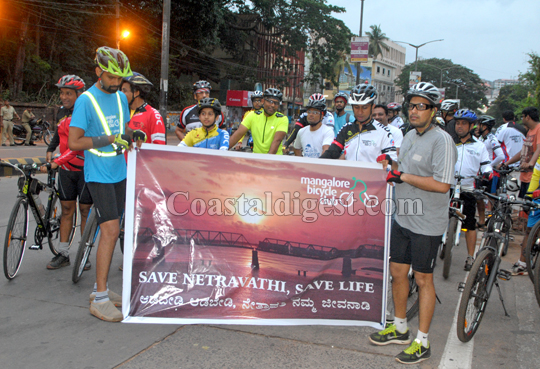
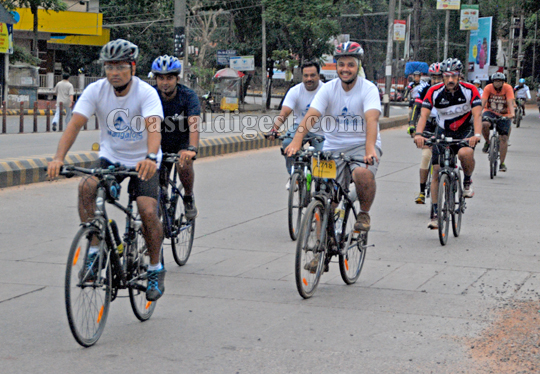
Mangaluru, May 19: Expressing their opposition to the Yettinahole Integrated Drinking Water Project, hundreds of cyclists in the coastal city joined the Dakshina Kannada district bandh on Thursday and took out a rally.

cyclerally 2

The Mangalore Bicycle Club, which has been organising several such green-initiatives, today led Save Netravathi Protest Ride. Members of Mangalore Cycling Club too joined the ride.
Members of both the clubs had participated in the Save Netravathi Ride from the city to Netravathi's confluence with the Arabian Sea at Ullal on October 4 last.

The 12-km ride started at 6 a.m. in front of the City Corporation Office at Lalbagh and passed through Urva Stores, Lady Hill, PVS Circle, Bunts Hostel, Balmatta Road, Deputy Commissioner's Office, Hampanakkate Circle, M.G. Road, V.T. Road, Car Street, Dongerkery Road, PVS Circle and culminated at the starting point.

Also Read : Dakshina Kannada once again shuts down against Yettinahole project

cyclerally 1

cyclerally 3

cyclerally 4

Comments

Priyanka
 - 
Thursday, 19 May 2016

we cyclist of mangalore always against yethinahole.

Swathi
 - 
Thursday, 19 May 2016

cycling for good cause we wont let other to take our water,

Add new comment

  • Coastaldigest.com reserves the right to delete or block any comments.
  • Coastaldigset.com is not responsible for its readers’ comments.
  • Comments that are abusive, incendiary or irrelevant are strictly prohibited.
  • Please use a genuine email ID and provide your name to avoid reject.
coastaldigest.com news network
May 23,2020

Mangaluru, May 23: Criticising the Karnataka government's fresh protocol for management of Covid-19 as expensive, a prominent physician in the city has demanded its withdrawal.

According to Dr B Srinivas Kakkilaya, the protocol released by the Health and Family Welfare Department on May 15 enlists unnecessary and unconfirmed tests and treatments. 

The protocol has classified Covid-19 cases into three categories and has provided for hospitalisation of all three categories of patients, from asymptomatic to the most severely ill.

In a letter to the government, Dr Kakkilaya said: "The protocol suggests several investigations to be done right on the day of admission, including blood counts, liver and renal function tests, chest X Ray, ECG, CT scan of the chest, and other special investigations, all of which, if done, will cost Rs 25,000 per patient."

"In the coming days when lakhs of patients are likely to be infected with SARS CoV2, is it necessary and feasible to hospitalise and test all these patients at Rs 25,000 per person," he questioned.

The treatment options suggested in the protocol are also surprising, he pointed out. "The protocol recommends choloroquine, azithromycin, oseltamivir, zinc and vitamin C for all patients, from asymptomatic to the severely ill, and also anti coagulant injections for many patients. All these would cost at least Rs 5,000 per patient. For severe cases of Covid-19, many unproven and experimental treatments have been suggested, which are very expensive and highly questionable," Dr Kakkilaya notes.

Therefore, this protocol, he asserted was not evidence based and likely to do more harm than good. He said these unnecessarily expensive tests and allowing private companies to conduct trials on Covid-19 patients is likely to be misused by vested interests and must be immediately withdrawn, and instead, a protocol that is evidence-based, simple and avoiding unnecessary expenses, must be developed.

Comments

Add new comment

  • Coastaldigest.com reserves the right to delete or block any comments.
  • Coastaldigset.com is not responsible for its readers’ comments.
  • Comments that are abusive, incendiary or irrelevant are strictly prohibited.
  • Please use a genuine email ID and provide your name to avoid reject.
News Network
July 2,2020

Bengaluru, Jul 2: As many as 3,363 students from Covid-19 containment zones have appeared for SSLC examinations in different parts of Karnataka till yesterday. On the first day of exam, i.e., on June 25, only 998 students these zones had written the exam.

In the past few days the number of containment zones has increased across the state in general and Bengaluru in particular. In all, 32 students could not appear for the exam as they turned positive.

While on June 25, the number of students who were found unwell during the check up at exam centre was 201, it was 613 on Wednesday. Students who are sick and those from the containment zones take the exam in a different room.

The social science exam on Wednesday saw an attendance percentage of 97.96 (7.68 lakh). This was against 98.78% last year. There were 7.45 lakh fresh candidates, 20,000 private candidates and 593 from outside the state.

Five students in Yadgir district were given question papers based on the old syllabus for maths exam on June 27. Their answerscripts will be evaluated separately and action will be taken against the officials.

Malpractices assisted by schools by switching off CCTV cameras were reported in Ballari and Koppal. “We’ve completed all the core subjects. Now only languages are left. We’ll complete them too in a safe environment,” said S Suresh Kumar, primary and secondary education minister.

Comments

Add new comment

  • Coastaldigest.com reserves the right to delete or block any comments.
  • Coastaldigset.com is not responsible for its readers’ comments.
  • Comments that are abusive, incendiary or irrelevant are strictly prohibited.
  • Please use a genuine email ID and provide your name to avoid reject.
Agencies
July 8,2020

The Central Board of Secondary Education (CBSE) has rationalised by up to 30 per cent the syllabus for classes 9 to 12 for the academic year 2020-21 to reduce course load on students amid the COVID-19 crisis, Union HRD Minister Ramesh Pokhriyal 'Nishank' announced on Tuesday.

The curriculum has been rationalised while retaining the core elements, the Human Resource Development said.

Among the chapters dropped after the rationalisation exercise are lessons on democracy and diversity, demonetisation, nationalism, secularism, India's relations with its neighbours and growth of local governments in India, among others.

"Looking at the extraordinary situation prevailing in the country and the world, CBSE was advised to revise the curriculum and reduce course load for the students of classes 9 to 12.

"To aid the decision, a few weeks back I also invited suggestions from all educationists on the reduction of syllabus for students and I am glad to share that we received more than 1.5K suggestions. Thank you, everyone, for the overwhelming response," Nishank tweeted.

"Considering the importance of learning achievement, it has been decided to rationalise syllabus up to 30 per cent by retaining the core concepts," he added.

The Union minister said the changes made in the syllabi have been finalised by the respective course committees with the approval of the curriculum committee and the Governing Body of the Board.

"The heads of schools and teachers have been advised by the board to ensure that the topics that have been reduced are also explained to the students to the extent required to connect different topics. However, the reduced syllabus will not be part of the topics for internal assessment and year-end board examination.

"Alternative academic calendar and inputs from the NCERT on transacting the curriculum using different strategies shall also be part of the teaching pedagogy in the affiliated schools," a senior official of the HRD ministry said.

For classes 1 to 8, the National Council of Education Research and Training (NCERT) has already notified an alternative calendar and learning outcomes.

According to the updated curriculum, among the chapters deleted from class 10 syllabus are-- democracy and diversity, gender, religion and caste, popular struggles and movement, challenges to democracy

For class 11, the deleted portions included chapters on federalism, citizenship, nationalism, secularism, growth of local governments in India.

Similarly, class 12 students will not be required to study chapters on India's relations with its neighbours, changing nature of India's economic development, social movements in India and demonetisation, among others.

Universities and schools across the country have been closed since March 16 when the central government announced a nationwide classroom shutdown as one of the measures to contain the COVID-19 outbreak.

A nationwide lockdown was announced on March 24, which came into effect the next day. While the government has eased several restrictions, schools and colleges continue to remain closed.


Comments

Add new comment

  • Coastaldigest.com reserves the right to delete or block any comments.
  • Coastaldigset.com is not responsible for its readers’ comments.
  • Comments that are abusive, incendiary or irrelevant are strictly prohibited.
  • Please use a genuine email ID and provide your name to avoid reject.