Mangaluru does it again: Green Corridor created for organ transport

[email protected] (CD Network)
February 25, 2016

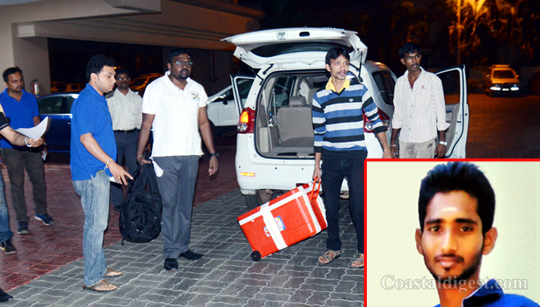
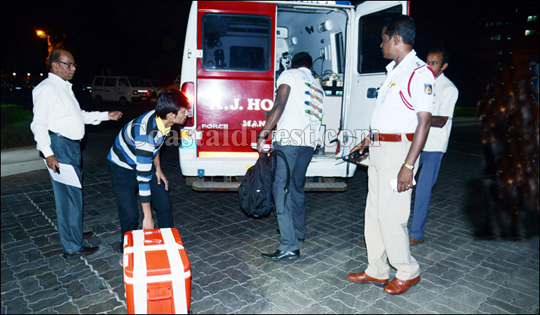
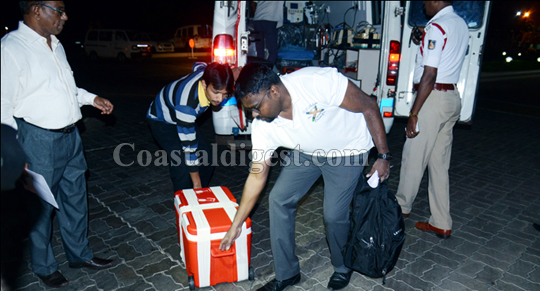
Mangaluru, Feb 25: For the second time in a year Mangaluru city traffic police on Thursday created a "green corridor" to facilitate unhindered transport of a brain dead donor's vital organ from a private hospital here to the Mangaluru International airport.

ajhospital

The harvested organs belonged to Vinith Raj, son of Krishna and Geetha Moolya, from Manjeshwar in Kasaragod district. The 19-year-old electrician was declared brain dead after he fell off a building following an electric shock recently.

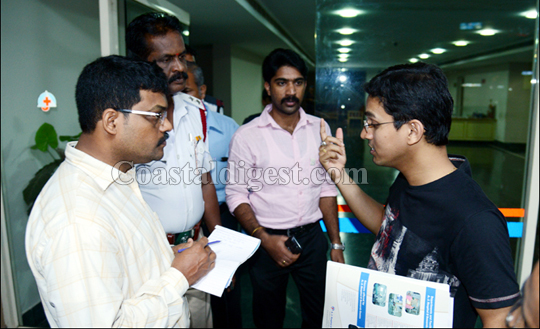
When Vinith Raj's parents conveyed their wish to donate his organs to the doctors at AJ Hospital, they made necessary arrangements. A team of surgeons from Bengaluru arrived on Wednesday night to assist the local doctors.

Though the surgeons from two hospitals successfully harvested kidney, heart valves, liver and cornea, only liver was taken to Bengaluru through Mangaluru Airport, sources said.

It is learnt that the transport took around 12 minutes, a distance of 11 kms, with nearly three dozen personnel overseeing that the ever-busy road remained clear of all vehicles.

It could be recalled here that Mangaluru police had created Green Corridor for the first time in April 2015 to transport the organ of Jeevan Vijay Fernandes, 24-year-old accident victim from Bellur in Bantwal taluk.

vinith 3

vinith 4

vinith 5

vinith 6

vinith 7

Comments

Sudesh pai
 - 
Thursday, 25 Feb 2016

Hats off to the above teamwork

Bhavya Shree
 - 
Thursday, 25 Feb 2016

A wonderful selfless act. He must have been a compassionate person.

Simmy
 - 
Thursday, 25 Feb 2016

Oh, my heart breaks for the family. My family also had to make the decision to donate my niece's organs. For me personally it was one of the most healing things knowing she had saved so many lives but I do often wonder how/where these people are.

Priyanka Kumta
 - 
Thursday, 25 Feb 2016

Selflessness - the stuff of real heroes.

Arjun Mahajan
 - 
Thursday, 25 Feb 2016

As a recipient of a heart just over two years ago I am eternally grateful for those who make this decision. I can continue to be a son, a husband, and a father to two small children.

Lemondo
 - 
Thursday, 25 Feb 2016

My brother passed unexpectedly on 24th February 2015, he too donated his organs. His selfless act has helped us, as a family to know he breaths through another & has assisted at least four other recipients & their families last year. We would love to reach out to the recipients on his 1yr memorial but understand the sensitivity for some and respect their privacy but it's hard.... I know it would mean the world to mum & dad to meet them & would greatly assist in their healing. I wish there was a 'tick box' option to opt in for communication between families.

Lisa
 - 
Thursday, 25 Feb 2016

My deepest condolences to his family and friends on his passing. Organ donation is a befitting gesture to honour this young man. With much love to you all at his difficult time.

Ivan
 - 
Thursday, 25 Feb 2016

Feel sorry for the man and his family...life is unpredictable.

Mohan Puthran
 - 
Thursday, 25 Feb 2016

RIP!!! You r a real hero buddy...

Lavina Monteiro
 - 
Thursday, 25 Feb 2016

these idiots will construct green corridors with lot of potholes. do practical and proper work rather than bs talk

Majid
 - 
Thursday, 25 Feb 2016

Why drones flying at low heights in some Specific colour can not be used for Organ Transportation?

Pinky
 - 
Thursday, 25 Feb 2016

At times the Mangalore Police makes us proud and kudos to the team that coordinated with the transplant team of one and all.

Pinky
 - 
Thursday, 25 Feb 2016

Very good. Appreciated the good work Police department

loyad Lesrado
 - 
Thursday, 25 Feb 2016

he has shown that humanity does still exist in India. well done,. May Almighty Bless him , this deceased Son as well as the patients who received the organs. Kudos ot medical fraternity along with police who made this happen

Add new comment

  • Coastaldigest.com reserves the right to delete or block any comments.
  • Coastaldigset.com is not responsible for its readers’ comments.
  • Comments that are abusive, incendiary or irrelevant are strictly prohibited.
  • Please use a genuine email ID and provide your name to avoid reject.
News Network
April 24,2020

Wayanad/Thiruvananthapuram, Apr 24: Amid the strict lockdown, a school teacher travelled from Thiruvananthapuram to Muthanga in Wayanad -- a distance of about 465 km -- on her way to neighbouring Karnataka en route to Delhi following which cases have been registered against her and an excise official.

The woman, Kamna Sharma, said to be working in Kendriya Vidyalaya, Pattom, undertook the journey on April 21 along with her two year-old daughter, police sources told news agency PTI.

An Excise Circle Inspector, Shahjahan, had provided his vehicle to travel allegedly on the instructions of Malappuram excise officer, in whose private vehicle, the woman and the child had reached Wayanad border from Thiruvananthapuram, the sources said.

The two were charged under the Kerala Epidemic Act and various sections of the IPC including sect 269 (negligent act likely to spread infection) and 271 (disobedience to quarantine rule).

Because of the lockdown even inter-district travel is not allowed by police and district administration, unless there is an extremely genuine reason.

A senior police official in Thiruvananthapuram said he does not remember issuing any such pass.

The woman may have "misused" government machinery as private vehicles would have been stopped somewhere during the long journey, he said.

She came to Kalpetta in Wayanad allegedly in an official car of the excise department.

Wayanad District police chief R Elango said that an FIR has been filed based on preliminary information and investigations have begun.

"We will check if she has followed procedures in obtaining a pass and if she made any false claim to get the pass."

As per preliminary information the woman came in an excise official's car from Thamarassery (Kozhikode) to Muthunga(Wayanad), he said. Her mode of transport before that--from Thiruvananthapuram to Wayanad--will also be investigated, he said, adding they have no information if she has reached Delhi.

"We will track down her movement," he said Meanwhile, theWayanad district administration has intensified the lockdown protocol from Thursday to prevent people's movement within and from outside the district/state.

Interception at all the check posts on district an state borders of the district, bordering Tamil Nadu and Karnataka, will also be intensified. No one would be allowed to travel frequently to and fro the district under the pretext of official duty.

Wayanad collector Adhila Abdulla said officials from outside the district will no longer be allowed to commute daily.

"Elderly people above the age of 65 should confine to their homes unless it is extremely urgent or unavoidable. Cases will be registered against family members who allow elderly people to go out for buying medicines and other essentials," she said.

Senior citizens, who live alone, can call either the Fire (101) or Police (100) departments for any help and to get things they need, the collector said.

Whatever relaxations were in place have also been withdrawn with effect from Thursday, she added.

Wayanad and Thiruvananthapuram come under the "Orange B" zone where there are some relaxations.

However, Thiruvananthapuram city limits falls under the hotspot area.

Police said a case was also registered against a doctor and her husband who entered Kerala from Tamil Nadu border.


Comments

Add new comment

  • Coastaldigest.com reserves the right to delete or block any comments.
  • Coastaldigset.com is not responsible for its readers’ comments.
  • Comments that are abusive, incendiary or irrelevant are strictly prohibited.
  • Please use a genuine email ID and provide your name to avoid reject.
Agencies
June 30,2020

Washington, Jun 30: Researchers in China have discovered a new type of swine flu that is capable of triggering a pandemic, according to a study published Monday in the US science journal PNAS.

Named G4, it is genetically descended from the H1N1 strain that caused a pandemic in 2009.

It possesses "all the essential hallmarks of being highly adapted to infect humans," say the authors, scientists at Chinese universities and China's Center for Disease Control and Prevention.

The researchers then carried out various experiments including on ferrets, which are widely used in flu studies because they experience similar symptoms to humans -- principally fever, coughing and sneezing. 

G4 was observed to be highly infectious, replicating in human cells and causing more serious symptoms in ferrets than other viruses.

Tests also showed that any immunity humans gain from exposure to seasonal flu does not provide protection from G4.

According to blood tests which showed up antibodies created by exposure to the virus, 10.4 percent of swine workers had already been infected.

The tests showed that as many as 4.4 percent of the general population also appeared to have been exposed.

The virus has therefore already passed from animals to humans but there is no evidence yet that it can be passed from human to human -- the scientists' main worry.

"It is of concern that human infection of G4 virus will further human adaptation and increase the risk of a human pandemic," the researchers wrote.

The authors called for urgent measures to monitor people working with pigs.

"The work comes as a salutary reminder that we are constantly at risk of new emergence of zoonotic pathogens and that farmed animals, with which humans have greater contact than with wildlife, may act as the source for important pandemic viruses," said James Wood, head of the department of veterinary medicine at Cambridge University.

A zoonotic infection is caused by a pathogen that has jumped from a non-human animal into a human.

Comments

Add new comment

  • Coastaldigest.com reserves the right to delete or block any comments.
  • Coastaldigset.com is not responsible for its readers’ comments.
  • Comments that are abusive, incendiary or irrelevant are strictly prohibited.
  • Please use a genuine email ID and provide your name to avoid reject.
News Network
June 7,2020

Bengaluru, Jun 7: An eminent scientist on Sunday suggested a shift system in schools to prevent spread of the coronavirus and continuing with online classes with focus on project-based learning in a big way to promote creativity.

Former Director General of the Defence Research and Development Organisation (DRDO) V K Saraswat supported the idea of online teaching in the absence of regular classes in view of closure of schools due to the COVID-19 pandemic.

But, he said it should be organised in far better and more interactive ways so that delivery of knowledge can be better. The NITI Aayog member stressed the need for schools to have a strategy when they reopen keeping in mind the safety of students.

May be they will have to organise shifts so that within the same space they can handle the students; May be they will have to employ more teachers, and they can run two shifts. "May be half the strength in a class can come in the morning and others in the afternoon.

Or students of first to sixth standard can come in the morning and seventh to tenth can come in the afternoon, Saraswat told PTI. Reopening strategy will have to be worked out by the education department, added the former Chief Scientific Advisor to the Defence Minister.

Along with normal classes, online education should be continued as a regular system in future, and promoted in a big way because that is the way technology is going to help delivery of knowledge, he added. Saraswat also raised the pitch for reforms in the education sector, saying India is facing the problem of rote learning.

Rote learning has to give way for more project-based teaching, he underlined. Children should be made to work on projects at home and that can be done online. That will also support the changeover from rote learning to creative learning.

I personally believe the education delivery system -- primary, secondary and college levels -- has to be completely changed because creativity in India is less and creativity would come only if we replace rote learning with project-based learning, Saraswat said.

On some academics holding the view that the marks-based model is killing the education system in India as it does not promote creativity, he said evaluation of any outcome is important. Even when we perform in our normal way, evaluation cannot be replaced.

Otherwise, you cant find out how much you have succeeded in delivery. Certainly evaluation cannot be dispensed with. He did not agree with some experts, who favoured a single, uniform system for school education in India by dispensing with CBSE, ICSE and state boards. I am not for normalising everything in life.

I personally believe variety should be there. This concept of one kind of a system is okay for a Communist society, society which was trying to drive everybody like a herd, he said.

Creativity comes with variety, and there is nothing wrong in having different kinds of education system, but one thing which is important is we have to integrate vocational training as part of the education curriculum," Saraswat said. Vocational part cannot be kept away from the education system, he added.

Comments

Add new comment

  • Coastaldigest.com reserves the right to delete or block any comments.
  • Coastaldigset.com is not responsible for its readers’ comments.
  • Comments that are abusive, incendiary or irrelevant are strictly prohibited.
  • Please use a genuine email ID and provide your name to avoid reject.