Mangaluru to get 15 smart CCTV cameras in sensitive places

News Network
January 5, 2020

Mangaluru, Jan 5: To keep an hawk's eye on the city, 15 prominent and crowded junctions in the city will have the most advanced CCTV cameras installed under the Smartcity project.

The junctions are-- Bejai KSRTC, Pumpwell, Vamanjoor, Padil, Mullikatte, Bejai, Bendoor, Falnir, Morgans Gate, Kulashekara-Shakthinagar Cross, Kottara Chowki, Kuntikan, Rao & Rao Circle, Padavinangady and Kavoor junctions.

According to top police officials, these junctions will receive approximately 75 cameras to check crime and aid in solving the cases of murder and robbery in the city.

A ‘smartpole’ will be installed there with each pole containing about five cameras along with a 360 degree swivelling camera.

Comments

Angry Indian
 - 
Sunday, 5 Jan 2020

One camera need inside the poilce cabin..


this will revel whom the police meet 

nidhin
 - 
Sunday, 5 Jan 2020

Better to install in Police station itself, at least it can reveal undisclosed Bhaithak. 

Add new comment

  • Coastaldigest.com reserves the right to delete or block any comments.
  • Coastaldigset.com is not responsible for its readers’ comments.
  • Comments that are abusive, incendiary or irrelevant are strictly prohibited.
  • Please use a genuine email ID and provide your name to avoid reject.
News Network
May 6,2020

Mysuru, May 6: A seven-months pregnant woman fled Covid-19 hotspot Mumbai along with her family, and made it to her village 1000 km away in KR Pet taluka in Mandya district of Karnataka, flashing her mother's ID card at each checkpost. After reaching her destination, she got herself tested for Covid-19.

She tested positive for the virus on Monday in Mandya.

The 20-year-old woman (assigned the number P637) had been living with her husband and in-laws at Santa Cruz East, Agripada in Mumbai for the past three years. To get out of the containment zone, they started out from Mumbai at 7.30 pm on April 23 -- she, her husband, brother-in-law, co-sister and their children, and a 19-year-old girl. She made it past checkposts at Belagavi, Hubballi, Davanagere, Kadur, Arasikere, Channarayapatna and Shravanabelagola and reached her village Jaaginakere at 3 pm on April 24.

She stayed at her home in the village from 24 April to April 29. With the Mandya district administration testing people on a campaign mode in the entire district, she and her family got themselves tested on May 1.

Her test returned positive on May 4, according to deputy commissioner M V Venkatesh.

Along with her, the 19-year-old girl (P638) who travelled with the family also tested positive. The girl is in the sixth semester of her BE Electronics course at an engineering college in Mumbai.

This is not the first case of a corona fugitive from Mumbai. Earlier, a 50-year-old man who ran a hotel in Mumbai travelled in a vehicle carrying dates and reached Channarayapatna in Hassan district.

In fact there have been three such incidents, including that of seven people coming to Mandya from Mumbai transporting a dead man's body for cremation in his native village of B Kodagalli in Pandavapura taluk.

Mandya deputy commissioner Dr Venkatesh has appealed to natives of Mandya who are stuck in Mumbai to stay there till the Covid situation comes to control.

So far 28 people in Mandya diatrict have tested positive for Covid 19. Seven people have been discharged. Currently there are 21 active cases being treated at the Mandya Institute of Medical Sciences.

Comments

Add new comment

  • Coastaldigest.com reserves the right to delete or block any comments.
  • Coastaldigset.com is not responsible for its readers’ comments.
  • Comments that are abusive, incendiary or irrelevant are strictly prohibited.
  • Please use a genuine email ID and provide your name to avoid reject.
News Network
August 2,2020

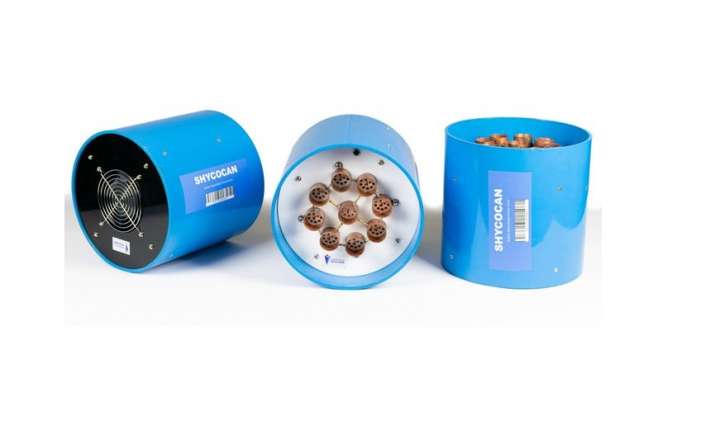
Bengaluru, Aug 2: Bengaluru based Centre for Advanced Research and Development (CARD), the research wing of organisation De scalene has come up with a device called "SHYCOCAN" (Scalene Hypercharge Corona Canon) which neutralizes the coronavirus.

Speaking to news agency Dr Rajah Vijay Kumar, Chairman, Organisation De Scalene said that the device will not kill any bacteria or fungus, however, neutralizes the coronavirus particles.

"The device was tested for its safety and efficacy and is soon going to be manufactured and marketed in the US under the Enforcement Discretion policy of USFDA and in Europe as the device is CE compliant and is CE marked," said Kumar.

He also added the device will cover a volume of 10,000 cubic feet.

The device Scalene Hypercharge Corona Canon (SHYCOCAN) is intended to be used in the residential, industrial and commercial environment and is designed for active containment by attenuation of Corona family of viruses. (Laboratories de Especialidades Immunological S.A. de C.V, Virucidal Activity concludes 99.9 per cent virus elimination), Kumar asserted.

"SHYCOCAN operates on regular 110/240V - 50/60 Hz wall socket and is a plug and play device, that delivers the necessary signals to a photon mediated electrons emitters (PMEE), that produces hypercharge high-velocity electrons by photon mediation that interacts with the negative seeking S-protein of Corona family of viruses thus reducing infectivity and prevent air and surface borne transmission of corona family of viruses," said Kumar.

The device does not use any chemicals, or any other consumables and does not produce harmful ozone gas or any other substances and is completely safe for use in any environment, he added.

"The attack mechanism of the Virus starts with the initial attachment of the virion to the host cell, it is initiated by interactions between the S-protein and its receptor on the "negative" cell membrane. The sites of receptor binding domains (RBD) within the S1 region of a coronavirus S-protein vary depending on the virus. 

The S-protein/receptor interaction is the primary determinant for a coronavirus to infect a host species and governs the tissue tropism of the virus. However, the end result is the fusion and release of the viral genome into the cytoplasm," said Kumar.

He continued saying that the counter mechanism by the device SHYCOCAN is that if negative seeking is the guidance mechanism of the S- Protein, attracted by the transmembrane potential of the host cells, then breaking this mechanism would block the Coronavirus infectivity and spread.

"The device has been in use for more than a year at the S-CARD campus, the headquarters of Scalene," said Kumar.


Comments

Add new comment

  • Coastaldigest.com reserves the right to delete or block any comments.
  • Coastaldigset.com is not responsible for its readers’ comments.
  • Comments that are abusive, incendiary or irrelevant are strictly prohibited.
  • Please use a genuine email ID and provide your name to avoid reject.
News Network
June 21,2020

India on Sunday witnessed annual solar eclipse or 'surya grahan' 2020, the third eclipse even for this year after first two lunar eclipses took place in January and June and the last annual solar eclipse of this decade.

The solar eclipse started from around 9 a.m. across the Indian map as the Sun, the Moon, and the Earth came in a straight line, and the country witnessed the 'deepest' annular solar eclipse in over a century.

Astrologers said it a fourth super rare hybrid eclipse which is a mix between an annular and total solar eclipse.

Areas like Hyderabad, Chennai, Bhubaneshwar, Kolkata, Lucknow, Mumbai, Delhi, Patna, Shillong and more witnessed a partial phase of the annular solar eclipse from 9 a.m.

In the eclipse, the distance of the Moon and Earth will be larger than usual which means the moon will not be able to cover up the sun fully and will leave out the borders of the sun - giving an appearance of a "Ring of Fire".

Press Information Bureau in a tweet informed that it is the last annular solar eclipse in India of this decade.

People can catch glimpse of the partially covered sun between 10 a.m. and 2.28 p.m. as per the time differing as locations in India. The eclipse will continue for over three hours covering 84 per cent Sun.

There are three types of solar eclipses - total, partial, and annular.

Comments

Add new comment

  • Coastaldigest.com reserves the right to delete or block any comments.
  • Coastaldigset.com is not responsible for its readers’ comments.
  • Comments that are abusive, incendiary or irrelevant are strictly prohibited.
  • Please use a genuine email ID and provide your name to avoid reject.

