


Mangaluru goes cashless; common man's struggles continue on 6th day

[email protected] (CD Network | Suresh)
November 14, 2016

Mangaluru, Nov 14: Even six days after the abolishment of Rs 500 and Rs 1,000 notes, the coastal city of Mangaluru has failed to recover from the unexpected shock.
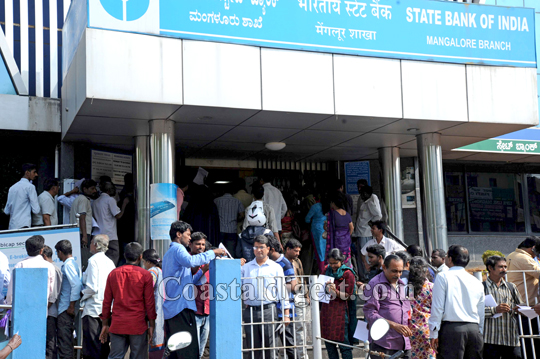
bankque 5

In fact, the demonetization move has affected pretty much every sphere of life — from getting provisions and eating out, to making routine payments such as rent and salaries to domestic help.

While making announcement of demonetization, the government has assured that banks would work on weekends too for exchange of notes. Ironically, on week days too the banks and ATMs are functioning partially thanks to scarcity of notes.

The government on Monday has extended the usage of existing Rs.500 and Rs.1,000 notes for select transactions till 24 November from the earlier deadline of 14 November.

This means that people can now use these notes at government hospitals, government-run cooperative shops, air-ticket counters, milk booths, petrol stations, international airports, to buy tickets at railway stations, to pay for medicines in government and private medical shops, to get cooking gas cylinders, and to pay court fees till 24 November. 

However, thanks to the scarcity of change, the government's relaxation has not improved the situation in the city.

No change in bunks

Petrol bunks are accepting old Rs 500 and Rs 1,000 notes, but you can only fill up for amounts in increments of Rs 500. The reason is that the bunk employees don't have Rs 100 notes to return as change. So if you want to fill fuel for, say, Rs 200, chances are you won't get Rs 300 back.

Market Woes

The future for hundreds of vegetable, fruits and other household merchants, who supply daily needs to entire city is in quandary. "From Sunday onwards I have stopped the purchasing of goods and will resume when everything turns to normalcy," says worried vegetable merchant Peter D'Souza.

Abdul Salam, wholesale fruit merchant at the market shares that they have given goods in credit to regular customers. "Since all are transactions are done in Rs 500 and Rs 1000 currency, we have no other way out. For some we have given credit and asked our suppliers to wait for some days to clear their dues," he maintains.

Other merchants complain that they don't have enough change to tender with customers. "All customers are giving us Rs 2000 note. If they make business of Rs 200 or Rs 300, we have to give them change in Rs 100 notes. How can it be possible when bank themselves don't have Rs 100 notes," adds another lemon merchant.

Comments

ibbu Saheb
 - 
Monday, 14 Nov 2016

ACCHE DIN AAGAYE... AUR BI ACCHE DIN ANE WALE HAI...
SO KEEP YOUR ENERGY FOR MORE AND MORE ACCHE DIN...

Rikaz
 - 
Monday, 14 Nov 2016

Be patient, Mr. Modi said it would take 50 days.....after 50 days they will withdrew 2,000 and re-initiate new 1,000 currency....wait and see....

Add new comment

  • Coastaldigest.com reserves the right to delete or block any comments.
  • Coastaldigset.com is not responsible for its readers’ comments.
  • Comments that are abusive, incendiary or irrelevant are strictly prohibited.
  • Please use a genuine email ID and provide your name to avoid reject.
News Network
April 19,2020

Kasaragod, Apr 19: Kasaragod, Kerala's COVID-19 hotspot, is the only district in the southern state lacking adequate health infrastructure.

In spite of treating the highest number of COVID-19 patients in the state with meagre infrastructural facilities and even without the support of a medical college in the north Kerala district, no deaths have been reported due to coronavirus.

The state health department views the performance of M Kunhiraman and his team, consisting of Janardhana Naik and Krishna Naik, at the General hospital in Kasaragod as a success story.

"Not only did they control the situation quickly with minimum infrastructure, they also started turning out a large number of negative cases within a few weeks and creditably ensured zero mortality.

This can be showcased as a best global model," Chairman of the Information Education and Communication (IEC) Committee and Project Director Kerala State Aids Control Society, R Ramesh said.

Recalling the ordeal, Janardhana Naik said his first major challenge was the physical examination of a patient with suspected COVID-19.

"Even with the PPE kit, nobody knew how effective they were and it took a whole 30 minutes to wear them properly.

But as time passed, we got accustomed to it," he said.

The traditional method of dealing with a patient involved knowing his or her history, observation and physical examination.

For hundreds of years, the hands-on body approach has been the soul of the doctor-patient relationship -- taking the pulse, tapping on and listening to the chest, feeling lumps.

With the onset of COVID-19 all that has changed.

"In fact, the whole exercise was fraught with grave risks because everything connected with COVID-19 was new.

Doctors have to keep a distance even though the physical examination wearing a Personal Protective Equipment (PPE) is difficult.

Sounds from the body are inaudible, vision is blurred through the smog-covered goggles and a stethoscope seldom has any use," Janardhana Naik said.

It was from March 15 that the hospital started receiving COVID-19 patients, primarily from Dubai.

By the time the first person came, the hospital was ready for him.

Soon, patient numbers began to swell and in a couple of weeks they reached about 91.

From then on, it was teamwork.

Committees were formed for each and every task, including the help desk, IT, treatment, medical board, training, food, waste disposal and data maintenance.

Initially, patients had many misgivings about the hospital.

"Some were disillusioned and even aggressive. Some were not happy with the facilities the hospital had to offer.

But gradually through good treatment and counselling by a psychiatrist, who visited the hospital on alternate days, the confidence and mood of the patients changed and they became friendly with the staff," Naik elaborated.

Counselling was also given to the concerned family members of the patients.

Besides treatment, the medical staff had to spend a considerable amount of time clearing the doubts of patients.

When they got discharged some patients insisted on seeing the faces of the medical staff, who till then were anonymous entities covered from head to toe.

Some even wanted to take selfies with them.

However, the medical team politely turned down their requests and preferred to remain hidden in their work attires.

The mood of the patients also rubbed off on the doctors and hospital staff.

All the physicians and hospital staff are now more confident of dealing with contagious diseases after treating COVID-19 patients.

"Our previous experience of treating H1N1, Chikungunya and Dengue cases helped us a lot.

Words of encouragement from the Health Minister K K Shailaja, Health Principal Secretary Dr Rajan N Khobragade and Health Services Director Dr Sarita R L gave us the impetus to build up confidence.

Moreover, the field health workers did a wonderful job in containing the viral spread," Naik added.

As the number of coronavirus cases rose, the state government on April 5 deputed a 26-member medical team from Thiruvananthapuram to set up a COVID-19 hospital in the district.

They turned a block of the under construction Government Medical College as a hospital-like facility, setting up a 200 bed facility to treat coronavirus patients.

Comments

Add new comment

  • Coastaldigest.com reserves the right to delete or block any comments.
  • Coastaldigset.com is not responsible for its readers’ comments.
  • Comments that are abusive, incendiary or irrelevant are strictly prohibited.
  • Please use a genuine email ID and provide your name to avoid reject.
News Network
July 15,2020

Bengaluru, Jul 15: As on Wednesday, Bengaluru witnessed its first day of lockdown after rising number of Corona cases in the city. In a latest development, popular Kannada actor Dhruva Sarja and his wife Prerana Sarja have tested positive for COVID-19 sending shockwaves in the indutry.

Dhruva Sarja is the nephew of Arjun Sarja and younger brother of Chiranjeevi Sarja who passed away last month after suffering a massive heart attack.

The actor has requested people, who came in contact with them, to get tested immediately.

"My wife and I have both been tested positive for COVID-19 with mild symptoms and hence chosen to get ourselves hospitalised. I'm sure we'll be back all fine! All those who were in close proximity with us please get yourselves tested and remain safe," he tweeted.

In recent times, Mandya MP and popular actress Sumalatha Ambereesh too tested positive, now Dhruva Sarja is the second notable celebrity from Sandalwood to have tested positive for COVID-19.

A source close to the actor's family says that "During Chiranjeevi's funeral last month, some sections of people who had attended had also tested positive, as social distancing rules were not followed by those who attended the funeral. But now, the family has quarantined and there is no cause for worry. Dhruva has also requested all his primary contact to come forward voluntarily and get tested."

Comments

Add new comment

  • Coastaldigest.com reserves the right to delete or block any comments.
  • Coastaldigset.com is not responsible for its readers’ comments.
  • Comments that are abusive, incendiary or irrelevant are strictly prohibited.
  • Please use a genuine email ID and provide your name to avoid reject.
Agencies
June 13,2020

New Delhi, Jun 13: Loss of smell or taste has been added to the list of COVID-19 symptoms, according to the revised clinical management protocols released by the Union Health Ministry on Saturday.

The ministry said that coronavirus-infected patients reporting to various COVID-19 treatment facilities have been reporting symptoms like fever, cough, fatigue, shortness of breath, expectoration, myalgia, rhinorrhea, sore throat and diarrhea.

They have also complained of loss of smell (anosmia) or loss of taste (ageusia) preceding the onset of respiratory symptoms.

Older people and immune-suppressed patients in particular may present with atypical symptoms such as fatigue, reduced alertness, reduced mobility, diarrhoea, loss of appetite, delirium, and absence of fever, the ministry said.

Children might not have reported fever or cough as frequently as adults.

The US's national public health institute, the Centers for Disease Control and Prevention (CDC), had in early May incorporated "a new loss of taste or smell" in the list of COVID-19 symptoms.

According to the data from Integrated Health Information Platform and Integrated Disease Surveillance Programme, portal case investigation forms for COVID 19 (n=15,366), the details on the signs and symptoms reported are (as on June 11), fever (27 per cent), cough (21 pc), sore throat (10 pc), breathlessness (8 pc), Weakness (7 pc), running nose (3pc ) and others 24 pc.

According to the health ministry, people infected by the novel coronavirus are the main source of infection.

Direct person-to-person transmission occurs through close contact, mainly through respiratory droplets that are released when the infected person coughs, sneezes, or talks.

These droplets may also land on surfaces, where the virus remains viable. Infection can also occur if a person touches an infected surface and then touches his or her eyes, nose, or mouth.

The median incubation period is 5.1 days (range 2–14 days). The precise interval during which an individual with COVID-19 is infectious is uncertain.

As per the current evidence, the period of infectivity starts 2 days prior to onset of symptoms and lasts up to 8 days.

The extent and role played by pre-clinical/ asymptomatic infections in transmission still remain under investigation.

Comments

Add new comment

  • Coastaldigest.com reserves the right to delete or block any comments.
  • Coastaldigset.com is not responsible for its readers’ comments.
  • Comments that are abusive, incendiary or irrelevant are strictly prohibited.
  • Please use a genuine email ID and provide your name to avoid reject.