


Mangaluru goes cashless; common man's struggles continue on 6th day

[email protected] (CD Network | Suresh)
November 14, 2016

Mangaluru, Nov 14: Even six days after the abolishment of Rs 500 and Rs 1,000 notes, the coastal city of Mangaluru has failed to recover from the unexpected shock.
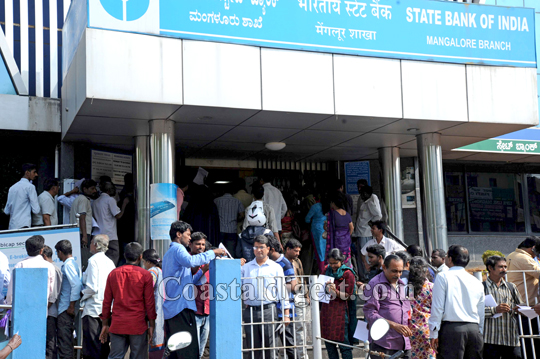
bankque 5

In fact, the demonetization move has affected pretty much every sphere of life — from getting provisions and eating out, to making routine payments such as rent and salaries to domestic help.

While making announcement of demonetization, the government has assured that banks would work on weekends too for exchange of notes. Ironically, on week days too the banks and ATMs are functioning partially thanks to scarcity of notes.

The government on Monday has extended the usage of existing Rs.500 and Rs.1,000 notes for select transactions till 24 November from the earlier deadline of 14 November.

This means that people can now use these notes at government hospitals, government-run cooperative shops, air-ticket counters, milk booths, petrol stations, international airports, to buy tickets at railway stations, to pay for medicines in government and private medical shops, to get cooking gas cylinders, and to pay court fees till 24 November. 

However, thanks to the scarcity of change, the government's relaxation has not improved the situation in the city.

No change in bunks

Petrol bunks are accepting old Rs 500 and Rs 1,000 notes, but you can only fill up for amounts in increments of Rs 500. The reason is that the bunk employees don't have Rs 100 notes to return as change. So if you want to fill fuel for, say, Rs 200, chances are you won't get Rs 300 back.

Market Woes

The future for hundreds of vegetable, fruits and other household merchants, who supply daily needs to entire city is in quandary. "From Sunday onwards I have stopped the purchasing of goods and will resume when everything turns to normalcy," says worried vegetable merchant Peter D'Souza.

Abdul Salam, wholesale fruit merchant at the market shares that they have given goods in credit to regular customers. "Since all are transactions are done in Rs 500 and Rs 1000 currency, we have no other way out. For some we have given credit and asked our suppliers to wait for some days to clear their dues," he maintains.

Other merchants complain that they don't have enough change to tender with customers. "All customers are giving us Rs 2000 note. If they make business of Rs 200 or Rs 300, we have to give them change in Rs 100 notes. How can it be possible when bank themselves don't have Rs 100 notes," adds another lemon merchant.

Comments

ibbu Saheb
 - 
Monday, 14 Nov 2016

ACCHE DIN AAGAYE... AUR BI ACCHE DIN ANE WALE HAI...
SO KEEP YOUR ENERGY FOR MORE AND MORE ACCHE DIN...

Rikaz
 - 
Monday, 14 Nov 2016

Be patient, Mr. Modi said it would take 50 days.....after 50 days they will withdrew 2,000 and re-initiate new 1,000 currency....wait and see....

Add new comment

  • Coastaldigest.com reserves the right to delete or block any comments.
  • Coastaldigset.com is not responsible for its readers’ comments.
  • Comments that are abusive, incendiary or irrelevant are strictly prohibited.
  • Please use a genuine email ID and provide your name to avoid reject.
News Network
March 3,2020

Kalaburagi, Mar 3: Former Karnataka Minister Priyank Kharge on Monday in a letter requested Karnataka Assembly Speaker Sri Vishveshvaraya Hegade Kageri that the restricted media coverage in Assembly Budget session was not the right thing and it will be danger of for healthy democracy.

The letter written by Mr. Kharge to the Karnataka Assembly speaker which available to the press said that the fourth pillar of democracy 'Media' ban from covering assembly proceedings was not a healthy move and requested to immediately withdraw the government order in this regards, he said.

Comments

Add new comment

  • Coastaldigest.com reserves the right to delete or block any comments.
  • Coastaldigset.com is not responsible for its readers’ comments.
  • Comments that are abusive, incendiary or irrelevant are strictly prohibited.
  • Please use a genuine email ID and provide your name to avoid reject.
costaldigest.com news network
June 28,2020

Mangaluru, June 28: Three fresh deaths in last 24 hours have taken the total number of covid-19 deaths in Dakshina Kannada district to 13.

While a 31-year-old youth from Idya in Surathkal and a 57-year-old woman from Bantwal passed away last night, a 52-year-old woman from Jokatte breathed her last today. 

The youth from Suratkal breathed his last in Wenlok. The woman from Bantwal’s Loretto Padav village was unwell for last 1 year. She was tested positive three days ago and passed away at a private hospital. 

The woman from Jokatte was reportedly suffering from tuberculosis. On June 26, she was admitted to a private hospital in the city, where she was tested coronavirus positive.

As per the district health bulletin on Saturday June 27 evening, a total of 12,919 samples have been sent for tests till date, out of which 12,198 have turned out negative, and 576 positive, including 10 persons from other districts. 

Out of these, 148 are currently active. As many as 416 persons have recovered and been discharged.

Comments

Add new comment

  • Coastaldigest.com reserves the right to delete or block any comments.
  • Coastaldigset.com is not responsible for its readers’ comments.
  • Comments that are abusive, incendiary or irrelevant are strictly prohibited.
  • Please use a genuine email ID and provide your name to avoid reject.
Agencies
May 8,2020

Washington D.C., May 8: The prime time for brain development in a child's life is the first year, where the infant spends most of the time asleep. It is the time when neural connections form and sensory memories are encoded.

However, when sleep is disrupted, as occurs more often among children with autism, brain development may be affected, too.

New research led by the University of Washington finds that sleep problems in a baby's first 12 months may not only precede an autism diagnosis but also may be associated with altered growth trajectory in a key part of the brain, the hippocampus.

The study, which was published in the American Journal of Psychiatry, researchers report that in a sample of more than 400 taken of 6- to 12-month-old infants, those who were later diagnosed with autism were more likely to have had difficulty falling asleep.

It also states that this sleep difficulty was associated with altered growth trajectories in the hippocampus.

"The hippocampus is critical for learning and memory, and changes in the size of the hippocampus have been associated with poor sleep in adults and older children.

As many as 80 per cent of the children with autism spectrum disorder have sleep problems," said Annette Estes, director of the UW Autism Center and senior author of the study.

"In our clinical experience, parents have a lot of concerns about their children's sleep, and in our work on early autism intervention, we observed that sleep problems were holding children and families back," added Estes, who is also a UW professor of speech and hearing sciences.

"It could be that altered sleep is part-and-parcel of autism for some children. One clue is that behavioural interventions to improve sleep don't work for all children with autism, even when their parents are doing everything just right. This suggests that there may be a biological component to sleep problems for some children with autism," said Estes.

To consider links among sleep, brain development, and autism, researchers at the IBIS Network looked at MRI scans of 432 infants, surveyed parents about sleep patterns, and measured cognitive functioning using a standardized assessment.

At the outset of the study, infants were classified according to their risk for developing autism: Those who were at higher risk of developing autism -- about two-thirds of the study sample -- had an older sibling who had already been diagnosed.

Infant siblings of children with autism have a 20 per cent chance of developing autism spectrum disorder -- a much higher risk than children in the general population.

In the current study, 127 of the 432 infants were identified as "low risk" at the time the MRI scans were taken because they had no family history of autism.

They later evaluated all the participants at 24 months of age to determine whether they had developed autism. Of the roughly 300 children originally considered "high familial risk," 71 were diagnosed with autism spectrum disorder at that age.

Problems with sleep were more common among the infants later diagnosed with an autism spectrum disorder, as were larger hippocampi. No other subcortical brain structures were affected, including the amygdala, which is responsible for certain emotions and aspects of memory, or the thalamus, a signal transmitter from the spinal cord to the cerebral cortex.

The authors note that while parents reported more sleep difficulties among infants who developed autism compared to those who did not, the differences were very subtle and only observed when looking at group averages across hundreds of infants.

Sleep patterns in the first years of life change rapidly as infants transition from sleeping around the clock to a more adult-like sleep/wake cycle. Until further research is completed, Estes said, it is not possible to interpret challenges with sleep as an early sign of increased risk for autism.

Comments

Add new comment

  • Coastaldigest.com reserves the right to delete or block any comments.
  • Coastaldigset.com is not responsible for its readers’ comments.
  • Comments that are abusive, incendiary or irrelevant are strictly prohibited.
  • Please use a genuine email ID and provide your name to avoid reject.