


Mangaluru goes cashless; common man's struggles continue on 6th day

[email protected] (CD Network | Suresh)
November 14, 2016

Mangaluru, Nov 14: Even six days after the abolishment of Rs 500 and Rs 1,000 notes, the coastal city of Mangaluru has failed to recover from the unexpected shock.
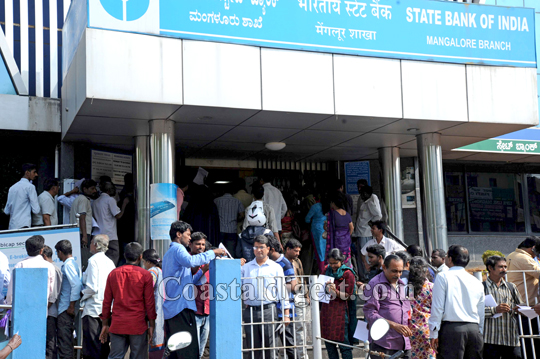
bankque 5

In fact, the demonetization move has affected pretty much every sphere of life — from getting provisions and eating out, to making routine payments such as rent and salaries to domestic help.

While making announcement of demonetization, the government has assured that banks would work on weekends too for exchange of notes. Ironically, on week days too the banks and ATMs are functioning partially thanks to scarcity of notes.

The government on Monday has extended the usage of existing Rs.500 and Rs.1,000 notes for select transactions till 24 November from the earlier deadline of 14 November.

This means that people can now use these notes at government hospitals, government-run cooperative shops, air-ticket counters, milk booths, petrol stations, international airports, to buy tickets at railway stations, to pay for medicines in government and private medical shops, to get cooking gas cylinders, and to pay court fees till 24 November. 

However, thanks to the scarcity of change, the government's relaxation has not improved the situation in the city.

No change in bunks

Petrol bunks are accepting old Rs 500 and Rs 1,000 notes, but you can only fill up for amounts in increments of Rs 500. The reason is that the bunk employees don't have Rs 100 notes to return as change. So if you want to fill fuel for, say, Rs 200, chances are you won't get Rs 300 back.

Market Woes

The future for hundreds of vegetable, fruits and other household merchants, who supply daily needs to entire city is in quandary. "From Sunday onwards I have stopped the purchasing of goods and will resume when everything turns to normalcy," says worried vegetable merchant Peter D'Souza.

Abdul Salam, wholesale fruit merchant at the market shares that they have given goods in credit to regular customers. "Since all are transactions are done in Rs 500 and Rs 1000 currency, we have no other way out. For some we have given credit and asked our suppliers to wait for some days to clear their dues," he maintains.

Other merchants complain that they don't have enough change to tender with customers. "All customers are giving us Rs 2000 note. If they make business of Rs 200 or Rs 300, we have to give them change in Rs 100 notes. How can it be possible when bank themselves don't have Rs 100 notes," adds another lemon merchant.

Comments

ibbu Saheb
 - 
Monday, 14 Nov 2016

ACCHE DIN AAGAYE... AUR BI ACCHE DIN ANE WALE HAI...
SO KEEP YOUR ENERGY FOR MORE AND MORE ACCHE DIN...

Rikaz
 - 
Monday, 14 Nov 2016

Be patient, Mr. Modi said it would take 50 days.....after 50 days they will withdrew 2,000 and re-initiate new 1,000 currency....wait and see....

Add new comment

  • Coastaldigest.com reserves the right to delete or block any comments.
  • Coastaldigset.com is not responsible for its readers’ comments.
  • Comments that are abusive, incendiary or irrelevant are strictly prohibited.
  • Please use a genuine email ID and provide your name to avoid reject.
News Network
February 22,2020

Bengaluru, Feb 22: Thanks to joint efforts by the Protector of Emigrants in Bengaluru and Indian Embassy in Qatar, a 26-year-old woman from Karnataka who had been kept in confinement in Qatar has been rescued and brought back to India.

Anupama (name changed) from Holenarasipura in Hassan district arrived in Bengaluru on Thursday night. She was allegedly locked up in a house for 14 days, restrained from using a mobile and wasn't fed. There were three other women with her. On the midnight of February 12, they broke the window panes and fled before contacting local police.

Anupama, a diploma graduate in computer science, was jobless and her friend working in Kuwait suggested she try for a job abroad. She contacted an agency based in Chikkamagaluru which offered her a nanny's job in Qatar. After document verification, the agency demanded she pay Rs 2 lakh but she said she didn't have that kind of money.

The agency sent Anupama on a visitor visa but told her if questioned by immigration officials, she must claim she was visiting her sister. They also gave her a return ticket.

As Anupama was travelling abroad for the first time, she said she was ignorant about several things.

On January 12, Anupama left Bengaluru. But as she reached Qatar, all her documents, including passport, were confiscated by the agency. Her return ticket was cancelled and she was sent to a house to work as babysitter-cum-cook for Rs 30,000. She lived with four other maids in the same house, where they were made to work for 16-18 hours a day.

"I used to wake up around 5.30am every day and had to prepare breakfast for the employers by 6.30am. My work would end around 11pm every day. We never even got time to eat," Anupama told media on Friday. Four days into work, Anupama's nose started bleeding. However, the employers cared little and insisted she continue to work. After 18 days, she requested her employers that she be relieved.

The agency sent her to a house where three women were already present and locked her up with them. "They used to give us a glass of raw rice, an onion, tomato and potato to cook for ourselves. While we got rice every day, we had to use the vegetables for three days. We were not supposed to use mobiles or go out. Two people were monitoring us," she recalled.

Anupama and the others decided to approach police but for that they needed to escape. Around 1.30am on February 12, the four women managed to break window panes and jumped out. They ran for more than a kilometre and managed to approach police, who summoned the agency and got the women to speak to their families.

Anupama called her brother-in-law, who approached the Protector of Emigrants office in Koramangala, Bengaluru. Shubham Singh, PoE in Bengaluru, said they took up the issue with the Indian Embassy in Qatar, which immediately got in touch with Qatar police. Anupama said, "We were kept in prison for a couple of days and were sent to the deportation centre later."

Meanwhile, the Indian embassy got the agency to return the women's documents. However, the agents did not pay their salaries. Two of the women were sent to Hyderabad and the third to Kerala. On Friday, Anupama met Singh at his office, where her statement was recorded. "We have started the process of initiating action against the agency in India," he said.

Comments

Add new comment

  • Coastaldigest.com reserves the right to delete or block any comments.
  • Coastaldigset.com is not responsible for its readers’ comments.
  • Comments that are abusive, incendiary or irrelevant are strictly prohibited.
  • Please use a genuine email ID and provide your name to avoid reject.
News Network
February 14,2020

Mangaluru, Feb 14: Police have submitted over 50 videos in a pen drive to Udupi Deputy Commissioner G Jagadeesha as evidence to violent protests that led to police firing on December 19 in which Jaleel and Nausheen died.

ACP and police nodal officer Belliyappa submitted a pen drive consisting over 50 video clips including CCTV footage. 

The police earlier had submitted 20 digital video recorder (DVR) before the court and an acknowledgement of the same was produced before the Magistrate.

Hearing on video evidence will be held at High Court on February 24.

Comments

Add new comment

  • Coastaldigest.com reserves the right to delete or block any comments.
  • Coastaldigset.com is not responsible for its readers’ comments.
  • Comments that are abusive, incendiary or irrelevant are strictly prohibited.
  • Please use a genuine email ID and provide your name to avoid reject.
News Network
July 26,2020

Bengaluru, Jul 26: A year-long probe by Coffee Day Enterprises Ltd (CDEL) has found that its late founder V G Siddhartha routed Rs 2,693 crore out of the company to Mysore Amalgamated Coffee Estates Ltd (MACEL), another privately-owned entity of him.

The MACEL owes Rs 3,535 crore to subsidiaries of Coffee Day Enterprises as of July 31, 2019 of which only Rs 842 crore was accounted.

"Therefore, a sum of Rs 2,693 crore is the incremental outstanding that needs to be addressed," said the report of an investigation headed by Ashok Kumar Malhotra, a retired DIG of Central Bureau of Investigation (CBI) and assisted by law firm Agastya Agastya Legal.

Siddhartha was found dead in early August 2019, and many suspected that he had committed suicide.

Steps are being taken by subsidiaries of CDEL for recovery of dues from MACEL, the company said.

"The board authorised the Chairman to appoint an ex-judge of the Supreme Court or the High Court, or any other person of eminence, to suggest and oversee actions for recovery of the dues from MACEL and to help on any other associated matters," it said in regulatory filings at stock exchanges late on Friday.

The probe further gives clean chits to the Income Tax Department and the private equity firms who Siddhartha in his parting letter had alleged of harassment.

"We have not been provided with any documentary evidence to draw an inference that there may have been any advertent or inadvertent harassment from the Income Tax Department," said the probe report.

The probe also highlighted severe liquidity crunch at CDEL in the build-up to Siddhartha's death.

A committee supported by senior professionals was formed to protect the interest of all stakeholders. CDEL said the debt levels which were about Rs 7,200 crore on March 31, 2019 have been brought down significantly by Rs 4,000 crore. The present debt of the group is around Rs 3,200 crore.

"The disinvestment process in the group continues and we are confident to have effective solution to all stakeholders," it said.

Comments

Add new comment

  • Coastaldigest.com reserves the right to delete or block any comments.
  • Coastaldigset.com is not responsible for its readers’ comments.
  • Comments that are abusive, incendiary or irrelevant are strictly prohibited.
  • Please use a genuine email ID and provide your name to avoid reject.