


Mangaluru goes cashless; common man's struggles continue on 6th day

[email protected] (CD Network | Suresh)
November 14, 2016

Mangaluru, Nov 14: Even six days after the abolishment of Rs 500 and Rs 1,000 notes, the coastal city of Mangaluru has failed to recover from the unexpected shock.
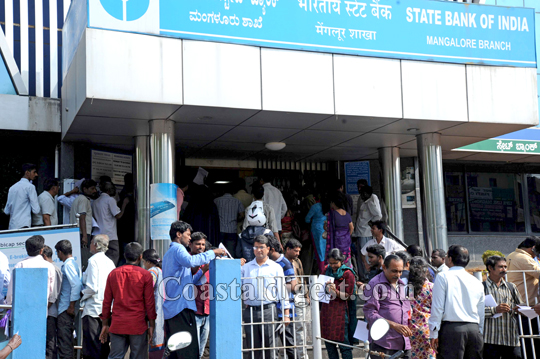
bankque 5

In fact, the demonetization move has affected pretty much every sphere of life — from getting provisions and eating out, to making routine payments such as rent and salaries to domestic help.

While making announcement of demonetization, the government has assured that banks would work on weekends too for exchange of notes. Ironically, on week days too the banks and ATMs are functioning partially thanks to scarcity of notes.

The government on Monday has extended the usage of existing Rs.500 and Rs.1,000 notes for select transactions till 24 November from the earlier deadline of 14 November.

This means that people can now use these notes at government hospitals, government-run cooperative shops, air-ticket counters, milk booths, petrol stations, international airports, to buy tickets at railway stations, to pay for medicines in government and private medical shops, to get cooking gas cylinders, and to pay court fees till 24 November. 

However, thanks to the scarcity of change, the government's relaxation has not improved the situation in the city.

No change in bunks

Petrol bunks are accepting old Rs 500 and Rs 1,000 notes, but you can only fill up for amounts in increments of Rs 500. The reason is that the bunk employees don't have Rs 100 notes to return as change. So if you want to fill fuel for, say, Rs 200, chances are you won't get Rs 300 back.

Market Woes

The future for hundreds of vegetable, fruits and other household merchants, who supply daily needs to entire city is in quandary. "From Sunday onwards I have stopped the purchasing of goods and will resume when everything turns to normalcy," says worried vegetable merchant Peter D'Souza.

Abdul Salam, wholesale fruit merchant at the market shares that they have given goods in credit to regular customers. "Since all are transactions are done in Rs 500 and Rs 1000 currency, we have no other way out. For some we have given credit and asked our suppliers to wait for some days to clear their dues," he maintains.

Other merchants complain that they don't have enough change to tender with customers. "All customers are giving us Rs 2000 note. If they make business of Rs 200 or Rs 300, we have to give them change in Rs 100 notes. How can it be possible when bank themselves don't have Rs 100 notes," adds another lemon merchant.

Comments

ibbu Saheb
 - 
Monday, 14 Nov 2016

ACCHE DIN AAGAYE... AUR BI ACCHE DIN ANE WALE HAI...
SO KEEP YOUR ENERGY FOR MORE AND MORE ACCHE DIN...

Rikaz
 - 
Monday, 14 Nov 2016

Be patient, Mr. Modi said it would take 50 days.....after 50 days they will withdrew 2,000 and re-initiate new 1,000 currency....wait and see....

Add new comment

  • Coastaldigest.com reserves the right to delete or block any comments.
  • Coastaldigset.com is not responsible for its readers’ comments.
  • Comments that are abusive, incendiary or irrelevant are strictly prohibited.
  • Please use a genuine email ID and provide your name to avoid reject.
News Network
January 29,2020

Newsroom, Jan 29: Karnataka’s capital has earned the unwelcome distinction of global capital of traffic congestion. According to a report by TomTom, the Netherlands-based global provider of navigation, traffic and map products, Bengaluru beat 415 other cities across 57 countries to earn the title of world's most traffic congested city in 2019.

“Bengaluru takes the top spot this year with drivers in the southern Indian city expecting to spend an average of 71% extra travel time stuck in traffic," TomTom said in the ninth edition of its annual Traffic Index.

Three other Indian cities, namely, Mumbai, Pune and New Delhi are also ranked in the 2019 edition of TomTom’s Traffic Index of the world’s most traffic-congested cities. 

The report released on Tuesday ranks cities by the average time added to a trip. TomTom index also includes details on when congestion is heaviest and lightest, how highways compare with surface streets, and how much time drivers wasted waiting for other drivers to get out of their way.

Following closely on the heels of Bengaluru is Manila, Philippines, with the similar 71% traffic congestion. Among the top five worst traffic affected cities are Mumbai and Pune from India at the fourth and fifth place respectively, while Bogota, Colombia is on third spot.

Delhi, the national capital of India is on the 8th spot, while Moscow (Russia), Lima (Peru), Istanbul (Turkey) and Jakarta (Indonesia) are on 6th, 7th, 9th and 10th spot respectively.

Mumbai recorded a 65% traffic congestion with 9th September, 2019 being the worst day. On an average, a Mumbaikar lost 209 hours in traffic congestion. Pune has 59% traffic congestion with 2nd August, 2019 being the worst day. 193 hours are lost due to congestion. Delhi, on the other hand, has 56% traffic congestion. 23rd October, 2019 was the worst day, while 190 hours are lost in traffic congestion.

Interestingly, among all the four Indian cities, Delhi has the most number of cars. Previous studies have concluded that Delhi has the best road conditions among the Metro cities of India.

If you are wondering what exactly the percentages mean, a 53% congestion level in Bangkok, for example, means that a trip will take 53% more time than it would during Bangkok’s baseline uncongested conditions.

TomTom calculates the baseline per city by analyzing free-flow travel times of all vehicles on the entire road network – recorded 24/7, 365 days a year. The report by Dutch navigation and mapping company ranks cities by the average time added to a trip. It also includes details on when congestion is heaviest and lightest, and how much time drivers wasted waiting for other drivers to get out of their way.

Comments

Add new comment

  • Coastaldigest.com reserves the right to delete or block any comments.
  • Coastaldigset.com is not responsible for its readers’ comments.
  • Comments that are abusive, incendiary or irrelevant are strictly prohibited.
  • Please use a genuine email ID and provide your name to avoid reject.
News Network
February 16,2020

Hubballi, Feb 16: Rs 72,000 crore investment proposals were received at the Invest Karnataka meet, here on Friday, for the states northern region, said an official on Saturday.

"About 50 foreign and domestic firms have proposed to invest Rs 72,000 crore in the northwest and northern regions of the state and a dozen companies signed agreements with us," state Industries Department Secretary Gaurav Gupta said.

Rajesh Exports, Bengaluru-based group, signed an agreement to set up a manufacturing unit at Dharwad to rollout electric vehicles and make lithium ion batteries.

"Rajesh Exports proposes to invest about Rs 50,000 crore for manufacturing electric cars and lithium ion batteries for the domestic and overseas markets. It will generate about 10,000 jobs," said Gupta.

Similarly, Sonali Power has signed a pact with the state nodal agency (Udyog Mitra) to set up a solar power plant at Davangere at a cost of Rs 4,800 crore, which will generate 2,100 direct jobs.

Chief Minister B.S. Yediyurappa claimed several firms had come forward to collectively invest Rs 1 lakh crore since the BJP government came into being in July 2019.

"Many Indian and foreign firms will sign agreements with the state government at the 3-day Global Investors meet in Bengaluru on November 3-5," Yediyurappa said at the 'Invest Karnataka' meet.

Noting that Karnataka was rich in natural and human resources, especially in high-tech and skilled workforce, Yediyurappa said investment opportunities were plenty in aerospace, automobiles, machine tools, electric vehicles and bio-technology besides information technology.

"About 40 global firms expressed interest to invest in the state at a roadshow held at Davos, Switzerland, on the margins of the World Economic Forum (WEF) meet on January 23," he said.

Under the new industrial policy, the state government will set up clusters to make toys at Koppal, textiles in Bellari, solar equipment at Kalaburagi and farm machinery at Bidar.

"We are committed to make North Karnataka a power house of industries for the region's development, with Hubballi-Dharwad as the growth hub," Yediyurappa said.

Comments

Add new comment

  • Coastaldigest.com reserves the right to delete or block any comments.
  • Coastaldigset.com is not responsible for its readers’ comments.
  • Comments that are abusive, incendiary or irrelevant are strictly prohibited.
  • Please use a genuine email ID and provide your name to avoid reject.
News Network
May 29,2020

Bengaluru, May 29: Seven out of ten (72 per cent) workers in Karnataka reported having lost their employment during the COVID-19-induced lockdown, according to findings of a survey by Azim Premji University, in collaboration with ten civil society organisations.

The university said in a statement it conducted "a detailed" phone survey of 5,000 workers across 12 states in the country, to gauge the impact of the COVID-19 lockdown on employment, livelihoods, and access to government relief schemes.

The survey covered self-employed, casual, and regular wage and salaried workers and it released the findings for Karnataka on Thursday.

Seventy-six per cent of urban workers and 66 per cent of rural workers lost their employment, the survey findings said.

For non-agricultural self-employed workers and wage workers, who were still employed, average weekly earnings fell by two-third.

More than four in ten salaried workers (44 per cent) saw either a reduction in their salary or received no salary during the lockdown.

Six out of ten households reported that they did not have enough money to buy even a weeks worth of essential items, according to the survey.

Eight out ten households reported a reduction in food intake, while less than three in ten vulnerable households (27 per cent) in urban Karnataka received any form of cash transfer from the government, it said.

In summary, the disruption in the Karnatakas economy and labour markets is enormous. Livelihoods have been devastated at unprecedented levels during the lockdown.

The recovery from this could be slow and very painful, the statement said.

As a response to the findings of this survey, the team which has conducted the survey suggested a universalisation of the PDS to expand its reach and implementation of expanded rations for at least the next six months.

It suggested cash transfers equal to at least Rs.7000 per month for two months, and proactive steps like expansion of MGNREGA, introduction of urban employment guarantee, and investment in universal basic services, among others.

Comments

Add new comment

  • Coastaldigest.com reserves the right to delete or block any comments.
  • Coastaldigset.com is not responsible for its readers’ comments.
  • Comments that are abusive, incendiary or irrelevant are strictly prohibited.
  • Please use a genuine email ID and provide your name to avoid reject.