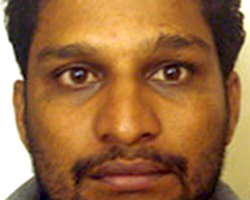
Mangaluru: Homestay attacker Subahsh Padil attacked on court premises

[email protected] (CD Network)
June 4, 2016

Mangaluru, Jun 4: Hindutva leader Subash Padil who was arrested under goonda Act in 2012 following his involvement in infamous Mangaluru homestay attack, was on Saturday attacked by a rival gang on the court premises in the cityhomesty.

homestayIt is learnt that Subhash Padil and his associates suffered injuries after Raja alias Japan Manga, a petty criminal, attacked them randomly with a sharp weapon.

According to sources, the intention of Japan Marga was to murder Subhash Padil. However, the assailant was caught by constables Harish, Mahanthesh and ASI Sridhar and taken into custody immediately.

The incident occurred when Subhash Padil and other accused were brought to the Sessions Court in connection with the hearing of homestay attack case.

It could be recalled here that on July 28, 2012, activists belonging to the Hindu Jagarana Vedike, affiliated with the Sangh Parivar, allegedly a birthday party at Morning Mist' homestay at Padil in the city.

The 12 people at the party, including 5 girls, were allegedly beaten, stripped and molested. The faces of some girls were blackened. The assailants claimed the youngsters were consuming alcohol and were involved in "some indecent activities".

Subhash Padil was one of the main accused in the case. He was also involved in threatening women sitting in Amnesai Bar and Restaurant in Mangaluru in January 2009. He has nearly two dozen cases against him in various police stations in the city.

japan 1

japan 2

japan 3

japan 4

Comments

Satyameva Jayate
 - 
Sunday, 5 Jun 2016

@ preeti......Dogs will die like dog one day........with respect...... These dogs will die like pigs one day....

Ask yourself.
 - 
Saturday, 4 Jun 2016

Cheddis trapped him badly...They ask him to the act and know it is out of control to take him out of this situation.. May be they want to finish him and blame it on others... That the nature of Cheddis ... So cheddis members who commit evil acts.. REMEMBER THis when some of your leaders encourage to do evil in the society.

Shayan Manohan
 - 
Saturday, 4 Jun 2016

A big Solute to the police, today exactly police strike still police doing their job,

mohammed fayaz
 - 
Saturday, 4 Jun 2016

shay just miss !!!!

Shahid
 - 
Saturday, 4 Jun 2016

Maadiddunno maraya.....

Manohar
 - 
Saturday, 4 Jun 2016

he s innocent he dint do anything, simply politicians are targeting him to slow down other serious issues.

Zaheer
 - 
Saturday, 4 Jun 2016

why police saved him, simply daily food and his expenses loss for the govt. i mean for the people living in this country should take all his expenses by through tax paying,

Arun Rao
 - 
Saturday, 4 Jun 2016

this attack planned by \akorchi anna birthday yenna\" guy. :P"

Preethi
 - 
Saturday, 4 Jun 2016

Dog will die like dog one day.

Arjun
 - 
Saturday, 4 Jun 2016

this are criminals dont call them hindu jagarana vedike activists, criminals dont have any religion and group. this third class people are always fighting and die one day, their s no end if u call them as a activists..

Add new comment

  • Coastaldigest.com reserves the right to delete or block any comments.
  • Coastaldigset.com is not responsible for its readers’ comments.
  • Comments that are abusive, incendiary or irrelevant are strictly prohibited.
  • Please use a genuine email ID and provide your name to avoid reject.
News Network
January 10,2020

Bengaluru, Jan 10: Education technology company Byju’s is learnt to have raised $200 million in a funding round from Tiger Global Management, which has valued the Bengaluru-based start-up at around $8 billion, making it the third-largest unicorn (start-up valued over $1 billion) in the country.

With this, the Byju Raveendran-founded company has seen over 50 per cent jump in its valuation in just around nine months. In March 2019, Byju’s was valued $5.4 billion, when it raised around $31 million from General Atlantic, and Chinese investment giant Tencent.

At the current valuation, Byju’s has now replaced home-grown cab-hailing major Ola as the third-largest unicorn, next only to Paytm and OYO, which are valued around $16 billion and $10 billion, respectively.

Byju’s confirmed the transaction through a press statement, though the company declined to share any specific details of the deal. Tiger Global could not be immediately reached for its comments.

“We are happy to partner with a strong investor like Tiger Global Management. They share our sense of purpose and this partnership will advance our long-term vision of creating an impact by changing the way students learn,” said Raveendran. “This partnership is both a validation of the impact created by us so far and a vote of confidence for our long-term vision.”

This is Tiger Global’s first investment in the edutech space in India after Vendantu, an online tutoring platform, where it, along with WestBridge Capital, led a $42-million round in August.

An early backer of India’s internet growth story, the New York-headquartered Tiger Global has been a prolific investor in the Indian start-up space. Its portfolio in the country ranges from consumer focused e-commerce companies that are vital for the growth of the sector, such as Flipkart, Delhivery, Grofers, Quikr and PolicyBazaar, to mention a few.

After tasting success with Flipkart, one of its earliest investments, where it had pumped in around $1 billion, the PE major is now doubling down its focus on the Indian start-up space, under its new investment head Scott Shleifer.

Shleifer, who set up international private equity practice for Tiger Global, is said to be as aggressive deal maker like his predecessor Lee Fixel, who left the investment firm in March. Since then, Tiger has also invested in a host of technology-focused companies in diverse sectors including Ninjacart, CRED, NoBroker and Facilio to mention a few.

“Byju’s has emerged as the leader in the Indian education-tech sector. They are pioneering technology shaping the future of learning for millions of school students in India,” Shleifer was quoted in the press statement issued by the edutech firm.

Comments

Add new comment

  • Coastaldigest.com reserves the right to delete or block any comments.
  • Coastaldigset.com is not responsible for its readers’ comments.
  • Comments that are abusive, incendiary or irrelevant are strictly prohibited.
  • Please use a genuine email ID and provide your name to avoid reject.
News Network
July 1,2020

Bengaluru, Jul 1: Karnataka Pradesh Congress Committee (KPCC) chief DK Shivakumar on Wednesday said that the state Chief Minister BS Yediyurappa should apologise to the nation for the Ballari incident.

"It is shocking to see the Ballari incident. The way the dead bodies of the corona victims have been treated is very unfortunate. The entire country witnessed it. I request the Chief Minister BS Yediyurappa to apologise to the nation. India is known for its values and traditions," Shivakumar told reporters here.

Earlier, Shivakumar had posted a video which allegedly showed officials 'inhumanly' dumping bodies of those patients who die of COVID into a pit in Ballari, the district administration confirmed it and said that the entire field team involved in the incident has been disbanded.

"It's disturbing to see bodies of COVID patients who have died being dumped inhumanly into a pit in Ballari. Is this civility? This is a reflection of how the government has handled this Corona crisis. I urge the govt to take immediate action and ensure that this doesn't happen again," Shivakumar's tweet, which also had a video of the incident embedded, read.

The Deputy Commissioner, Ballari issued a press note which stated that it had conducted an enquiry after the video surfaced and it was found that the video belonged to the district and "comprises of burial of eight people who passed away after succumbing to COVID-19."

Although, according to the DC, all protocols and SOPs were followed by the team during the burial process, however, the "disrespectful handling of the bodies while being lowered on to the ground by the field staff" led to the entire field team involved being disbanded and will be replaced by a new team trained by the HOD, Forensic, VIMS.

The district administration also issued an unconditional apology to the families of the deceased and to others who were hurt by the incident.

Meanwhile, Chief Minister BS Yediyurappa also termed the behaviour of the staff "very inhuman and very painful" and urged the staff to tread cautiously with humanity in handling the funeral of those affected by the disease, and added, "Let's walk with humanity, and realize that there is no greater religion than humanity." 

Comments

Add new comment

  • Coastaldigest.com reserves the right to delete or block any comments.
  • Coastaldigset.com is not responsible for its readers’ comments.
  • Comments that are abusive, incendiary or irrelevant are strictly prohibited.
  • Please use a genuine email ID and provide your name to avoid reject.
News Network
July 28,2020

Hounde, Jul 28: Coronavirus and its restrictions are pushing already hungry communities over the edge, killing an estimated 10,000 more young children a month as meager farms are cut off from markets and villages are isolated from food and medical aid, the United Nations warned Monday.

In the call to action shared with The Associated Press ahead of publication, four UN agencies warned that growing malnutrition would have long-term consequences, transforming individual tragedies into a generational catastrophe.

Hunger is already stalking Haboue Solange Boue, an infant from Burkina Faso who lost half her former body weight of 5.5 pounds (2.5 kilograms) in just a month. Coronavirus restrictions closed the markets, and her family sold fewer vegetables. Her mother was too malnourished to nurse.

“My child,” Danssanin Lanizou whispered, choking back tears as she unwrapped a blanket to reveal her baby's protruding ribs.

More than 550,000 additional children each month are being struck by what is called wasting, according to the UN — malnutrition that manifests in spindly limbs and distended bellies. Over a year, that's up 6.7 million from last year's total of 47 million. Wasting and stunting can permanently damage children physically and mentally.

“The food security effects of the COVID crisis are going to reflect many years from now,” said Dr. Francesco Branca, the WHO head of nutrition. “There is going to be a societal effect.”

From Latin America to South Asia to sub-Saharan Africa, more poor families than ever are staring down a future without enough food.

In April, World Food Program head David Beasley warned that the coronavirus economy would cause global famines “of biblical proportions” this year. There are different stages of what is known as food insecurity; famine is officially declared when, along with other measures, 30% of the population suffers from wasting.

The World Food Program estimated in February that one Venezuelan in three was already going hungry, as inflation rendered salaries nearly worthless and forced millions to flee abroad. Then the virus arrived.

“Every day we receive a malnourished child,” said Dr. Francisco Nieto, who works in a hospital in the border state of Tachira.

In May, Nieto recalled, after two months of quarantine, 18-month-old twins arrived with bodies bloated from malnutrition. The children's mother was jobless and living with her own mother. She told the doctor she fed them only a simple drink made with boiled bananas.

“Not even a cracker? Some chicken?” he asked.

“Nothing,” the children's grandmother responded. By the time the doctor saw them, it was too late: One boy died eight days later.

The leaders of four international agencies — the World Health Organization, UNICEF, the World Food Program and the Food and Agriculture Organization — have called for at least dollar 2.4 billion immediately to address global hunger.

But even more than lack of money, restrictions on movement have prevented families from seeking treatment, said Victor Aguayo, the head of UNICEF's nutrition program.

“By having schools closed, by having primary health care services disrupted, by having nutritional programs dysfunctional, we are also creating harm,” Aguayo said. He cited as an example the near-global suspension of Vitamin A supplements, which are a crucial way to bolster developing immune systems.

In Afghanistan, movement restrictions prevent families from bringing their malnourished children to hospitals for food and aid just when they need it most. The Indira Gandhi hospital in the capital, Kabul, has seen only three or four malnourished children, said specialist Nematullah Amiri. Last year, there were 10 times as many.

Because the children don't come in, there's no way to know for certain the scale of the problem, but a recent study by Johns Hopkins University indicated an additional 13,000 Afghans younger than 5 could die.

Afghanistan is now in a red zone of hunger, with severe childhood malnutrition spiking from 690,000 in January to 780,000 — a 13% increase, according to UNICEF.

In Yemen, restrictions on movement have blocked aid distribution, along with the stalling of salaries and price hikes. The Arab world's poorest country is suffering further from a fall in remittances and a drop in funding from humanitarian agencies.

Yemen is now on the brink of famine, according to the Famine Early Warning Systems Network, which uses surveys, satellite data and weather mapping to pinpoint places most in need.

Some of the worst hunger still occurs in sub-Saharan Africa. In Sudan, 9.6 million people live from one meal to the next — a 65% increase from the same time last year.

Lockdowns across Sudanese provinces, as around the world, have dried up work and incomes for millions. With inflation hitting 136%, prices for basic goods have more than tripled.

“It has never been easy but now we are starving, eating grass, weeds, just plants from the earth,” said Ibrahim Youssef, director of the Kalma camp for internally displaced people in war-ravaged south Darfur.

Adam Haroun, an official in the Krinding camp in west Darfur, recorded nine deaths linked with malnutrition, otherwise a rare occurrence, over the past two months — five newborns and four older adults, he said.

Before the pandemic and lockdown, the Abdullah family ate three meals a day, sometimes with bread, or they'd add butter to porridge. Now they are down to just one meal of “millet porridge” — water mixed with grain. Zakaria Yehia Abdullah, a farmer now at Krinding, said the hunger is showing “in my children's faces.”

“I don't have the basics I need to survive,” said the 67-year-old, who who hasn't worked the fields since April. “That means the 10 people counting on me can't survive either.”


Comments

Add new comment

  • Coastaldigest.com reserves the right to delete or block any comments.
  • Coastaldigset.com is not responsible for its readers’ comments.
  • Comments that are abusive, incendiary or irrelevant are strictly prohibited.
  • Please use a genuine email ID and provide your name to avoid reject.