Mangaluru: MLA J R Lobo lauds PFI's national scholarship scheme

[email protected] (CD Network)
January 16, 2017

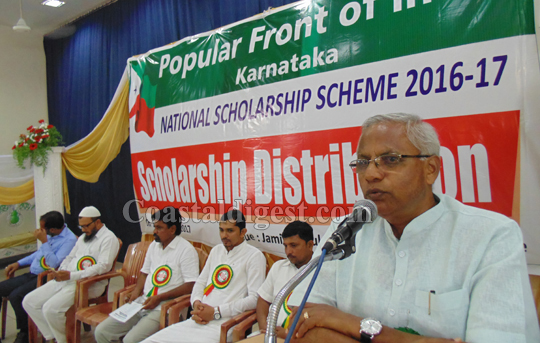
Mangaluru, Jan 16: The Popular Front of India's national scholarship scheme (NSS) through which economically backward meritorious students across the country are identified and provided scholarship is commendable, said J R Lobo, Mangaluru South MLA.

pfi 4

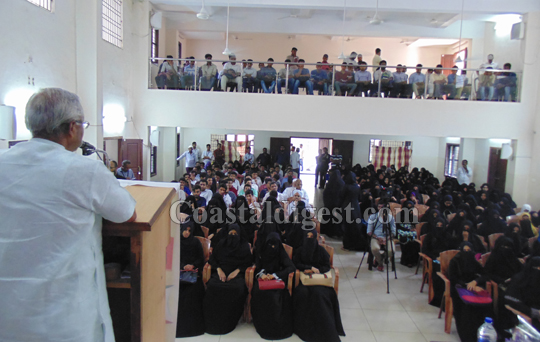
He was speaking after inaugurating a scholarship distribution programme organized as part of NSS at Jamiatul Falah Auditorium, Mangaluru on Sunday. Scholarships worth Rs 12.93 lakh were distributed among 180 students on the occasion.

M A Gafoor, president, Minority Development Corporation, said that the development of our country is possible if all social organizations give prominence to education by taking up such initiatives. “In our county which is known for unity in diversity, the Muslim community has contributed enormously since pre-independence period,” he added.

“As our organization is working for the development of the Muslim community and backward communities, it is giving due importance to educational development” said Shafi Bellare, State Secretary of PFI in his presidential speech.

Ajaz Krishnapura, Corporater, Mangaluru, Nazir Tumbe, Director of Community Development unit, PFI were also present. Hanif Katipalla welcomed and Siraj Kavuru proposed vote of thanks.

pfi 2

pfi 3

Comments

Mohammad
 - 
Monday, 16 Jan 2017

Khader Should Learn from Lobo what is PFI?

Think Tank
 - 
Monday, 16 Jan 2017

Well done PFI....Good initiatives

Think Tank
 - 
Monday, 16 Jan 2017

Well done Mr.Lobo ......this is the real secularism............you deserve to be our guest for this occasion................

Add new comment

  • Coastaldigest.com reserves the right to delete or block any comments.
  • Coastaldigset.com is not responsible for its readers’ comments.
  • Comments that are abusive, incendiary or irrelevant are strictly prohibited.
  • Please use a genuine email ID and provide your name to avoid reject.
News Network
April 2,2020

The current physical distancing guidelines provided by the World Health Organisation (WHO) and by the US Centers for Disease Control and Prevention (CDC) may not be adequate to curb the coronavirus spread, according to a research which says the gas cloud from a cough or sneeze may help virus particles travel up to 8 metres. The research, published in the Journal of the American Medical Association, noted that the the current guidelines issued by the WHO and CDC are based on outdated models from the 1930s of how gas clouds from a cough, sneeze, or exhalation spread.

Study author, MIT associate professor Lydia Bourouiba, warned that droplets of all sizes can travel 23 to 27 feet, or 7-8 metres, carrying the pathogen.

According to Bourouiba, the current guidelines are based on "arbitrary" assumptions of droplet size, "overly simplified", and "may limit the effectiveness of the proposed interventions" against the deadly pandemic.

 She explained that the old guidelines assume droplets to be one of two categories, small or large, taking short-range semi-ballistic trajectories when a person exhales, coughs, or sneezes.

However based on more recent discoveries, the MIT scientist said, sneezes and coughs are made of a puff cloud that carries ambient air, transporting within it clusters of droplets of a wide range of sizes.

Bourouiba warned that this puff cloud, with ambient air entrapped in it, can offer the droplets moisture and warmth that can prevent it from evaporation in the outer environment.

"The locally moist and warm atmosphere within the turbulent gas cloud allows the contained droplets to evade evaporation for much longer than occurs with isolated droplets," she said.

"Under these conditions, the lifetime of a droplet could be considerably extended by a factor of up to 1000, from a fraction of a second to minutes," the researcher explained in the study.

The MIT scientist, who has researched the dynamics of coughs and sneezes for years, added that these droplets settle along the trajectory of a cough or sneeze contaminating surfaces, with their residues staying suspended in the air for hours.

"Even when maximum containment policies were enforced, the rapid international spread of COVID-19 suggests that using arbitrary droplet size cutoffs may not accurately reflect what actually occurs with respiratory emissions, possibly contributing to the ineffectiveness of some procedures used to limit the spread of respiratory disease," Bourouiba wrote in the study

Comments

Add new comment

  • Coastaldigest.com reserves the right to delete or block any comments.
  • Coastaldigset.com is not responsible for its readers’ comments.
  • Comments that are abusive, incendiary or irrelevant are strictly prohibited.
  • Please use a genuine email ID and provide your name to avoid reject.
News Network
February 22,2020

Bengaluru, Feb 22: Thanks to joint efforts by the Protector of Emigrants in Bengaluru and Indian Embassy in Qatar, a 26-year-old woman from Karnataka who had been kept in confinement in Qatar has been rescued and brought back to India.

Anupama (name changed) from Holenarasipura in Hassan district arrived in Bengaluru on Thursday night. She was allegedly locked up in a house for 14 days, restrained from using a mobile and wasn't fed. There were three other women with her. On the midnight of February 12, they broke the window panes and fled before contacting local police.

Anupama, a diploma graduate in computer science, was jobless and her friend working in Kuwait suggested she try for a job abroad. She contacted an agency based in Chikkamagaluru which offered her a nanny's job in Qatar. After document verification, the agency demanded she pay Rs 2 lakh but she said she didn't have that kind of money.

The agency sent Anupama on a visitor visa but told her if questioned by immigration officials, she must claim she was visiting her sister. They also gave her a return ticket.

As Anupama was travelling abroad for the first time, she said she was ignorant about several things.

On January 12, Anupama left Bengaluru. But as she reached Qatar, all her documents, including passport, were confiscated by the agency. Her return ticket was cancelled and she was sent to a house to work as babysitter-cum-cook for Rs 30,000. She lived with four other maids in the same house, where they were made to work for 16-18 hours a day.

"I used to wake up around 5.30am every day and had to prepare breakfast for the employers by 6.30am. My work would end around 11pm every day. We never even got time to eat," Anupama told media on Friday. Four days into work, Anupama's nose started bleeding. However, the employers cared little and insisted she continue to work. After 18 days, she requested her employers that she be relieved.

The agency sent her to a house where three women were already present and locked her up with them. "They used to give us a glass of raw rice, an onion, tomato and potato to cook for ourselves. While we got rice every day, we had to use the vegetables for three days. We were not supposed to use mobiles or go out. Two people were monitoring us," she recalled.

Anupama and the others decided to approach police but for that they needed to escape. Around 1.30am on February 12, the four women managed to break window panes and jumped out. They ran for more than a kilometre and managed to approach police, who summoned the agency and got the women to speak to their families.

Anupama called her brother-in-law, who approached the Protector of Emigrants office in Koramangala, Bengaluru. Shubham Singh, PoE in Bengaluru, said they took up the issue with the Indian Embassy in Qatar, which immediately got in touch with Qatar police. Anupama said, "We were kept in prison for a couple of days and were sent to the deportation centre later."

Meanwhile, the Indian embassy got the agency to return the women's documents. However, the agents did not pay their salaries. Two of the women were sent to Hyderabad and the third to Kerala. On Friday, Anupama met Singh at his office, where her statement was recorded. "We have started the process of initiating action against the agency in India," he said.


Comments

Add new comment

  • Coastaldigest.com reserves the right to delete or block any comments.
  • Coastaldigset.com is not responsible for its readers’ comments.
  • Comments that are abusive, incendiary or irrelevant are strictly prohibited.
  • Please use a genuine email ID and provide your name to avoid reject.
News Network
March 13,2020

Bengaluru, Mar 13: India has registered the first confirmed case of death due to novel coronavirus. A 76-year-old man from Karnataka's Kalaburgi who passed away recently has been tested positive for Covid-19.

The doctors had suspected that the man had coronavirus, however, the test had not confirmed it.

In an official notification, a senior health official in Karnataka government Dr Suresh Shastri said that the lab test has confirmed that the deceased man had Covid-19.

"The 76-year-old man from Kalburgi who passed away and was a suspected COVID 19 patient has been confirmed for COVID 19. The necessary contact tracing, isolation and other measures as per protocol are being carried out. Telangana government has also been informed since he went to a private hospital there," Dr Suresh Shastri said.

The same information was also shared by Karnataka health minister B Sriramulu.

A senior Union health ministry official said in New Delhi that the death of the man had visited Saudi Arabia from January 29 to February 29. The official said the man had reached in Hyderabad on February 29 and went to Kalaburagi in Karnataka.

State Joint Director (Communicable Diseases) BG Prakash Kumar said all protocols were followed for disposal of the body.

"The body is disinfected completely and disposed of as per the Government of India guidelines," he added when asked to elaborate on the protocols.

He said the Telangana government has also been informed as the man had gone to a private hospital in Hyderabad earlier.

While announcing the death of the man on Tuesday, the state authorities had said the exact cause his death was being ascertained.

According to the Union health ministry official, "While he was asymptomatic on his return (from Saudi Arabia), he developed symptoms of fever and cough on 6th March. One private doctor visited him at his home and treated him there."

"On 9th March, the symptoms got aggravated and he was shifted to a private hospital in Kalaburagi. In this private hospital, he was provisionally diagnosed as 'mid-zone viral pneumonia' and 'suspected Covid-19'," the official said.

"The sample was collected on March 9... Without waiting for the test results, the attendees insisted and the patient was discharged against medical advice and the attendees took him to a private hospital in Hyderabad," the official said.

The patient was admitted to a private hospital in Hyderabad and treated. He died on Tuesday when he was being brought back to the Gulbarga Institute of Medical Sciences (GIMS) in Kalaburagi.

Apart from the deceased, Karnataka has confirmed five other positive cases of the novel coronavirus. The fifth case, confirmed on Thursday is of a 26-year-old man who recently returned from Greece.

The patient has been admitted and isolated at a hospital and his condition is stable, a department media bulletin said.

The day also saw the education department declaring summer holidays for students from kindergarten to class six and study leave for higher classes in the city as a precautionary measure.

Comments

Add new comment

  • Coastaldigest.com reserves the right to delete or block any comments.
  • Coastaldigset.com is not responsible for its readers’ comments.
  • Comments that are abusive, incendiary or irrelevant are strictly prohibited.
  • Please use a genuine email ID and provide your name to avoid reject.