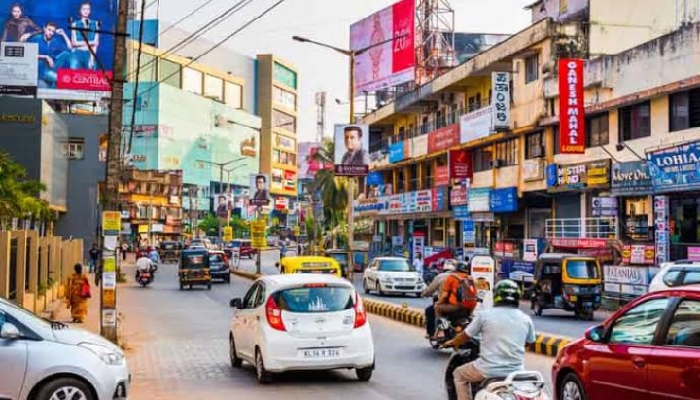
Mangaluru: NRI’s 7-year-old son dies after getting stuck in lift

coastaldigest.com web desk
August 24, 2018

Mangaluru, Aug 24: In a heartbreaking tragedy, a 7-year-old boy died after getting stuck in a lift in a residential apartment in the heart of the city of Mangaluru.

The deceased has been identified as Muhammed Sinan, whose parents hail from Addoor on the outskirts of the city. He was a Class 1 student at Baraka School.

Sinan’s family had returned from a gulf country a few months ago to get him admitted in the school. His father still works abroad, sources said.

The incident took place on Thursday (Aug 23) at around 7 p.m. at Shama Residency Apartment on Vas Lane in the city in the presence of the victim’s mother and siblings.

Sinan’s mother was locking her house door to go out with his three kids when the farmer directly entered the old-fashioned elevator alone.

The door of the elevator immediately got closed and Sinan’s head got stuck in the gap. The lift started moving down and got stuck halfway through. People from the other flats in the apartment rushed to the spot when the boy and his helpless mother began to scream.

Although the door was opened forcefully within a couple of minutes, the injured boy breathed his last without responding to any treatment at a nearby hospital.

A case has been registered at Kadri police station and investigations are on. The incident has put a question mark on maintenance and security arrangements of multi-story apartments mushrooming in the city.

Comments

SR
 - 
Friday, 24 Aug 2018

Inna lillahi wa inna ilayhi raji'un 

"We belong to Allah and to Him we shall return."

Add new comment

  • Coastaldigest.com reserves the right to delete or block any comments.
  • Coastaldigset.com is not responsible for its readers’ comments.
  • Comments that are abusive, incendiary or irrelevant are strictly prohibited.
  • Please use a genuine email ID and provide your name to avoid reject.
coastaldigest.com news network
August 2,2020

Mangaluru/Udupi, Aug 2: The twin coastal districts of Dakshina Kannada and Udupi witnessed sporadic movement of vehicles and relatively less commercial activities today in spite of the withdrawal of ‘Sunday lockdown’ by the state government. 

After the central government announced guidelines under Unlock 3.0, the Karnataka government has removed the complete lockdown concept on Sundays and done away with the night curfews too. So from today (August 2), there will be no lockdown on Sundays.

KSRTC operated its buses as usually. However, compared to other days, today the number of private and city buses on the roads in Dakshina Kannada was limited. 

In Udupi, city buses remained off the roads as the number of passengers was less. However, KSRTC and NARM buses were seen transporting passengers.

In containment zones ban on movement of people will continue till August 31 in Udupi. The Santhekatte market used to function on Saturdays, as there was Sunday lockdown on earlier Sundays. Now the market will be open on Sundays only.

Comments

Add new comment

  • Coastaldigest.com reserves the right to delete or block any comments.
  • Coastaldigset.com is not responsible for its readers’ comments.
  • Comments that are abusive, incendiary or irrelevant are strictly prohibited.
  • Please use a genuine email ID and provide your name to avoid reject.
Agencies
May 8,2020

Washington D.C., May 8: The prime time for brain development in a child's life is the first year, where the infant spends most of the time asleep. It is the time when neural connections form and sensory memories are encoded.

However, when sleep is disrupted, as occurs more often among children with autism, brain development may be affected, too.

New research led by the University of Washington finds that sleep problems in a baby's first 12 months may not only precede an autism diagnosis but also may be associated with altered growth trajectory in a key part of the brain, the hippocampus.

The study, which was published in the American Journal of Psychiatry, researchers report that in a sample of more than 400 taken of 6- to 12-month-old infants, those who were later diagnosed with autism were more likely to have had difficulty falling asleep.

It also states that this sleep difficulty was associated with altered growth trajectories in the hippocampus.

"The hippocampus is critical for learning and memory, and changes in the size of the hippocampus have been associated with poor sleep in adults and older children.

As many as 80 per cent of the children with autism spectrum disorder have sleep problems," said Annette Estes, director of the UW Autism Center and senior author of the study.

"In our clinical experience, parents have a lot of concerns about their children's sleep, and in our work on early autism intervention, we observed that sleep problems were holding children and families back," added Estes, who is also a UW professor of speech and hearing sciences.

"It could be that altered sleep is part-and-parcel of autism for some children. One clue is that behavioural interventions to improve sleep don't work for all children with autism, even when their parents are doing everything just right. This suggests that there may be a biological component to sleep problems for some children with autism," said Estes.

To consider links among sleep, brain development, and autism, researchers at the IBIS Network looked at MRI scans of 432 infants, surveyed parents about sleep patterns, and measured cognitive functioning using a standardized assessment.

At the outset of the study, infants were classified according to their risk for developing autism: Those who were at higher risk of developing autism -- about two-thirds of the study sample -- had an older sibling who had already been diagnosed.

Infant siblings of children with autism have a 20 per cent chance of developing autism spectrum disorder -- a much higher risk than children in the general population.

In the current study, 127 of the 432 infants were identified as "low risk" at the time the MRI scans were taken because they had no family history of autism.

They later evaluated all the participants at 24 months of age to determine whether they had developed autism. Of the roughly 300 children originally considered "high familial risk," 71 were diagnosed with autism spectrum disorder at that age.

Problems with sleep were more common among the infants later diagnosed with an autism spectrum disorder, as were larger hippocampi. No other subcortical brain structures were affected, including the amygdala, which is responsible for certain emotions and aspects of memory, or the thalamus, a signal transmitter from the spinal cord to the cerebral cortex.

The authors note that while parents reported more sleep difficulties among infants who developed autism compared to those who did not, the differences were very subtle and only observed when looking at group averages across hundreds of infants.

Sleep patterns in the first years of life change rapidly as infants transition from sleeping around the clock to a more adult-like sleep/wake cycle. Until further research is completed, Estes said, it is not possible to interpret challenges with sleep as an early sign of increased risk for autism.


Comments

Add new comment

  • Coastaldigest.com reserves the right to delete or block any comments.
  • Coastaldigset.com is not responsible for its readers’ comments.
  • Comments that are abusive, incendiary or irrelevant are strictly prohibited.
  • Please use a genuine email ID and provide your name to avoid reject.
News Network
June 19,2020

Bengaluru, Jun 19: The Karnataka government has been advised by its Educational Advisor to cancel holidays observed in educational institutions on the occasion of various Jayantis (birth annivesaries).

Advisor to Karnataka government on Education, Professor MR Doreswamy, has recommended cancellation of holidays on Jayanti and celebrate the day with more meaningful programmes remembering the great personalities.

The state government has declared public holidays on Valmiki Jayanti, Basava Jayanti, Kanaka Jayanti, Mahavir Jayanti, Ambedkar Jayanti and Gandhi Jayanti.

On Thursday, Doreswamy submitted a report containing seven key suggestions including cancelling holidays, to Deputy Chief Minister CN Aswath Narayan, who holds higher education portfolio.

Doreswamy in his report suggested to hold thematic workshops, lectures, conferences and other such activities to celebrate the life and works of the great personalities, instead of declaring holidays.

"It would not only educate our youth about the significance of the great personalities to our culture and society and also reinvents the tradition of paying tributes to their contributions to our civil society,'' he said.

Dr Narayan said that the decision on cancelling holidays on Jayanti's has to be taken by Chief Minister BS Yediyurappa.

Moreover, to bring education back on track during the present COVID-19 pandemic situation, Doreswamy made a few suggestions to complete exams of final semester engineering and graduate students. He also said that it was a challenge for the education sector to overcome the pandemic crisis and structure the next academic year 2021-22.

He also advised implementation of a mentoring system in all higher education institutions in Karnataka and empowering specially-abled students.

Comments

Add new comment

  • Coastaldigest.com reserves the right to delete or block any comments.
  • Coastaldigset.com is not responsible for its readers’ comments.
  • Comments that are abusive, incendiary or irrelevant are strictly prohibited.
  • Please use a genuine email ID and provide your name to avoid reject.