



Mangaluru stares at worst water crisis

[email protected] (CD Network)
November 7, 2016

Mangaluru, Nov 7: With the receding rains and the Indian Meteorological Department predicting that there will be no more continuous rains in the coastal Karnataka this year, the city of Mangaluru is staring at another water crisis.
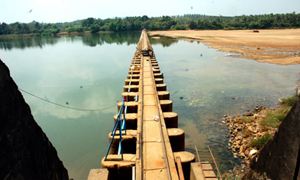
waterDeputy Commissioner Dr K G Jagadeesha has hinted that Mangaluru City Corporation (MCC)?will supply water to its citizens on alternate days from January 1, 2017 if the inflow of water to the Thumbe vented dam declines.

“If there was good inflow of water to the dam, then water will be supplied daily. In the wake of the city facing acute shortage of water during last April-May, the district administration has chalked out measures to mitigate the water crisis,” he said.

The maximum storage level of the old dam is 13 feet. About 160 MLD (million litres a day) of water was being lifted from Thumbe dam for the city daily and only 90 MLD of water was available for distribution.

Jagadeesha, the work on painting the new vented dam built across River Nethravathi should be completed by November end. The work on closing the gate of the new vented dam should also be completed by month end. The water upto five metre in the dam should be stored by December 10. The silt near the new Thumbe vented dam that has come up in the downstream should also be removed immediately.

The process of closing the gates of old Thumbe vented dam has been initiated and will be completed by November 15 to ensure full storage for supplying water to the city during the summer months. He directed MCC Commissioner Mohammed Nazeer to identify the exact extent of land to be submerged with the MCC storing five-metre water in new Vented dam within a week and put up a red colour flag on the area to make people aware of submerge of land.

A meeting of the farmers who will lose land will also be convened to appraise them of the situation within a week. A proposal has already been sent to the state government for the release of amount to be distributed as compensation among those who lose land.

With zero inflow of water to the dam, the water stored upto five metre would cater to the needs of the citizens for 45 days. With water available in AMR dam, the city can manage the water situation for three months, he stated.

Comments

Nayaz Baksh
 - 
Tuesday, 8 Nov 2016

I guess we need to start looking at other options . Desalination plants can be a viable option, with abundantly available sea water we should use it to our advantage by having one of the plants in our region.

Satyameva jayate
 - 
Monday, 7 Nov 2016

We should learn and also advise our kids how to save water..... authorities should start controlling water supply from now on that leaving it to zero at peak summer like last time.

Deepak
 - 
Monday, 7 Nov 2016

no problem for me in dubai... i dont have any problem for water, if i come down then there will be a big problem.

Harish
 - 
Monday, 7 Nov 2016

no problem.. will get it from cauvery, siddaramaiah will not leave us.

Add new comment

  • Coastaldigest.com reserves the right to delete or block any comments.
  • Coastaldigset.com is not responsible for its readers’ comments.
  • Comments that are abusive, incendiary or irrelevant are strictly prohibited.
  • Please use a genuine email ID and provide your name to avoid reject.
coastaldigest.com news network
May 15,2020

Mangaluru, May 15: In a shocking development, five residents of Udupi district, who recently came from United Arab Emirates today tested positive for covid-19.

As many as 49 passengers among over 175 repatriates who were brought from Dubai to Mangaluru International Airport on May 12 were from Udupi district.

Hence they were quarantined in Udupi district and their throat swabs were sent for testing on the same day. Today, five of them obtained positive report. They were today shifted to TMA Pai covid-hospital from their hotel rooms.

Comments

Add new comment

  • Coastaldigest.com reserves the right to delete or block any comments.
  • Coastaldigset.com is not responsible for its readers’ comments.
  • Comments that are abusive, incendiary or irrelevant are strictly prohibited.
  • Please use a genuine email ID and provide your name to avoid reject.
Agencies
July 5,2020

The deadly coronavirus that entered India while there was still nip in the air has beaten rising mercury, humid conditions, unique Indian genome and has entered monsoon season with more potency as fresh cases are only breaking all records in the country.

India recorded a single-day spike of record 24,850 new coronavirus cases on Sunday, taking its total tally to 6.73 lakh corona-positive cases.

Top Indian microbiologists were hopeful in March that after the 21-day lockdown, as summer approaches, the rise in temperature would play an important role in preventing the drastic spread of COVID-19 virus in India.

Several virologists hinted that by June this year, the impact of COVID-19 would be less than what it appeared in March-April.

The claims have fallen flat as the virus is mutating fast, becoming more potent than ever.

According to experts, the novel coronavirus is a new virus whose seasonality and response to hot humid weather was never fully understood.

"The theory was based on the fact that high temperatures can kill the virus as in sterilisation techniques used in healthcare. But these are controlled environment conditions. There are many other factors besides temperature, humidity which influence the transmission rate among humans," Dr Anu Gupta, Head, Microbiologist and Infection Control, Fortis Escorts Heart Institute, told IANS.

There is no built-up immunity to COVID-19 in humans.

"Also, asymptomatic people might be passing it to many others unknowingly. New viruses tend not to follow the seasonal trend in their first year," Gupta emphasized.

Globally, as several countries are now experiencing hot weather, the World Health Organization (WHO) reported a record hike in the number of coronavirus cases, with the total rising by 2,12,326 in 24 hours in the highest single-day increase since COVID-19 broke out.

So far over 11 million people worldwide have tested positive for the disease which has led to over 5,25,000 deaths, according to data from Johns Hopkins University. The US remained the worst-hit country with over 28 lakh cases, followed by Brazil with 15.8 lakh.

According to Sandeep Nayar, Senior Consultant and HOD, Respiratory Medicine, Allergy & Sleep Disorders, BLK Super Speciality Hospital in New Delhi, whether temperature plays a role in COVID-19 infection is highly debated.

One school of thought said in the tropical regions of South Asia, the virus might not thrive longer.

"On the other hand, another school of thought has found that novel Coronavirus can survive in a hot and humid environment and tropical climate does not make a difference to the virus. According to them, this is what distinguishes the novel coronavirus from other common viruses, which usually wane in hot weather," stressed Nayar.

Not much has been studied in the past and no definite treatment or vaccine is available to date.

"Every day, new properties and manifestation of the disease come up. As of now, the only way to prevent this monster is by taking appropriate precautions. Hand hygiene, social distancing, cough etiquette and face masks definitely reduce spread of COVID-19 infection," Nayar told IANS.

Not just top Indian health experts, even Indian-American scientists had this theory in mind that sunshine and summer may ebb the spread of the coronavirus.

Ravi Godse, Director of Discharge Planning, UPMC Shadyside Pennsylvania in the US told IANS in April: "In the summer, the humidity can go up as well, meaning more water drops in the air. If the air is saturated with water and somebody sneezes virus droplets into such air, it is likely that the droplets will fall to the ground quicker, making them less infectious. So the short answer is yes, summer/sunshine could be bettera.

According to Dr Puneet Khanna, Head of Respiratory Medicine and Pulmonology, Manipal Hospital, Delhi, COVID-19 death rates are not too different in tropical countries but since the disease affected them late it was yet to show its peak in these areas.

"The virus can survive well in hot and humid countries and this is proven now," he stressed.

Comments

Add new comment

  • Coastaldigest.com reserves the right to delete or block any comments.
  • Coastaldigset.com is not responsible for its readers’ comments.
  • Comments that are abusive, incendiary or irrelevant are strictly prohibited.
  • Please use a genuine email ID and provide your name to avoid reject.
News Network
January 30,2020

Mangaluru: The police team investigating the case of bomb planting at the international airport here on January 20, took suspect Aditya Rao to several places in the city where he had frequented in the past few months, police said on Wednesday.

Police had earlier recovered a box from his bank locker at Udupi that contained a white powder which he claimed was cyanide. The substance has been sent to the Forensic Science laboratory for confirmation.

On further interrogation, Rao told police that he had a locker in a bank in Mangaluru also, where he was taken. Only some papers were seen in the locker, police said. He was also taken to the room where he stayed while he was working at a hotel in Balmatta here and to a hardware workshop from where he had purchased some spare parts, they said.

A 'live' explosive device was found in an unattended bag near a ticket counter of the departure gate of the airport here on January 20, triggering a scare before it was defused at a nearby open ground.

Police had released a picture of a man captured on CCTV camera as the suspect who placed the bomb and Rao later surrendered. Meanwhile, sources said the airport authorities got an anonymous call on Monday evening that a bomb had been planted in the airport. After thorough search, it was found to be a hoax. City police commissioner P S Harsha has warned of stringent action against those who make such calls.

Comments

Add new comment

  • Coastaldigest.com reserves the right to delete or block any comments.
  • Coastaldigset.com is not responsible for its readers’ comments.
  • Comments that are abusive, incendiary or irrelevant are strictly prohibited.
  • Please use a genuine email ID and provide your name to avoid reject.