



Mangaluru stares at worst water crisis

[email protected] (CD Network)
November 7, 2016

Mangaluru, Nov 7: With the receding rains and the Indian Meteorological Department predicting that there will be no more continuous rains in the coastal Karnataka this year, the city of Mangaluru is staring at another water crisis.
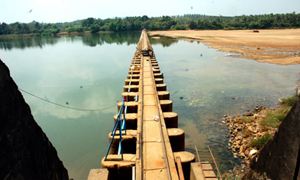
waterDeputy Commissioner Dr K G Jagadeesha has hinted that Mangaluru City Corporation (MCC)?will supply water to its citizens on alternate days from January 1, 2017 if the inflow of water to the Thumbe vented dam declines.

“If there was good inflow of water to the dam, then water will be supplied daily. In the wake of the city facing acute shortage of water during last April-May, the district administration has chalked out measures to mitigate the water crisis,” he said.

The maximum storage level of the old dam is 13 feet. About 160 MLD (million litres a day) of water was being lifted from Thumbe dam for the city daily and only 90 MLD of water was available for distribution.

Jagadeesha, the work on painting the new vented dam built across River Nethravathi should be completed by November end. The work on closing the gate of the new vented dam should also be completed by month end. The water upto five metre in the dam should be stored by December 10. The silt near the new Thumbe vented dam that has come up in the downstream should also be removed immediately.

The process of closing the gates of old Thumbe vented dam has been initiated and will be completed by November 15 to ensure full storage for supplying water to the city during the summer months. He directed MCC Commissioner Mohammed Nazeer to identify the exact extent of land to be submerged with the MCC storing five-metre water in new Vented dam within a week and put up a red colour flag on the area to make people aware of submerge of land.

A meeting of the farmers who will lose land will also be convened to appraise them of the situation within a week. A proposal has already been sent to the state government for the release of amount to be distributed as compensation among those who lose land.

With zero inflow of water to the dam, the water stored upto five metre would cater to the needs of the citizens for 45 days. With water available in AMR dam, the city can manage the water situation for three months, he stated.

Comments

Nayaz Baksh
 - 
Tuesday, 8 Nov 2016

I guess we need to start looking at other options . Desalination plants can be a viable option, with abundantly available sea water we should use it to our advantage by having one of the plants in our region.

Satyameva jayate
 - 
Monday, 7 Nov 2016

We should learn and also advise our kids how to save water..... authorities should start controlling water supply from now on that leaving it to zero at peak summer like last time.

Deepak
 - 
Monday, 7 Nov 2016

no problem for me in dubai... i dont have any problem for water, if i come down then there will be a big problem.

Harish
 - 
Monday, 7 Nov 2016

no problem.. will get it from cauvery, siddaramaiah will not leave us.

Add new comment

  • Coastaldigest.com reserves the right to delete or block any comments.
  • Coastaldigset.com is not responsible for its readers’ comments.
  • Comments that are abusive, incendiary or irrelevant are strictly prohibited.
  • Please use a genuine email ID and provide your name to avoid reject.
News Network
February 27,2020

Bengaluru, Feb 27: Karnataka Chief Minister and veteran BJP leader B S Yediyurappa turned 78 on Thursday with Prime Minister Narendra Modi and a host of leaders greeting him.

Modi hailed Yediyurappa as a "hardworking" chief minister and wished him long life and good health, while several state leaders flocked to his residence and greeted the Lingayat strongman.

"Birthday greetings to Karnataka's hardworking CM @BSYBJP Ji. He is passionately working for the state's progress, especially on farmer welfare and rural development. I pray for his long life and good health," the Prime Minister tweeted.

A large-scale "non-partisan" birthday bash will be held here later in the evening.

The felicitation function will see Defence Minister Rajnath Singh and former chief minister S M Krishna besides Siddaramaiah of Congress and H D Kumaraswamy of JD(S) sharing the stage.

Union Ministers D V Sadananda Gowda, also a former chief minister, Pralhad Joshi and Suresh Angadi will be in attendance.

BJP National General Secretary (Organisation) B L Santosh and state party chief Nalin Kumar Kateel are among those who will be gracing the event.

While Santosh will release a felicitation volume in Kannada with 78 articles from a cross-section of people, including politicians, writers, bureaucrats, and spiritual leaders; Siddaramaiah and Kumaraswamy will unveil a coffee table book and documentary respectively.

Yediyurappa, on the eve of his birthday on Wednesday, had said whatever he has achieved is a result of the people's "blessings and faith" and requested well-wishers not to bring bouquets, flowers, shawls, sweets, turbans or any souvenirs to greet him.

The birthday function organised by "Yediyurappa Abhinandana Samiti" (Yediyurappa Felicitation Committee) is being seen in some quarters as an attempt by Yediyurappa and his loyalists to send a message to the party leadership that he was still "strong".

The BJP's current dispensation under Narendra Modi and Amit Shah has retired several senior party leaders who crossed the age of 75.

However, an exception was said to have been made in Yediyurappa's case after the BJP won 25 of 28 seats in the Lok Sabha election under his leadership.

In the 2018 elections, he spearheaded the campaign of the BJP which emerged as the single largest party but fell short of the majority mark following which Congress and JD(S) came to power stitching a post-poll pact.

However, the coalition collapsed in July last year, paving the way for return of Yediyurappa as Chief Minister for the fourth time.

Comments

Add new comment

  • Coastaldigest.com reserves the right to delete or block any comments.
  • Coastaldigset.com is not responsible for its readers’ comments.
  • Comments that are abusive, incendiary or irrelevant are strictly prohibited.
  • Please use a genuine email ID and provide your name to avoid reject.
Wafa Sultana
April 4,2020

Over the last couple of days when the world was occupied with unifying efforts to fight the deadly Covid19 pandemic, sections of Indian media provided viewers a familiar scapegoat – the Indian Muslims – who are often stereotyped as a community being constantly at loggerheads with the citizenry and the State. Biased media channels were quick to resort to blaming the entire Muslim community for the spread of the disease in the country, thanks to an ill-timed Tablighi Jamaat gathering at its international headquarters in Delhi’s Nizamuddin. Unsurprisingly, the opprobrium was also marked by a sudden spike in WhatsApp forwards of videos with people wearing skullcaps licking spoons and performing Sufi breathing rituals, suggesting some sort of wild conspiracy on the part of the community to spread the virus.  Some media channels were quick to formulate, hypothesize and provide loose definitions of a newly discovered form of Jihad i.e. ‘Corona Jihad ’ thereby vilifying the Islamic faith and its followers.

While the investigation on the culpability of the organizers of the Nizamuddin event is still ongoing, there is enough information to suggest that the meeting was held before any lockdown was in force, and the problem began when there was no way of getting people out once the curfew was announced. Be that as it may, there is little doubt that organizing a meet of such a scale when there is a global pandemic smacks of gross misjudgment, and definitely the organizers should be held accountable if laws or public orders were defied. Attendees who attempt to defy quarantine measures must be dealt with strictly. However, what is alarming is that the focus and narrative have now shifted from the unfortunate event at Nizamuddin to the Tablighi Jamaat itself.

For those not familiar with the Tablighi Jamaat, the organization was founded in 1926 in Mewat by scholar Maulana Mohammad Ilyas. The Jamaat’s main objective was to get Muslim youth to learn and practice pristine Islam shorn of external influences. This is achieved through individuals dedicating time for moral and spiritual upliftment secluded from the rest of the world for a brief period of time. There is no formal membership process. More senior and experienced participants typically travel from one mosque to other delivering talks on religious topics, inviting local youth to attend and then volunteer for a spiritual retreat for a fixed number of days to a mosque in a nearby town or village to present the message to their co-religionists. Contrary to ongoing Islamophobic rhetoric, the movement does not actively proselytize. The focus is rather on getting Muslims to learn the teachings and practices of Islam.  This grassroots India-based movement has now grown to almost all countries with substantial Muslim populations. Its annual meets, or ‘ijtemas’ are among the largest Islamic congregations in the world after the annual Haj. One of the reasons for its popularity and wide network in the subcontinent and wordwide is the fact that it has eschewed the need for scholarly intervention, focusing on peer learning of fundamental beliefs and practice rather than high-falutin ideological debates. The Tablighi Jamaat also distinguishes itself from other Islamic movements through its strictly apolitical nature, with a focus on individual self-improvement rather than political mobilization. Hardships and difficulty in the world are expected to be face through ‘sabr’ (patience) and ‘dua’ (supplication),  than through quest for political power or influence. In terms of ideology, it is very much based on mainstream Sunni Islamic principles derived from the Deobandi school.

So, why is all this background important in the current context? While biased media entities have expectedly brought out their Islamophobic paraphernalia out for full display, more neutral commentators have tried to paint the Tablighi Jamaat as a fringe group and have tried to distance it from 'mainstream Muslims'. While the intent is no doubt innocent, this is a trap we must not fall into. This narrative, unfortunately, is also gaining ground due to apathy some Muslims have for the group, accusing it of being “disconnected from the realities of the world”. Unlike other Muslim organizations and movements, the Tablighi Jamat, by virtue of its political indifference, does not boast of high-profile advocates and savvy spokespersons who can defend it in mainstream or social media.  The use of adjectives such as 'outdated' and 'orthodox' by liberal columnists to describe the Jamaat feeds into the malignant attempt to change the narrative from the control of the spread of the pandemic due to the Nizamuddin gathering to 'raison d'etre' of the organization itself.

A large mainstream religious group like the Tablighi Jamaat with nearly a hundred-year history, normally considered to be peaceful, apolitical and minding its own business is now suddenly being villainized owing to unfortunate circumstances. Biased media reactions filled with disgust and hate seem to feed the Indian public conscience with a danngerous misconception - to be a nominal Muslim is okay but being a practicing one is not.  For those committed to the truth and fighting the spread of Islamophobia, the temptation to throw the entire Tablighi Jamaat under the bus must be resisted.

The writer is a lawyer and research scholar at Qatar University. Her research interests include Islamic law and politics.

Comments

zahoorahmed
 - 
Saturday, 4 Apr 2020

great article! provides a great perspective on tableeg jamat

Add new comment

  • Coastaldigest.com reserves the right to delete or block any comments.
  • Coastaldigset.com is not responsible for its readers’ comments.
  • Comments that are abusive, incendiary or irrelevant are strictly prohibited.
  • Please use a genuine email ID and provide your name to avoid reject.
News Network
May 15,2020

Marriages will have to shed decadence as the state government, in an advisory, has restricted the number of guests to 50 and barred consumption of liquor at such events. 

The advisory was issued in anticipation that the COVID-19 lockdown will be eased in a phased manner. 

The advisory, issued by the Department of Health & Family Welfare, states that events can be held in a “suitable public place with good natural ventilation (no air condition).”

For latest updates on coronavirus outbreak, click here
All guests must have the Arogya Setu app on their phones and the contact details all marriage attendees should be maintained. 

No person from a containment zone will be allowed to attend the event, and persons aged above 65 years, pregnant women and children below 10 years are not permitted. 

Sanitizers are to be provided at the entry and at “appropriate” places. Thermal screening is a must at the entry point of the venue. The scanner should be held 3-15 cm away from a person’s forehead. “Anyone found having a fever (37.5 degree centigrade or 99.5 farenheit), cold, cough, difficulty in breathing shall not be permitted to attend the event and immediately referred to seek medical advice,” the advisory said. 

Besides prohibition on consumption of alcohol, the advisory said paan, gutka and tobacco will not be allowed. 

Face masks are compulsory and all persons should maintain a physical distance of more than one metre. The venue shall be clean and hygienic, with a prohibition on spitting in public places.

A nodal person should be identified to oversee the arrangements, the advisory said.

Comments

Add new comment

  • Coastaldigest.com reserves the right to delete or block any comments.
  • Coastaldigset.com is not responsible for its readers’ comments.
  • Comments that are abusive, incendiary or irrelevant are strictly prohibited.
  • Please use a genuine email ID and provide your name to avoid reject.