



Mangaluru stares at worst water crisis

[email protected] (CD Network)
November 7, 2016

Mangaluru, Nov 7: With the receding rains and the Indian Meteorological Department predicting that there will be no more continuous rains in the coastal Karnataka this year, the city of Mangaluru is staring at another water crisis.
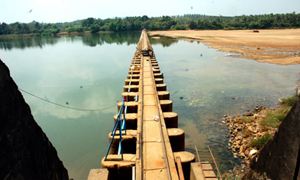
waterDeputy Commissioner Dr K G Jagadeesha has hinted that Mangaluru City Corporation (MCC)?will supply water to its citizens on alternate days from January 1, 2017 if the inflow of water to the Thumbe vented dam declines.

“If there was good inflow of water to the dam, then water will be supplied daily. In the wake of the city facing acute shortage of water during last April-May, the district administration has chalked out measures to mitigate the water crisis,” he said.

The maximum storage level of the old dam is 13 feet. About 160 MLD (million litres a day) of water was being lifted from Thumbe dam for the city daily and only 90 MLD of water was available for distribution.

Jagadeesha, the work on painting the new vented dam built across River Nethravathi should be completed by November end. The work on closing the gate of the new vented dam should also be completed by month end. The water upto five metre in the dam should be stored by December 10. The silt near the new Thumbe vented dam that has come up in the downstream should also be removed immediately.

The process of closing the gates of old Thumbe vented dam has been initiated and will be completed by November 15 to ensure full storage for supplying water to the city during the summer months. He directed MCC Commissioner Mohammed Nazeer to identify the exact extent of land to be submerged with the MCC storing five-metre water in new Vented dam within a week and put up a red colour flag on the area to make people aware of submerge of land.

A meeting of the farmers who will lose land will also be convened to appraise them of the situation within a week. A proposal has already been sent to the state government for the release of amount to be distributed as compensation among those who lose land.

With zero inflow of water to the dam, the water stored upto five metre would cater to the needs of the citizens for 45 days. With water available in AMR dam, the city can manage the water situation for three months, he stated.

Comments

Nayaz Baksh
 - 
Tuesday, 8 Nov 2016

I guess we need to start looking at other options . Desalination plants can be a viable option, with abundantly available sea water we should use it to our advantage by having one of the plants in our region.

Satyameva jayate
 - 
Monday, 7 Nov 2016

We should learn and also advise our kids how to save water..... authorities should start controlling water supply from now on that leaving it to zero at peak summer like last time.

Deepak
 - 
Monday, 7 Nov 2016

no problem for me in dubai... i dont have any problem for water, if i come down then there will be a big problem.

Harish
 - 
Monday, 7 Nov 2016

no problem.. will get it from cauvery, siddaramaiah will not leave us.

Add new comment

  • Coastaldigest.com reserves the right to delete or block any comments.
  • Coastaldigset.com is not responsible for its readers’ comments.
  • Comments that are abusive, incendiary or irrelevant are strictly prohibited.
  • Please use a genuine email ID and provide your name to avoid reject.
News Network
May 7,2020

Bengaluru, May 7: Karnataka has revised its standard operating procedure (SOP) for international passengers. The first group of passengers will arrive in the state on May 8.

The number of categories has been reduced to two from three. Category A includes passengers symptomatic on arrival while Category B passengers are those asymptomatic on arrival. These are passengers who are either healthy or those having co-morbidities.

As per the revised SOP, the passenger will be released on the seventh day, if tested negative, to strict home quarantine for another seven days with stamping.

This norm is in contradiction to the Ministry of Home Affairs’ SOP for international passengers. As per the MHA’s SOP, the passengers (asymptomatic) will be under institutional quarantine for 14 days. Testing negative after 14 days, they will be allowed to go home and will undertake self-monitoring of their health for 14 more days.

On the contradiction, Pandey said, "We don't take chances as we rely on tests instead of just quarantining. Other states may be depending on just 14-day institutional quarantine."

"GOI SOP doesn't talk about Covid tests on international passengers. We have put an additional safety layer of three Covid tests on returnees -- one on arrival, second from 5-7 days and last on 12th day. This will ensure definite identification of positive cases even if they are asymptomatic and their subsequent treatment. We should look at the spirit behind the order," he added.

On the 14-day additional reporting period for category B, he said, "It is implied as category B patients should report to us for 14 days after their first 14-day quarantine period is over."

Medical Education Minister Dr K Sudhakar said that the State would follow the Centre’s norms.

Till Tuesday, Karnataka’s SOP had three categories. Under Category A (symptomatic), 14-day institutional quarantine at COVID-19 Health Care Centre was mandatory followed by 14-day reporting period. Under Category B (asymptomatic above 60 years with co-morbidities), seven-day institutional quarantine at hotel/hostel followed by seven-day home quarantine and 14-day reporting period had been recommended. The 14-day home quarantine and 14-day reporting period was mandatory for Category C (asymptomatic).

Comments

Add new comment

  • Coastaldigest.com reserves the right to delete or block any comments.
  • Coastaldigset.com is not responsible for its readers’ comments.
  • Comments that are abusive, incendiary or irrelevant are strictly prohibited.
  • Please use a genuine email ID and provide your name to avoid reject.
News Network
May 29,2020

Bengaluru, May 29: Seven out of ten (72 per cent) workers in Karnataka reported having lost their employment during the COVID-19-induced lockdown, according to findings of a survey by Azim Premji University, in collaboration with ten civil society organisations.

The university said in a statement it conducted "a detailed" phone survey of 5,000 workers across 12 states in the country, to gauge the impact of the COVID-19 lockdown on employment, livelihoods, and access to government relief schemes.

The survey covered self-employed, casual, and regular wage and salaried workers and it released the findings for Karnataka on Thursday.

Seventy-six per cent of urban workers and 66 per cent of rural workers lost their employment, the survey findings said.

For non-agricultural self-employed workers and wage workers, who were still employed, average weekly earnings fell by two-third.

More than four in ten salaried workers (44 per cent) saw either a reduction in their salary or received no salary during the lockdown.

Six out of ten households reported that they did not have enough money to buy even a weeks worth of essential items, according to the survey.

Eight out ten households reported a reduction in food intake, while less than three in ten vulnerable households (27 per cent) in urban Karnataka received any form of cash transfer from the government, it said.

In summary, the disruption in the Karnatakas economy and labour markets is enormous. Livelihoods have been devastated at unprecedented levels during the lockdown.

The recovery from this could be slow and very painful, the statement said.

As a response to the findings of this survey, the team which has conducted the survey suggested a universalisation of the PDS to expand its reach and implementation of expanded rations for at least the next six months.

It suggested cash transfers equal to at least Rs.7000 per month for two months, and proactive steps like expansion of MGNREGA, introduction of urban employment guarantee, and investment in universal basic services, among others.

Comments

Add new comment

  • Coastaldigest.com reserves the right to delete or block any comments.
  • Coastaldigset.com is not responsible for its readers’ comments.
  • Comments that are abusive, incendiary or irrelevant are strictly prohibited.
  • Please use a genuine email ID and provide your name to avoid reject.
News Network
June 14,2020

Kozhikode, Jun 14: A mosque in Kuttichira of Kozhikode has found a unique way to avoid crowding amid the COVID-19 pandemic. The committee that runs the mosque has started issuing smart cards to people for offering prayers and simultaneously encouraging social distancing.

"The committee has given smart cards with numbers to the people in the surroundings of the Masjid. One who enters the mosque premises has to rub their hands with sanitizers. They also have to tell their identity on camera. The automatic system has been put in place to save the address and phone number. Next time onwards they have to say their smart card number only so that other details will be automatically filled," said Muhammad Sajjad, who is part of the Mosque committee.

"The door of the mosque will open automatically after swiping the card. We have fit in a sensor on the doors. We have also made marks inside the mosque area so that people can abide by social distancing norm," he added.

A couple of days back the Kerala government has rolled out an order allowing the opening of places of worship, malls and restaurants from June 9 in strict accordance with guidelines and social distancing norms. As per the guidelines, pregnant women and those with co-morbidities should not visit any places of worship. Those with symptoms should not be allowed.

Comments

Add new comment

  • Coastaldigest.com reserves the right to delete or block any comments.
  • Coastaldigset.com is not responsible for its readers’ comments.
  • Comments that are abusive, incendiary or irrelevant are strictly prohibited.
  • Please use a genuine email ID and provide your name to avoid reject.