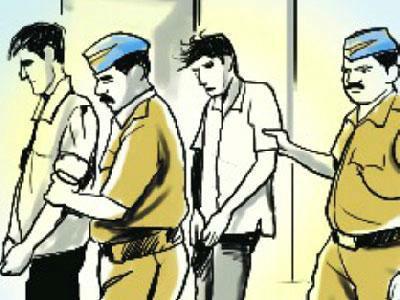
Mangaluru: Three youngsters held for demanding hafta

[email protected] (CD Network)
July 18, 2016

Mangaluru, Jul 18: Three associates of a notorious criminal have been arrested by the sleuths of City Crime Branch (CCB) in Mangaluru on charges of executing his demand for protection money (hafta) from a local resident.

53259802The arrested are Preetham (22) from Aakash Bhavan, Rithesh (19) from Malady Road, and Vishal Kumar (22) from Kunjathbail, Kavoor.

Mangaluru city police acted on a complaint lodged by the resident with Barke police station, and city police chief M Chandra Sekhar handed over the case to CCB police inspector Sunil Y Naik.

Among them Preetham is also wanted in a case of illegally entering a hotel in Mangaluru East police station limits and damaging its property.

The three were alleged associates of Gaurish, an accused in a murder case and presently in judicial custody. Gaurish had alleged y called the complainant on July 11 and demanded 'hafta' of Rs 25,000.

He also got his associates to call the complainant and reiterated the demand and also sent out a warning that he would be murdered if the demand was not met. The CCB team, which followed up the leads, arrested the trio.

Comments

Well Wisher
 - 
Monday, 18 Jul 2016

Encounter all the three n close the chapter. No one should come to ask such things.

Add new comment

  • Coastaldigest.com reserves the right to delete or block any comments.
  • Coastaldigset.com is not responsible for its readers’ comments.
  • Comments that are abusive, incendiary or irrelevant are strictly prohibited.
  • Please use a genuine email ID and provide your name to avoid reject.
News Network
March 30,2020

Mangaluru, Mar 30: In continuing cases of tipplers in the southern states ending their lives due to non-availability of liquor during the lockdown, two men committed suicide in Karnataka's Dakshina Kannada district.

The two suicides were reported in Kadaba taluk on Saturday, police said.

Tomy Thomas (50), a rubber tapping labourer in an estate at Kutrupadi village of the taluk, was found hanging at his rented house on Saturday. Thomas, a native of Kottayam in Kerala, had joined at the estate here a month ago.

Local people said he was desperately moving around in the last few days asking about places where he can get liquor. He had also not reported to work in these days. The body has been kept at the mortuary of a hospital at Deralakatte.

In another incident, a 70-year old man, belonging to Kodimbala village in the taluk, allegedly hanged himself from the branch of a tree near his house at Nakur.

The deceased has been identified as Thomas, who had left his family here 30 years ago and had been working in Kerala. He had returned here only a few years back.

Sources said Thomas, an alcohol addict, was having health problems related to withdrawal. He has been living on pavements at Kadaba without going home.

Kadaba police has registered cases in connection with the two incidents.

Incidents of tipplers committing suicide have been reported in Kerala and Telangana in the past few days. Two men ended their lives in Kerala today while a 50-year old daily wage worker jumped to death from a building in Hyderabad on Friday.

Comments

Add new comment

  • Coastaldigest.com reserves the right to delete or block any comments.
  • Coastaldigset.com is not responsible for its readers’ comments.
  • Comments that are abusive, incendiary or irrelevant are strictly prohibited.
  • Please use a genuine email ID and provide your name to avoid reject.
Media Release
March 12,2020

Manipal, Mar 12: Team WGSHA is proud to announce that the culinary museum in WGSHA has been listed in Limca Book of Records as India's First Living Culinary Arts Museum.

Limca Book of Records (LBR) is a catalogue of achievements made by Indians, at home and abroad in diverse fields of human endeavour. LBR is a celebration of exemplary exploits and recognizes accomplishments such as firsts, inventions, discoveries, honours, awards and the truly extraordinary.

Chef Thirugnanasambantham, Principal of WGSHA, while thanking MAHE and ITC Leadership for extending all support towards instituting this museum in Manipal and WGSHA, also appreciated and thanked all those who have directly or indirectly helped towards setting up this museum in Manipal.

"The process for WGSHA's culinary museum to make an entry into the popular Limca Book of Records started almost six months back and after validation by LBR recently, has been listed in the book of records. We are glad that we could be the first of its kind in such endeavour and we also hope to be in Guinness World Records soon", said Chef Thiru.

"We are indeed grateful to Michelin-starred Indian celebrity Chef Vikas Khanna, the founder and curator of this museum, who had this idea of establishing a culinary museum and donated thousands of kitchen tools and equipment worth millions of dollars to this museum for preserving the history of India's rich tradition of culinary arts and to educate the future generations. Chef Vikas Khanna, 'Distinguished Alumnus' of WGSHA, being very desirous of making such a museum in India, what better place it would be than in his own Alma Mater!", he said on the background of having the museum.

Chef Thiru mentioned that Udupi, popular for the famous 'Udupi Cuisine', and being a temple town, is adjacent to International University Town of Manipal Academy of Higher Education (MAHE).

MAHE is home to thousands of international students and visitors. With a great heritage of Udupi, combined with the large number of Indian and International students residing in and around Manipal, it was very apt for the college to create a museum for today's Indian youth and the International visitors to understand the rich culinary heritage of India, through the priceless kitchen tools and equipment donated by Chef Vikas Khanna.

"Has placed WGSHA in the global culinary map and we are proud to have joined all such efforts to preserve the history of cuisines and cultures across the world", said Chef Thiru.

The culinary art academic block housing the museum was opened in April 2018, spread approximately over 25,000 sq ft and is shaped in the form of a giant pot very similar to the ones found in Harappa.

There are historical as well as regular household items such as plates made by the Portuguese in India, a 100-year-old ladle used to dole out food at temples and bowls dating to the Harappan era, an old seed sprinkler, an ancient Kashmiri tea brewer known as 'samovar', vessels from the Konkan, Udupi and Chettinad regions, apart from a large collection of rolling pins, utensils of all shapes and sizes, tea strainers of different types etc.

Comments

Add new comment

  • Coastaldigest.com reserves the right to delete or block any comments.
  • Coastaldigset.com is not responsible for its readers’ comments.
  • Comments that are abusive, incendiary or irrelevant are strictly prohibited.
  • Please use a genuine email ID and provide your name to avoid reject.
Ram Puniyani
February 22,2020

This January 2020, it is thirty years since the Kashmiri Pundits’ exodus from the Kashmir valley took place. They had suffered grave injustices, violence and humiliation prior to the migration away from the place of their social and cultural roots in Kashmir Valley. The phenomenon of this exodus had been due to the communalization of militancy in Kashmir in the decade of 1980s. While no ruling Government has applied itself enough to ‘solve’ this uprooting of pundits from their roots, there are communal elements who have been aggressively using ‘what about Kashmiri Pundits?’, every time liberal, human rights defenders talk about the plight of Muslim minority in India. This minority is now facing an overall erosion of their citizenship rights.

Time and over again in the aftermath of communal violence in particular, the human rights groups have been trying to put forward the demands for justice and rehabilitation of the victim minority. Instead of being listened to those particularly from Hindu nationalist combine, as a matter of routine shout back, where were you when Kashmiri Pundits were driven away from the Valley? In a way the tragedy being heaped on one minority is being justified in the name of suffering of Pundits and in the process violence is being normalized. This sounds as if two wrongs make a right, as if the suffering Muslim minority or those who are trying to talk in defense of minority rights have been responsible for the pain of Kashmiri Pundits.

During these three, many political formations have come to power, including BJP, Congress, third front and what have you. To begin with when the exodus took place Kashmir was under President’s rule and V. P. Singh Government was in power at the center. This Government had the external support of BJP at that time. Later BJP led NDA came to power for close to six years from 1998, under the leadership of Atal Bihari Vajpayee. Then from 2014 it is BJP, with Narerda Modi as PM, with BJP brute majority is in power. Other components of NDA are there to enjoy some spoils of power without any say in the policies being pursued by the Government. Modi is having absolute power with Amit Shah occasionally presenting Modi’s viewpoints.

Those blurting, ‘what about Kashmiri Pundits?’ are using it as a mere rhetoric to hide their communal color. The matters of Kashmir are very disturbing and cannot be attributed to be the making of Indian Muslims as it is being projected in an overt and subtle manner. Today, of course the steps taken by the Modi Government, that of abrogation of Article 370, abolition of clause 35 A, downgrading the status of Kashmir from a state to union territory have created a situation where the return of Kashmiri Pundits may have become more difficult, as the local atmosphere is more stifling and the leaders with democratic potential have been slapped with Public Safety Act, where they can be interned for long time without any answerability to the Courts. The internet had been suspended, communication being stifled in an atmosphere where democratic freedoms are curtailed which makes solution of any problem more difficult.

Kashmir has been a vexed issue where the suppression of the clause of autonomy, leading to alienation led to rise of militancy. This was duly supported by Pakistan. The entry of Al Qaeda elements, who having played their role against Russian army in 1980s entered into Kashmir and communalized the situation in Kashmir. The initial Kashmir militancy was on the grounds of Kashmiriyat. Kashmiriyat is not Islam, it is synthesis of teachings of Buddha, values of Vedant and preaching’s of Sufi Islam. The tormenting of Kashmiri Pundits begins with these elements entering Kashmir.

Also the pundits, who have been the integral part of Kashmir Valley, were urged upon by Goodwill mission to stay on, with local Muslims promising to counter the anti Pundit atmosphere. Jagmohan, the Governor, who later became a minister in NDA Government, instead of providing security to the Pundits thought, is fit to provide facilities for their mass migration. He could have intensified counter militancy and protected the vulnerable Pundit community. Why this was not done?

Today, ‘What about Kashmiri Pundits?’ needs to be given a serious thought away from the blame game or using it as a hammer to beat the ‘Muslims of India’ or human rights defenders? The previous NDA regime (2014) had thought of setting up enclosures of Pundits in the Valley. Is that a solution? Solution lies in giving justice to them. There is a need for judicial commission to identify the culprits and legal measures to reassure the Pundit community. Will they like to return if the high handed stifling atmosphere, with large number of military being present in the area? The cultural and religious spaces of Pundits need to be revived and Kashmiryat has to be made the base of any reconciliation process.

Surely, the Al Qaeda type elements do not represent the alienation of local Kashmiris, who need to be drawn into the process of dialogue for a peaceful Kashmir, which is the best guarantee for progress in this ex-state, now a Union territory. Communal amity, the hallmark of Kashmir cannot be brought in by changing the demographic composition by settling outsiders in the Valley. A true introspection is needed for this troubled area. Democracy is the only path for solving the emigration of Pundits and also of large numbers of Muslims, who also had to leave the valley due to the intimidating militancy and presence of armed forces in large numbers. One recalls Times of India report of 5th February 1992 which states that militants killed 1585 people from January 1990 to October 1992 out of which 982 were Muslims and 218 Hindus.

We have been taking a path where democratic norms are being stifled, and the promises of autonomy which were part of treaty of accession being ignored. Can it solve the problem of Pundits?


Comments

Add new comment

  • Coastaldigest.com reserves the right to delete or block any comments.
  • Coastaldigset.com is not responsible for its readers’ comments.
  • Comments that are abusive, incendiary or irrelevant are strictly prohibited.
  • Please use a genuine email ID and provide your name to avoid reject.