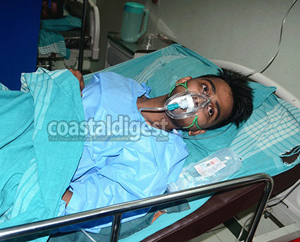
Mangaluru: Three youngsters held for murder attempt on engg student

coastaldigest.com news network
July 9, 2017

Mangaluru, Jul 9: The city crime branch of Mangaluru city police has arrested three accused in connection with the recent murder attempt on Mohammed Sajid, a student of a city based engineering college.stab 1 copy

The arrested have been identified as Nitin Poojary (21), son of Nitish Poojary, a resident of Farangipete; Pranesh Poojary (20), son of Madhava Poojary, a resident of Adyar Katte; and Kishan Poojary (21), son of Sudhir Poojary, a resident of Padil, Manglauru. Nitin and Pranesh are electricians by profession while Kishan is a carpenter.

Sajid, a native of Malappuram, is a third year student of civil engineering in a city based private college. He was residing at the rented house of one Naushad at Bithupaade village near Adyar.

The incident took place on at 4:15 p.m. on Friday, when Naushad and Sajid were returning home on a motorbike after having tea in Adyar.

The three miscreants, who had parked their scooter on the roadside and posed as innocent travelers, signaled the duo to stop their motorbike.

The miscreants claimed that the fuel in their scooter had been exhausted and requested bikers to give a bit petrol. When the two agreed to help them and alighted from the motorbike, the miscreants tried to attack Nausad with lethal weapons. However, Naushad managed to escape. The miscreants then attacked Saijd. He sustained hand and back injuries.

The CCB has also recovered the two-wheeler used for the crime by the accused and handed it over to the Mangaluru Rural Police Station.

Also Read: Mangaluru: Now, an engineering student stabbed at Adyar Padavu

Comments

VOX POPULI
 - 
Tuesday, 11 Jul 2017

venomous snake spitting hatred internationally as taught by his RSS and sanghi goons. shame on him, who is spoiling the name and respect of our great nation *India* and all indians, who live harmoniously overseas, despite of different religion, caste and creed. nobody should try to protect him or support this dirty shameless fanatic and lunatic. let the law of land of Kuwait take strict and stern action against this rogue, which will be an eye opener for all communal, racist and fascist poisonous minded dirty creatures in this earth. long live our great nation of india and indians.
jai ho.

Althaf
 - 
Tuesday, 11 Jul 2017

Should do GCC Ban for him.

Raees
 - 
Tuesday, 11 Jul 2017

And this news will be not publish by sangi channels. Like times now and republic

Indian
 - 
Tuesday, 11 Jul 2017

we are expecting a statement from media & government that he was mentally retarded. ROFL

Add new comment

  • Coastaldigest.com reserves the right to delete or block any comments.
  • Coastaldigset.com is not responsible for its readers’ comments.
  • Comments that are abusive, incendiary or irrelevant are strictly prohibited.
  • Please use a genuine email ID and provide your name to avoid reject.
coastaldigest.com news network
May 4,2020

Mangaluru, May 4: As the coronavirus lockdown norms have been relaxed in the coastal district of Dakshina Kannada, people will be able venture out for essential activities from 7 a.m to 7 p.m.

The lockdown was imposed in the coastal district on March 22 midnight to prevent the spread of Covid-19. Initially it did not apply to essential services such as sale of food, groceries, milk, vegetables, fruits, and meat and fish. Gradually the administration had to intensify the lockdown and allow those shops to remain open between 7 a.m. and 12 noon. However, today (May 4) onwards there will be relaxation of lockdown between 7 am to 7 pm. 

Precautionary measures like maintaining social distancing has been urged and use of face masks has been made mandatory.

Permitted activities

• Permission for plying of auto-rickshaws, cabs, private vehicles and bikes has been given. However only three occupants, including the driver will be allowed and no pillion rule is applicable for two-wheelers.

• OPDs, medical clinics are permitted to operate.

• Standalone shops, shops located in neighbourhood colony, residential complex will be allowed to operate.

• Private organisations can function with 33% staff capacity while allowing work from home for rest of staff.

• E-commerce activities only for essential goods permitted.

• In site construction activities in urban areas, rural areas including MNREGA works.

• Permission is only available to open the shop in the market and in the market complex.

Prohibited activities:

• Movement of individuals is not permitted for all non-essential activities.

• Travel by air, rail and inter-State movement by road.

• Functioning of schools, colleges, and other educational and training/ coaching institutions.

• Hospitality services, including hotels and restaurants.

• Cinema halls, malls, gymnasiums, sports complexes, bars, clubs, swimming pool, entertainment parks, assembly halls, etc; barber shops, spas and salons, textile and apparel(clothes) shops.

• Social, political, cultural, academic, entertainment, religious and other kinds of gatherings; and, religious places/ places of worship for public. 

• Shops in urban and rural areas, for non-essential goods not allowed in malls, markets and Market Complexes.

• All types of traffic movements will be prohibited after evening (7 pm to 7 am)

Comments

Add new comment

  • Coastaldigest.com reserves the right to delete or block any comments.
  • Coastaldigset.com is not responsible for its readers’ comments.
  • Comments that are abusive, incendiary or irrelevant are strictly prohibited.
  • Please use a genuine email ID and provide your name to avoid reject.
Ram Puniyani
February 10,2020

Noam Chomsky is one of the leading peace workers in the world. In the wake of America’s attack on Vietnam, he brought out his classic formulation, ‘manufacturing consent’. The phrase explains the state manipulating public opinion to have the public approve of it policies—in this case, the attack of the American state on Vietnam, which was then struggling to free itself from French colonial rule.

In India, we are witness to manufactured hate against religious minorities. This hatred serves to enhance polarisation in society, which undermines India’s democracy and Constitution and promotes support for a Hindu nation. Hate is being manufactured through multiple mechanisms. For example, it manifests in violence against religious minorities. Some recent ghastly expressions of this manufactured hate was the massive communal violence witnessed in Mumbai (1992-93), Gujarat (2002), Kandhamal (2008) and Muzaffarnagar (2013). Its other manifestation was in the form of lynching of those accused of having killed a cow or consumed beef. A parallel phenomenon is the brutal flogging, often to death, of Dalits who deal with animal carcasses or leather.

Yet another form of this was seen when Shambhulal Regar, indoctrinated by the propaganda of Hindu nationalists, burned alive Afrazul Khan and shot the video of the heinous act. For his brutality, he was praised by many. Regar was incited into the act by the propaganda around love jihad. Lately, we have the same phenomenon of manufactured hate taking on even more dastardly proportions as youth related to Hindu nationalist organisations have been caught using pistols, while police authorities look on.

Anurag Thakur, a BJP minster in the central government recently incited a crowd in Delhi to complete his chant of what should happen to ‘traitors of the country...” with a “they should be shot”. Just two days later, a youth brought a pistol to the site of a protest at Jamia Millia Islamia university and shouted “take Azaadi!” and fired it. One bullet hit a student of Jamia. This happened on 30 January, the day Nathuram Godse had shot Mahatma Gandhi in 1948. A few days later, another youth fired near the site of protests against the CAA and NRC at Shaheen Bagh. Soon after, he said that in India, “only Hindus will rule”.

What is very obvious is that the shootings by those associated with Hindu nationalist organisations are the culmination of a long campaign of spreading hate against religious minorities in India in general and against Muslims in particular. The present phase is the outcome of a long and sustained hate campaign, the beginning of which lies in nationalism in the name of religion; Muslim nationalism and Hindu nationalism. This sectarian nationalism picked up the communal view of history and the communal historiography which the British introduced in order to pursue their ‘divide and rule’ policy.

In India what became part of “social common sense” was that Muslim kings had destroyed Hindu temples, that Islam was spread by force, and that it is a foreign religion, and so on. Campaigns, such as the one for a temple dedicated to the Hindu god Rama to be built at the site where the Babri masjid once stood, further deepened the idea of a Muslim as a “temple-destroyer”. Aurangzeb, Tipu Sultan and other Muslim kings were tarnished as the ones who spread Islam by force in the subcontinent. The tragic Partition, which was primarily due to British policies, and was well-supported by communal streams also, was entirely attributed to Muslims. The Kashmir conflict, which is the outcome of regional, ethnic and other historical issues, coupled with the American policy of supporting Pakistan’s ambitions of regional hegemony, (which also fostered the birth of Al-Qaeda), was also attributed to the Muslims.

With recurring incidents of communal violence, these falsehoods went on going deeper into the social thinking. Violence itself led to ghettoisation of Muslims and further broke inter-community social bonds. On the one hand, a ghettoised community is cut off from others and on the other hand the victims come to be presented as culprits. The percolation of this hate through word-of-mouth propaganda, media and re-writing of school curricula, had a strong impact on social attitudes towards the minorities.

In the last couple of decades, the process of manufacturing hate has been intensified by the social media platforms which are being cleverly used by the communal forces. Swati Chaturvedi’s book, I Am a Troll: Inside the Secret World of the BJP’s Digital Army, tells us how the BJP used social media to spread hate. Whatapp University became the source of understanding for large sections of society and hate for the ‘Other’, went up by leaps and bounds. To add on to this process, the phenomenon of fake news was shrewdly deployed to intensify divisiveness.

Currently, the Shaheen Bagh movement is a big uniting force for the country; but it is being demonised as a gathering of ‘anti-nationals’. Another BJP leader has said that these protesters will indulge in crimes like rape. This has intensified the prevalent hate.

While there is a general dominance of hate, the likes of Shambhulal Regar and the Jamia shooter do get taken in by the incitement and act out the violence that is constantly hinted at. The deeper issue involved is the prevalence of hate, misconceptions and biases, which have become the part of social thinking.

These misconceptions are undoing the amity between different religious communities which was built during the freedom movement. They are undoing the fraternity which emerged with the process of India as a nation in the making. The processes which brought these communities together broadly drew from Gandhi, Bhagat Singh and Ambedkar. It is these values which need to be rooted again in the society. The communal forces have resorted to false propaganda against the minorities, and that needs to be undone with sincerity.

Combating those foundational misconceptions which create hatred is a massive task which needs to be taken up by the social organisations and political parties which have faith in the Indian Constitution and values of freedom movement. It needs to be done right away as a priority issue in with a focus on cultivating Indian fraternity yet again.


Comments

Add new comment

  • Coastaldigest.com reserves the right to delete or block any comments.
  • Coastaldigset.com is not responsible for its readers’ comments.
  • Comments that are abusive, incendiary or irrelevant are strictly prohibited.
  • Please use a genuine email ID and provide your name to avoid reject.
Agencies
July 8,2020

The Central Board of Secondary Education (CBSE) has rationalised by up to 30 per cent the syllabus for classes 9 to 12 for the academic year 2020-21 to reduce course load on students amid the COVID-19 crisis, Union HRD Minister Ramesh Pokhriyal 'Nishank' announced on Tuesday.

The curriculum has been rationalised while retaining the core elements, the Human Resource Development said.

Among the chapters dropped after the rationalisation exercise are lessons on democracy and diversity, demonetisation, nationalism, secularism, India's relations with its neighbours and growth of local governments in India, among others.

"Looking at the extraordinary situation prevailing in the country and the world, CBSE was advised to revise the curriculum and reduce course load for the students of classes 9 to 12.

"To aid the decision, a few weeks back I also invited suggestions from all educationists on the reduction of syllabus for students and I am glad to share that we received more than 1.5K suggestions. Thank you, everyone, for the overwhelming response," Nishank tweeted.

"Considering the importance of learning achievement, it has been decided to rationalise syllabus up to 30 per cent by retaining the core concepts," he added.

The Union minister said the changes made in the syllabi have been finalised by the respective course committees with the approval of the curriculum committee and the Governing Body of the Board.

"The heads of schools and teachers have been advised by the board to ensure that the topics that have been reduced are also explained to the students to the extent required to connect different topics. However, the reduced syllabus will not be part of the topics for internal assessment and year-end board examination.

"Alternative academic calendar and inputs from the NCERT on transacting the curriculum using different strategies shall also be part of the teaching pedagogy in the affiliated schools," a senior official of the HRD ministry said.

For classes 1 to 8, the National Council of Education Research and Training (NCERT) has already notified an alternative calendar and learning outcomes.

According to the updated curriculum, among the chapters deleted from class 10 syllabus are-- democracy and diversity, gender, religion and caste, popular struggles and movement, challenges to democracy

For class 11, the deleted portions included chapters on federalism, citizenship, nationalism, secularism, growth of local governments in India.

Similarly, class 12 students will not be required to study chapters on India's relations with its neighbours, changing nature of India's economic development, social movements in India and demonetisation, among others.

Universities and schools across the country have been closed since March 16 when the central government announced a nationwide classroom shutdown as one of the measures to contain the COVID-19 outbreak.

A nationwide lockdown was announced on March 24, which came into effect the next day. While the government has eased several restrictions, schools and colleges continue to remain closed.

Comments

Add new comment

  • Coastaldigest.com reserves the right to delete or block any comments.
  • Coastaldigset.com is not responsible for its readers’ comments.
  • Comments that are abusive, incendiary or irrelevant are strictly prohibited.
  • Please use a genuine email ID and provide your name to avoid reject.