Mangaluru: Tipper kills Engg student; body lies on road for half an hour

[email protected] (CD Network | Chakravarthi)
September 21, 2016

Mangaluru, Sep 21: An engineering student died after his motorbike collided with a tipper-lorry in Naguri on Mangaluru-Bengaluru National Highway on Wednesday.

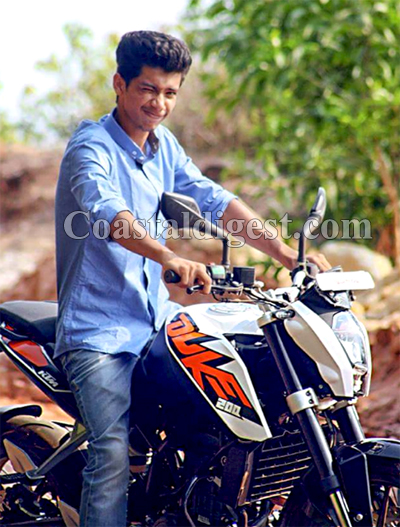
riyan

The deceased has been identified as Ahmed Raiyan (19), son of Riyaz Chenna, a native of Bhatkal. He was a first year Bachelor of Engineering student of Sahyadri College of Engineering, Adyar Mangaluru.

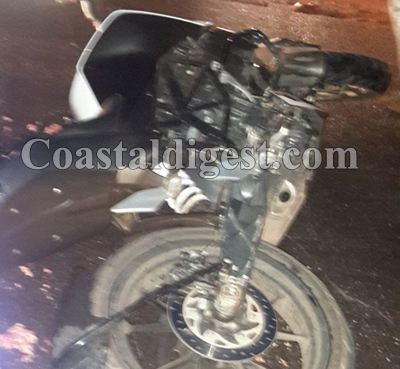
According to police, Raiyan was on his way to his hostel when the accident occurred. When the boy reached Nagori, a speeding tipper rammed into his motorbike

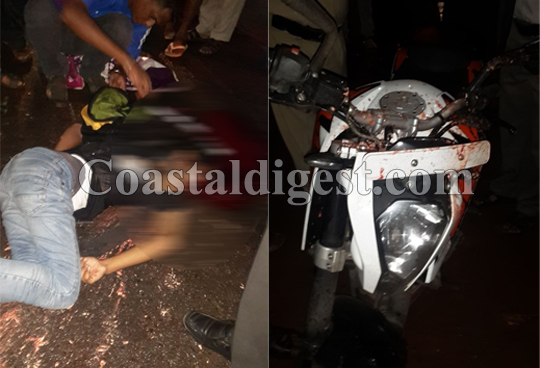
He was thrown onto the road and died on the spot. The driver of the tipper fled from the scene immediately.

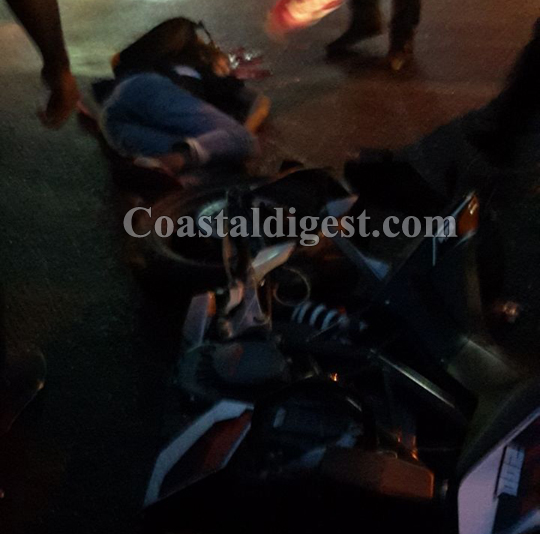
For more than half an hour the body of Riyan was lying on the road as passersby and local residents decided to stay away.

For more than half an hour of the death of Ahmed Riyan, no efforts were made by anyone to shift the dead body from the road.

Police reached the spot after half an hour and shifted the body for Government Wenlock Hospital for post-mortem. When the news began to spread members of Bhatkal Hostel, Mangaluru and Bhatkal Muslim Jamaath Mangaluru rushed to the hospital.

The body was later handed over to family members. The final rites will be held in Bhatkal.

naguriacc 1

naguriacc 2

naguriacc 3

Comments

Satyameva jayate
 - 
Thursday, 22 Sep 2016

rip......
His life and more other daily must be lesson for parents of reckless motorists who feel proud of their kids showing circus in streets and putting others lives in danger too...young blood should warm up for their future and their parents dreams....not to kill themselves for cheap show off....may God save us all from such incidents..

Mr Frank
 - 
Thursday, 22 Sep 2016

All parents must take care and advise their boys before gifting them two wheeler.May ALmighty bless parents to bear loss.

Add new comment

  • Coastaldigest.com reserves the right to delete or block any comments.
  • Coastaldigset.com is not responsible for its readers’ comments.
  • Comments that are abusive, incendiary or irrelevant are strictly prohibited.
  • Please use a genuine email ID and provide your name to avoid reject.
Media Release
February 14,2020

Veteran journalist P. Sainath has said that the nation is in a crisis. And this crisis is not limited to just the rural area. It has become a national crisis at various areas such as agriculture, education, economy, job creation etc.

He was delivering the endowment lecture on the topic ‘Indian democracy at the post-liberalization and post-truth era’ at Media Manthan 2020 organized by the PG department of journalism and mass communication at St Aloysius College (Autonomous). 

Mr Sainath said that the many policies adopted in the 90s led to India becoming unusually unequal. Referring to the speech Ambedkar had made at the Constituent Assembly while handing over the draft of the Constitution, Mr Sainath said, “Ambedkar had warned about the weakness of Indian democracy that liberty without equality allows the supremacy of a few over the multitude. Liberty, equality and fraternity must be kept together as we cannot have one without the other.” 

Mr Sainath stated that the agrarian crisis was no longer about the loss of productivity, employment or about farmer suicide; it was a societal, civilizational crisis. Commenting on the lopsided policies such as cow-slaughter ban, he explained how cow slaughter ban had adversely affected many industries due to their interdependency. While Muslims who slaughtered cows were rendered helpless, the cattle traders who were mostly OBCs lost their earnings as the cattle prices crashed. An important industry like Kolhapur sandals industry in Maharashtra went bankrupt as a result of the cow slaughter ban in Maharashtra. He said the policymakers had no idea how the rural industries were interconnected. Demonetisation too devastated the rural economy as 98 percent of rural transactions happen through cash. 

Mr Sainath also spoke about the crisis of inequality which affects the Dalits and the Adivasis far more than anyone else as 90 percent of the rural households take home less than Rs 10,000/- per month. “Women are yet another group whose labour is never counted in the gross domestic product. Women and girls globally do unpaid work which amounts to about 12.5 billion working hours per year. Monetarily speaking, this is worth 10.8 trillion dollars,” Mr Sainath added. 

Speaking about the crisis of jobs Mr Sainath said that major companies were laying off employees just to create more profits for the investors and the adoption of artificial intelligence in the industry would further destroy millions of jobs.

Rector of St Aloysius College Institutions Fr Dionysius Vaz SJ, Principal Dr (Fr) Praveen Martis SJ, HOD of Journalism and Mass Communication department Dr (Fr) Melwyn Pinto SJ were present.

‘Veerappan and Vijay Mallya’s business models are interesting!’

Addressing the gathering during his endowment lecture on Friday, Mr Sainath made an interesting comment on the so called ‘revenue model’. “Whenever I visit IIMs and IITs for lectures on my PARI project, the students there ask me what my revenue model for my project is. I tell them that I do not have a revenue model. In fact, journalism does not begin with a revenue model. Gandhiji, Ambedkar, Bhagat Singh were all great journalists. But they did not have a revenue model,” Mr Sainath said.

On a lighter note, he said that the best revenue model that he liked was that of forest brigand Veerappan and liquor baron Vijay Mallya. “Veerappan ruled the forest for forty years and from the top ministers to the villagers he could dictate terms and liver royally. Similarly, Mallya’s revenue model was to steal the banks and run away abroad and live like a king,” Mr Sainath added.

Journalism is not and can never be a business. It is a calling, he opined. While newspaper can be a business, television can be a business, journalism per se cannot be reduced to a business. “Unfortunately today, journalists are recruited on a contract basis and they have no bargaining power; and there are no unions to fight for their cause. Hence, they are at the mercy of the corporate media houses for their survival and are made to write stories that cannot be called journalism,” Mr Sainath said.

Answering a question as to the pressures he faced as a journalist, he said that external pressures from the government or others could be very well handled. It is the internal pressures from once own media house that journalists find it difficult to manage.


 

Comments

Add new comment

  • Coastaldigest.com reserves the right to delete or block any comments.
  • Coastaldigset.com is not responsible for its readers’ comments.
  • Comments that are abusive, incendiary or irrelevant are strictly prohibited.
  • Please use a genuine email ID and provide your name to avoid reject.
coastaldigest.com news network
June 12,2020

Mangaluru, Jun 12: A huge crowd gathered for the grand opening of the newly built 175-metre-long two-lane bridge across Phalguni River on National Highway 169 near Gurupura on the outskirts of the city today.

Even as the photos of the bridge inauguration ceremony went viral on social media, netizens took the elected representatives and the district administration to task for flouting safety norms at a time when the coronavirus cases are continuing to mount in coastal Karnataka.

The bridge was completed in a record time of 15 months. Dakshina Kannada MP and State BJP President Nalin Kumar Kateel and district in-charge Minister Kota Srinivas Poojari inaugurated the bridge in the presence of Mangaluru City North MLA Y. Bharath Shetty and others.

The bridge has come as a breather to thousands of travellers between Mangaluru-Moodbidri-Karkala on the busy NH. The age-old steel bridge had become dilapidated and was a cause for concern for road users. The highway is also under the process of getting widened to four lanes.

The bridge was constructed at an estimated cost of Rs 30 crore by contractor Sudhakar Shetty of Mugrodi Construction. Work started in February last and the contractor had time till February next.

While the two-lane carriageway is 16 metres wide, the bridge has 2.5-metre-wide pedestrian paths on both the sides. New approach roads of 500 metres each were also part of the project.

Comments

Add new comment

  • Coastaldigest.com reserves the right to delete or block any comments.
  • Coastaldigset.com is not responsible for its readers’ comments.
  • Comments that are abusive, incendiary or irrelevant are strictly prohibited.
  • Please use a genuine email ID and provide your name to avoid reject.
Media Release
March 18,2020

Mangalore, Mar 18: The Dakshina Kannada District Home Guards felicitated social activist and Executive Director of Centre for Integrated Learning, Sachitha Nandagopal at the Home Guards district office to mark the International Women's Day recently.

She was recognised for her achievements and contributions to the society in the field of education, culture and mental health.

Sachitha Nandagopal, a former Head of Department of Journalism at Besant Women's College and Principal of CMR Post Graduate Centre for Media Studies, Bangalore, is the Co-Founder of Centre for Integrated Learning, Mangalore which is an NGO working in the field of alternative education, adding value to the present education system. As a Facilitator in Dance Movement Therapy, she has founded Anveshanam - Centre for Mindfulness and Emotional Wellbeing, an organisation dedicated to addressing mental health issues.

She was honoured by District Commandant, Dakshina Kannada Home Guards, Dr. Muralimohan Chunthar. Senior Home Guard Ramesh Bhandary, Diwakar, Mahesh and lady personnel of Home Guards were present on the occasion.

Comments

Add new comment

  • Coastaldigest.com reserves the right to delete or block any comments.
  • Coastaldigset.com is not responsible for its readers’ comments.
  • Comments that are abusive, incendiary or irrelevant are strictly prohibited.
  • Please use a genuine email ID and provide your name to avoid reject.