


Mangaluru Town Hall to be named after social reformer Kudmul Ranga Rao

[email protected] (CD Network )
July 30, 2016

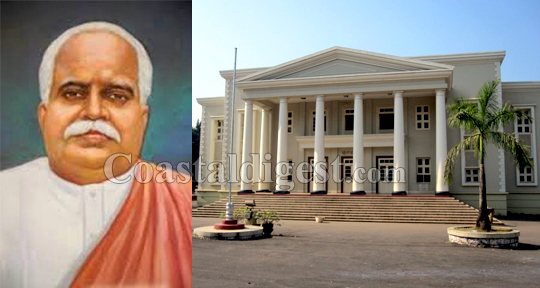
Mangaluru, Jul 30: The Mangaluru City Corporation has resolved to name the Town Hall after social reformer late Kudmul Ranga Rao, who fought for the rights of depressed classes and strived for their welfare.
kudmol

The decision comes about six months after the renovation of the five decade old Town Hall of Mangaluru, which hosted thousands of political, social and cultural events in the past 50 years.

Who is KRR?

Kudmul Ranga Rao (29 June 1859 – 30 January 1928) was a social reformer from Kudmul, a village in the erstwhile Madras Presidency, (in the present-day Dakshina Kannada district) who established "Depressed Classes Mission" in 1897 in Mangaluru for providing education, better housing, drinking water and empowering the backward classes socially by guarding them against exploitation by upper classes.

He was born into a middle-class Goud Saraswat Brahmin community. His father, Devappayya, worked as a clerk under a landlord and his mother, Gauri, a housewife. Rangarao completed his primary education in Kasaragod, before losing his father when he was 16.

Moving to Mangaluru in search of a job, he began working as a teacher for a monthly salary of R 8. Completing his matriculation amid financial difficulties through a correspondence course, he cleared the pleadership examination, that certified him argue for a client in courts. Following this, he began his career as a lawyer in Mangaluru.

Rangarao as an advocate in profession was better known as 'the poor man's lawyer'. 'Education is the source of progress' was his tenet. At a time when the depressed classes had no schools, when they were treated with scorn, Rangarao stepped forward as a crusader for the cause. Albeit facing grave opposition, Kudmul Rangarao continued to combat the orthodox beliefs of the then superstitious Indian society.

Rangarao set up schools in Kankanadi, Bannanje, Mulki, Beloor, Udupi, Nejaru, Atthavara, Baabuguddde, Dhaddal forests for the downtrodden. He called them 'Panchama schools'. To persuade the kids to attend schools, he arranged for mid day meals and 2 paise per day to the parents to develop an interest and motivate the families to get their progeny to schools. It is said that he bathed the young kids, sat with them for lunch, slept in their huts to win over their hearts. He freed many servants and slaves from the clutches of demanding and barbarous masters. Despite being threatened myriad times, his grit and gusto could not be dampened.

By marrying off his own daughter, RadhaBai to Dr. Subrayan of Madras, he set an example of inter-caste marriage in India. Following his inspiration, M K Gandhi's son entered wedlock with Chakravarthi Rajagopalachari's daughter. Mahatma Gandhi had once said, "I discerned social loyalty from Mr. Rangarao. He is an inspiration and a guide for me. He is my teacher when it comes to the upliftment of the untouchables".

Comments

LEON F VIEGAS
 - 
Thursday, 8 Dec 2016

There are other citizens who have done lots for the mangalore city. what about them ? town hall is good name please dont change it.

LEON F VIEGAS
 - 
Thursday, 8 Dec 2016

i feel town hall is the good name.

Raghuraj.
 - 
Sunday, 7 Aug 2016

Thank u city corporation.

Raghuraj.
 - 
Sunday, 7 Aug 2016

Good work done by mangalore city corporation .i personally apriciating you all.thank u im also one of the devotee of shri kudmul ranga rao.

Sameer
 - 
Sunday, 31 Jul 2016

If thy decide to name is has Late APJ Abdul Kalam, then we could have seen the frustation here!

Mehul Kamdar
 - 
Saturday, 30 Jul 2016

Great people who worked for their fellow human beings deserve to be honored. Kudos to Mangaluru for renaming it's Town Hall in the memory of this great gentleman.

True commentator
 - 
Saturday, 30 Jul 2016

Why not. It can be named as KRR Town Hall.
Let us start discovering our old ancestors who fought for us.

Let this be a good beginning.
But we should name all those regardless from what community.

Narendra Nayak
 - 
Saturday, 30 Jul 2016

Kudmul Ranga Rao is a much sweeter name. I strongly support the belated decision of the Mangalore City Corporation authorities to the name the town hall after him. It is not a honor done to him- the honor is for the city to have a town hall named after this great man. He said the day a dalit boy becomes a DC and comes to my village in his car raising the dust, I will make a tilak of that on my forehead and consider my life's ambition as fulfilled.

Ahmed
 - 
Saturday, 30 Jul 2016

Town Hall is the sweet name please no need to change in to KRR.....

Add new comment

  • Coastaldigest.com reserves the right to delete or block any comments.
  • Coastaldigset.com is not responsible for its readers’ comments.
  • Comments that are abusive, incendiary or irrelevant are strictly prohibited.
  • Please use a genuine email ID and provide your name to avoid reject.
coastaldigest.com news network
June 16,2020

Udupi, Jun 16: A young software engineer died on board a bus bound for Udupi’s Kundapura from Bengaluru due to suspected cardiac arrest this morning.

The deceased has been identified as Chaitanya (25), son of Vishnu Murthy, a resident of Kumbri in Koteshwar in Kundapura taluk. He was working for a software firm Bengaluru.

Chaitanya had boarded a ‘Durgamba’ bus from Bengaluru at 9 pm on June 15. At around 6.30 am on June 16, he called his father and informed that the bus had reached Barkur.

When his father called Chaitanya again at around 7.30 am, the bus driver answered the call and told him that his son had fallen ill and been taken to Vinaya hospital in Kundapur.

Vishnu Murthy rushed to the hospital, but was informed by the doctors that Chaitanya was declared brought dead.

A case has been registered at Kundapura police station. Even though it is suspected that he died of cardiac arrest, the exact cause will be known only after the post-mortem.

Comments

Add new comment

  • Coastaldigest.com reserves the right to delete or block any comments.
  • Coastaldigset.com is not responsible for its readers’ comments.
  • Comments that are abusive, incendiary or irrelevant are strictly prohibited.
  • Please use a genuine email ID and provide your name to avoid reject.
coastaldigest.com news network
January 8,2020

Mangaluru, Jan 8: No bandh-like situation prevailed in the coastal district of Dakshina Kannada, despite a nationwide strike called by trade union employees. Day-to-day activities are not disturbed, as buses and auto-rickshaws are moving as usual. 

However, in Bunder area, one of the business hubs of Mangaluru city, most of the shops today remained shut. As a result business was partially hit in the coastal city.

In other parts of Mangaluru city business firms, and market places are also open. Schools and colleges have not declared a holiday. government offices are also functioning as usually.

However, branches of many banks, excluding SBI, are closed for customers.

Members of various trade unions took out a rally and staged a protest in front of the Town Hall in Mangaluru.

Along with minimum wages, cancellation of contract labour system, no privatisation, welfare of farmers and other demands were also highlighted by the protestors. 

Slogans were also raised against Prime Minister Narendra Modi and anti-labour policies of his government. 

Members of AITUC, TUCC, AIUTUC, AIDYO, AIBEA, BSNLEU, INTUC, AIIEA, and associations of Anganwadi workers, mid-day meal workers, medical representatives, KSRTC employees, gram panchayat employees, and others took part in the protest.

Comments

Add new comment

  • Coastaldigest.com reserves the right to delete or block any comments.
  • Coastaldigset.com is not responsible for its readers’ comments.
  • Comments that are abusive, incendiary or irrelevant are strictly prohibited.
  • Please use a genuine email ID and provide your name to avoid reject.
Wafa Sultana
April 4,2020

Over the last couple of days when the world was occupied with unifying efforts to fight the deadly Covid19 pandemic, sections of Indian media provided viewers a familiar scapegoat – the Indian Muslims – who are often stereotyped as a community being constantly at loggerheads with the citizenry and the State. Biased media channels were quick to resort to blaming the entire Muslim community for the spread of the disease in the country, thanks to an ill-timed Tablighi Jamaat gathering at its international headquarters in Delhi’s Nizamuddin. Unsurprisingly, the opprobrium was also marked by a sudden spike in WhatsApp forwards of videos with people wearing skullcaps licking spoons and performing Sufi breathing rituals, suggesting some sort of wild conspiracy on the part of the community to spread the virus.  Some media channels were quick to formulate, hypothesize and provide loose definitions of a newly discovered form of Jihad i.e. ‘Corona Jihad ’ thereby vilifying the Islamic faith and its followers.

While the investigation on the culpability of the organizers of the Nizamuddin event is still ongoing, there is enough information to suggest that the meeting was held before any lockdown was in force, and the problem began when there was no way of getting people out once the curfew was announced. Be that as it may, there is little doubt that organizing a meet of such a scale when there is a global pandemic smacks of gross misjudgment, and definitely the organizers should be held accountable if laws or public orders were defied. Attendees who attempt to defy quarantine measures must be dealt with strictly. However, what is alarming is that the focus and narrative have now shifted from the unfortunate event at Nizamuddin to the Tablighi Jamaat itself.

For those not familiar with the Tablighi Jamaat, the organization was founded in 1926 in Mewat by scholar Maulana Mohammad Ilyas. The Jamaat’s main objective was to get Muslim youth to learn and practice pristine Islam shorn of external influences. This is achieved through individuals dedicating time for moral and spiritual upliftment secluded from the rest of the world for a brief period of time. There is no formal membership process. More senior and experienced participants typically travel from one mosque to other delivering talks on religious topics, inviting local youth to attend and then volunteer for a spiritual retreat for a fixed number of days to a mosque in a nearby town or village to present the message to their co-religionists. Contrary to ongoing Islamophobic rhetoric, the movement does not actively proselytize. The focus is rather on getting Muslims to learn the teachings and practices of Islam.  This grassroots India-based movement has now grown to almost all countries with substantial Muslim populations. Its annual meets, or ‘ijtemas’ are among the largest Islamic congregations in the world after the annual Haj. One of the reasons for its popularity and wide network in the subcontinent and wordwide is the fact that it has eschewed the need for scholarly intervention, focusing on peer learning of fundamental beliefs and practice rather than high-falutin ideological debates. The Tablighi Jamaat also distinguishes itself from other Islamic movements through its strictly apolitical nature, with a focus on individual self-improvement rather than political mobilization. Hardships and difficulty in the world are expected to be face through ‘sabr’ (patience) and ‘dua’ (supplication),  than through quest for political power or influence. In terms of ideology, it is very much based on mainstream Sunni Islamic principles derived from the Deobandi school.

So, why is all this background important in the current context? While biased media entities have expectedly brought out their Islamophobic paraphernalia out for full display, more neutral commentators have tried to paint the Tablighi Jamaat as a fringe group and have tried to distance it from 'mainstream Muslims'. While the intent is no doubt innocent, this is a trap we must not fall into. This narrative, unfortunately, is also gaining ground due to apathy some Muslims have for the group, accusing it of being “disconnected from the realities of the world”. Unlike other Muslim organizations and movements, the Tablighi Jamat, by virtue of its political indifference, does not boast of high-profile advocates and savvy spokespersons who can defend it in mainstream or social media.  The use of adjectives such as 'outdated' and 'orthodox' by liberal columnists to describe the Jamaat feeds into the malignant attempt to change the narrative from the control of the spread of the pandemic due to the Nizamuddin gathering to 'raison d'etre' of the organization itself.

A large mainstream religious group like the Tablighi Jamaat with nearly a hundred-year history, normally considered to be peaceful, apolitical and minding its own business is now suddenly being villainized owing to unfortunate circumstances. Biased media reactions filled with disgust and hate seem to feed the Indian public conscience with a danngerous misconception - to be a nominal Muslim is okay but being a practicing one is not.  For those committed to the truth and fighting the spread of Islamophobia, the temptation to throw the entire Tablighi Jamaat under the bus must be resisted.

The writer is a lawyer and research scholar at Qatar University. Her research interests include Islamic law and politics.

Comments

zahoorahmed
 - 
Saturday, 4 Apr 2020

great article! provides a great perspective on tableeg jamat

Add new comment

  • Coastaldigest.com reserves the right to delete or block any comments.
  • Coastaldigset.com is not responsible for its readers’ comments.
  • Comments that are abusive, incendiary or irrelevant are strictly prohibited.
  • Please use a genuine email ID and provide your name to avoid reject.