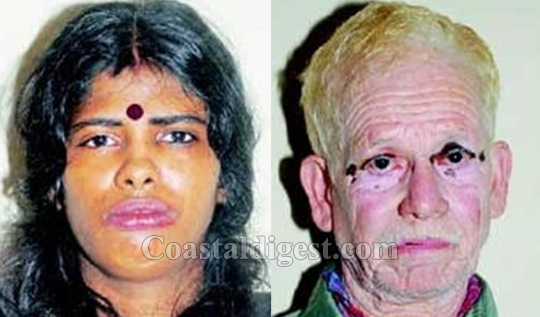
Mangaluru: Two sentenced to life for black magic murder of 3-year-old girl

[email protected] (CD Network)
April 1, 2016

Mangaluru, Apr 1: Nearly six years after a three-year-old girl was murdered in a black magic ritual in the city, a District and Sessions Court has sentenced an elderly man and his suspected foster daughter to life imprisonment.

blackmagic

Pronouncing the order Bhavani Nerale Veerabhadraiah, the judge of IV Additional District and Sessions court, Mangaluru, sentenced Kamalaksha Purusha (79) and Chandrakala (33), both residents of Kampadakody near Yeyyadi, here. The convicts were also sentenced to three years imprisonment for the offence of destroying evidence.

On December 17, 2010, the body of Priyanka, daughter of Firan Kumar Jha and Anjali Devi, a poor couple, was found with burns in the areca-nut garden of Kamalaksha Purusha at Yeyyadi. The girl had gone missing since December 16 afternoon from her parents' rented residence owned by Kamalaksha Purusha's brother.

Chandrakala had befriended Priyanka and used to take the girl to her residence in the neighbourhood frequently. Jha, a native of Madhubani district in Bihar, worked with an electronics retailer in Bengaluru for over two decades before being sent to the retailer's Mangaluru showroom.

After Chandrakala took Priyanka home in the afternoon of December 16, 2010, the girl did not return and a search launched by her parents was futile. The next day, the girl's body was found in the plantation of Kamalaksha Purusha. The post-mortem report said that the child was strangled to death after she had been doused with boiling water.

Though there was no eyewitness to the incident, neighbours told the police that the family of Kamalaksha Purusha was engaged in sorcery for materialistic gains. There were people who had seen Chandrakala taking the girl to her house, they said.

Prosecutors Harishchandra Udyawar and Pushparaj Adyantaya examined 18 witnesses during trial. While the then Mangaluru East Police Inspector Niranjan Urs initially investigated the case, Assistant Commissioner of Police Raveendra K. Gadadi filed the charge sheet before court.

Considering the circumstantial evidence, the judge convicted the two for offences under Sections 302 (murder) and 201 (destroying of evidence) of the Indian Penal Code. While Kamalaksha Purusha was directed to pay fine of Rs. 60,000, Chandrakala was asked to pay Rs. 20,000 for the two offences.

A sum of Rs. 10,000 out of the total fine has to be paid to the government while the balance is to be paid to the deceased girl's parents. The court has also directed the District Legal Services Authority to pay compensation under the Karnataka Victim Compensation Scheme to the parents.

The then Chief Minister B.S. Yeddyurappa had released Rs. 2 lakh compensation to the family of Priyanka through the district administration.

Comments

Aakhash
 - 
Friday, 1 Apr 2016

Instead of making un necessary issues like Bharath Maathaa Ki Jai., RSS should concentrate to address the people to come out from these types of ugly practice in the community.

Meenakshi Rao
 - 
Friday, 1 Apr 2016

This is ridiculous,..murderers should be murdered as same like they killed that innocent girl.

Karan
 - 
Friday, 1 Apr 2016

who knows this may not be the first time they killed, which has came to light.

Deepika
 - 
Friday, 1 Apr 2016

Ghostly act by these two, dont want to c their face , coastaldiget please blur their face, felt like watching some horror movie.

Mohan
 - 
Friday, 1 Apr 2016

Planet SKS land belongs to him, builder succeed.

Priyanka
 - 
Friday, 1 Apr 2016

syco path in mangalore, both should be hanged.

Add new comment

  • Coastaldigest.com reserves the right to delete or block any comments.
  • Coastaldigset.com is not responsible for its readers’ comments.
  • Comments that are abusive, incendiary or irrelevant are strictly prohibited.
  • Please use a genuine email ID and provide your name to avoid reject.
News Network
May 24,2020

Bengaluru, May 24: In an effort to protect passengers and staff from the risk of COVID-19 transmission, the Bangalore International Airport Limited (BIAL) has introduced a parking-to-boarding contactless journey at the airport.

With a greater emphasis on minimum touch and minimum exposure between passengers and airport personnel, BIAL aims to minimise all physical contact at the airport. The technology will continue to enable a seamless airport journey, with greater emphasis on health and safety.

"As the gateway to a new India, BLR Airport has a key role to play in helping passengers through this global health crisis by reassuring them that their safety is our top priority. We have introduced innovative contactless procedures to minimise exposure at the airport," said Hari Marar, MD and CEO, BIAL.

"These enhancements demonstrate our continued commitment to keep our passengers safe in this environment. We believe our new measures will boost confidence among passengers," continued Marar.

"BLR Airport is all geared up to welcome our passengers back and - working with various government departments - we're committed to offering them a safe experience by implementing the best-in-class standards, procedures and practices," Marar added.

Earlier, Civil Aviation Minister Hardeep Singh Puri said that domestic flight operations will resume from May 25 noting that all airlines and airports were ready but it is not viable to keep the middle seat vacant as it will lead to hike in the ticket price and prescribed social distancing norms would still not be met. 

Comments

Add new comment

  • Coastaldigest.com reserves the right to delete or block any comments.
  • Coastaldigset.com is not responsible for its readers’ comments.
  • Comments that are abusive, incendiary or irrelevant are strictly prohibited.
  • Please use a genuine email ID and provide your name to avoid reject.
News Network
July 3,2020

Bengaluru, Jul 3: Over 35 acres of land in nine villages on the outskirts of Bengaluru have been earmarked for burial and cremation of bodies of COVID-19 victims after concerns were raised over the safety of funerals being held in burial grounds located in residential areas.

Deputy Commissioner of Bengaluru Urban District GN Shivamurthy issued an order setting apart about 35.5 acres in the villages under four Taluks of Bengaluru North, Bengaluru South, Anekal and Yelahanka.

The order directed the respective Tahsildars to register these chunks of land as reserved for burial grounds and not to use for any purpose.

According to the sources in the district administration, Karnataka Health Minister B Sriramulu and Revenue Minister R Ashoka had directed the officials to identify places on the city outskirts to dispose of the bodies of COVID-19 victims.

Mr Sriramulu had on Wednesday said COVID-19 victims will not be laid to rest in burial grounds in the city and separate places will be earmarked on the outskirts in the backdrop of safety concerns raised by public.

He had also warned against unscientific disposal of used Personal Protection Equipment kits worn by the families of the victim for the final rites, referring to reports about such instances.

In some places, people have also expressed concern over bodies of those who died of the coronavirus being buried in their neighbourhood.

Comments

Add new comment

  • Coastaldigest.com reserves the right to delete or block any comments.
  • Coastaldigset.com is not responsible for its readers’ comments.
  • Comments that are abusive, incendiary or irrelevant are strictly prohibited.
  • Please use a genuine email ID and provide your name to avoid reject.
Agencies
January 1,2020

For many Indian tycoons, 2019 turned woeful as lenders -- empowered by the nation’s recent bankruptcy law and desperate to clean up soured debt from their books -- started seizing assets of delinquent firms or dragged them into insolvency.

Indian banks wrote off a record $39 billion of loans in the 18 months through September in a bid to repair their balance sheets as they battled the world’s worst bad debt pile. Making matters worse, a shadow banking crisis led to a funding squeeze, crushing debt-laden businesses that were critically dependent on rollover financing.

“Life has come a full circle for tycoons that had enjoyed debt-fueled growth,” said Nirmal Gangwal, founder of distress and debt restructuring advisory firm Brescon & Allied Partners LLP. “Many firms collapsed like a house of cards. The downfall was rather unprecedented.”
The government has also been cracking down on economic crime to assuage public anger over absconding businessmen. It’s even barred some from traveling overseas if they were deemed a flight risk.

Here are some of the country’s biggest and most-storied businessmen who saw their fortunes fade. Spokespersons for none of these tycoons, except Essar, immediately replied to emails and text messages seeking comments.

Anil Ambani

The chairman of Reliance Group, which makes movies to metro lines, had a close shave with jail time in March before his elder brother and Asia’s richest man, Mukesh Ambani, bailed him out at the last minute. The woes of the ex-billionaire came to the fore when India’s top court asked him to pay Ericsson AB’s India unit about $77 million of past dues or go to jail since Anil Ambani, 60, had given a personal guarantee. His telecom carrier slipped into insolvency this year, while unprofitable Reliance Naval & Engineering Ltd. faced a cash crunch. Reliance Capital Ltd. is selling assets to pare debt. Ambani is also fending off Chinese lenders in a London court.

Malvinder & Shivinder Singh

Karma caught up with ex-billionaires and brothers Malvinder Singh, 47, and Shivinder Singh, 44, and how. Scions of a prominent business family, they once helmed India’s top drug maker and second-largest hospital chain. In October, the two were arrested on charges of fraudulently diverting nearly $337 million from a lender they controlled. India’s market regulator found in 2018 that the brothers had defrauded their hospital company of about $56 million. The collapse of the $2 billion empire turned brother against brother, prompting their mother to broker a peace deal that was short-lived. In February, Malvinder accused Shivinder and their spiritual guru of fraud.

Shashikant & Ravikant Ruia

After a hard-fought battle to keep their flagship steel mill, the first-generation entrepreneurs finally saw the bankrupt Essar Steel India Ltd. pass on to ArcelorMittal last month. The $5.9 billion takeover was almost two years in the making with multiple legal wrangles. The group, controlled by Shashikant Ruia, 76, and Ravikant Ruia, 70, were also reprimanded by a U.K. judge in March this year for concealing documents. Started in 1969 as a construction firm, Essar Group diversified, investing about $18 billion between 2008 and 2012, and piled on debt. In 2017, the group had sold another prized asset, Essar Oil.

Selling an asset to pare a liability shouldn’t be seen as a “lost asset,” an Essar spokesman said, adding that the group remains a diversified conglomerate.

VG Siddhartha

Before jumping off a bridge into a river in July in an apparent suicide, the founder of India’s biggest coffee chain Cafe Coffee Day had penned a letter that spoke of pressure from lenders, a private equity firm and harassment by tax officials. He had spent much of the last two years pledging ever more of Coffee Day Enterprises Ltd. shares to refinance loans for ever shorter periods, at ever higher interest rates. “I would like to say I gave it my all,” V.G. Siddhartha, 60, wrote in the letter. “I fought for a long time but today I gave up.”

Naresh Goyal

The former ticketing agent who built India’s largest airline by value, stepped down as chairman of Jet Airways India Ltd. in March, caving in to pressure from banks who took over the company. Cut-throat price wars and surging costs pushed Jet deeper into loss. The airline stopped flying in April and went into bankruptcy two months later as lenders failed to find a buyer. In July, an Indian court barred Naresh Goyal from flying overseas after the government said it was investigating an alleged $2.6 billion fraud involving Jet Airways.

Rana Kapoor

The founder of Yes Bank Ltd., which became India’s fourth-largest non-state lender, tweeted in September 2018 that his shares were invaluable and requested his children never to sell them upon inheritance. But trouble was brewing. The nation’s banking regulator, which found the lender had repeatedly under-reported its bad loans, refused to extend his tenure as chief executive officer. This forced Rana Kapoor, 62, to step down by end-January. Kapoor, who has pledged some of his Yes Bank shares in July, sold almost his entire stake in the lender by October.

Subhash Chandra

The rice trader-turned-media mogul, 69, who brought cable television into Indian homes in the early 1990s with his ZEE TV, resigned as chairman of Zee Entertainment Enterprises Ltd. in November and lost control of his crown jewel. Subhash Chandra has been selling stake in Zee Entertainment in the past few months to repay group’s debt.

Gautam Thapar

A default by Gautam Thapar, founder of the paper mill-to-power transmission Avantha Group, on pledged shares made Yes Bank Ltd. the biggest shareholder in CG Power and Industrial Solutions Ltd. In August, the firm was hit by an accounting scandal forcing the board to remove Thapar, 59, from the chairman’s post. A month later, the market regulator ordered a forensic audit of the firm and barred Thapar from accessing securities market.


Comments

Add new comment

  • Coastaldigest.com reserves the right to delete or block any comments.
  • Coastaldigset.com is not responsible for its readers’ comments.
  • Comments that are abusive, incendiary or irrelevant are strictly prohibited.
  • Please use a genuine email ID and provide your name to avoid reject.