Mangaluru: Two sentenced to life for black magic murder of 3-year-old girl

[email protected] (CD Network)
April 1, 2016

Mangaluru, Apr 1: Nearly six years after a three-year-old girl was murdered in a black magic ritual in the city, a District and Sessions Court has sentenced an elderly man and his suspected foster daughter to life imprisonment.
blackmagic

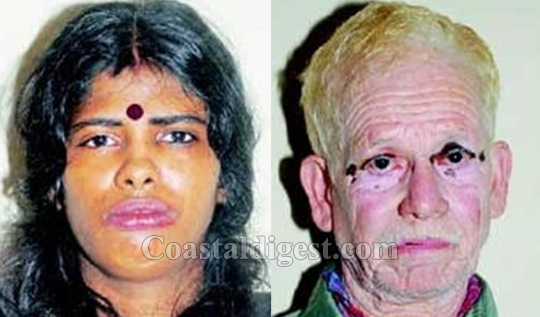
Pronouncing the order Bhavani Nerale Veerabhadraiah, the judge of IV Additional District and Sessions court, Mangaluru, sentenced Kamalaksha Purusha (79) and Chandrakala (33), both residents of Kampadakody near Yeyyadi, here. The convicts were also sentenced to three years imprisonment for the offence of destroying evidence.

On December 17, 2010, the body of Priyanka, daughter of Firan Kumar Jha and Anjali Devi, a poor couple, was found with burns in the areca-nut garden of Kamalaksha Purusha at Yeyyadi. The girl had gone missing since December 16 afternoon from her parents' rented residence owned by Kamalaksha Purusha's brother.

Chandrakala had befriended Priyanka and used to take the girl to her residence in the neighbourhood frequently. Jha, a native of Madhubani district in Bihar, worked with an electronics retailer in Bengaluru for over two decades before being sent to the retailer's Mangaluru showroom.

After Chandrakala took Priyanka home in the afternoon of December 16, 2010, the girl did not return and a search launched by her parents was futile. The next day, the girl's body was found in the plantation of Kamalaksha Purusha. The post-mortem report said that the child was strangled to death after she had been doused with boiling water.

Though there was no eyewitness to the incident, neighbours told the police that the family of Kamalaksha Purusha was engaged in sorcery for materialistic gains. There were people who had seen Chandrakala taking the girl to her house, they said.

Prosecutors Harishchandra Udyawar and Pushparaj Adyantaya examined 18 witnesses during trial. While the then Mangaluru East Police Inspector Niranjan Urs initially investigated the case, Assistant Commissioner of Police Raveendra K. Gadadi filed the charge sheet before court.

Considering the circumstantial evidence, the judge convicted the two for offences under Sections 302 (murder) and 201 (destroying of evidence) of the Indian Penal Code. While Kamalaksha Purusha was directed to pay fine of Rs. 60,000, Chandrakala was asked to pay Rs. 20,000 for the two offences.

A sum of Rs. 10,000 out of the total fine has to be paid to the government while the balance is to be paid to the deceased girl's parents. The court has also directed the District Legal Services Authority to pay compensation under the Karnataka Victim Compensation Scheme to the parents.

The then Chief Minister B.S. Yeddyurappa had released Rs. 2 lakh compensation to the family of Priyanka through the district administration.

Comments

Aakhash
 - 
Friday, 1 Apr 2016

Instead of making un necessary issues like Bharath Maathaa Ki Jai., RSS should concentrate to address the people to come out from these types of ugly practice in the community.

Meenakshi Rao
 - 
Friday, 1 Apr 2016

This is ridiculous,..murderers should be murdered as same like they killed that innocent girl.

Karan
 - 
Friday, 1 Apr 2016

who knows this may not be the first time they killed, which has came to light.

Deepika
 - 
Friday, 1 Apr 2016

Ghostly act by these two, dont want to c their face , coastaldiget please blur their face, felt like watching some horror movie.

Mohan
 - 
Friday, 1 Apr 2016

Planet SKS land belongs to him, builder succeed.

Priyanka
 - 
Friday, 1 Apr 2016

syco path in mangalore, both should be hanged.

Add new comment

  • Coastaldigest.com reserves the right to delete or block any comments.
  • Coastaldigset.com is not responsible for its readers’ comments.
  • Comments that are abusive, incendiary or irrelevant are strictly prohibited.
  • Please use a genuine email ID and provide your name to avoid reject.
News Network
February 23,2020

The euphoria over the claim that around 3,000 tonnes of gold reserves, worth Rs 12 trillion, have been discovered in Uttar Pradesh’s Sonbhadra district could not last even 24 hours, with the Geological Survey of India (GSI) clarifying on Saturday there had been no such discovery.

The GSI, headquartered in Kolkata, rebutted the claims of the Uttar Pradesh Directorate of Geology and Mining (UPDGM), and said “miscommunication” must have led to the wrong reporting of facts.

M Sridhar, director general of the GSI, said nobody in the agency gave any such data. He said 52,806 tonnes of gold ore was found in Sonbhadra district during the exploration work in 1998-2000. From this reserve, only 160 kg of gold can be extracted.

“There must have been some miscommunication of facts because of which the gold ore deposits have been overestimated. We have written a letter to Uttar Pradesh (UPDGM), stating the facts. The GSI has not estimated such kind of vast resource of gold deposits in Sonbhadra,” Sridhar said.

ALSO READ: 2,900-tonne gold mine found in Sonbhadra, 4 times that of India's reserves

The UPDGM had said on Friday that gold deposits were found in Son Pahadi and Hardi areas of the district. Sridhar said while gold ore was found in the area during the GSI’s exploration work in 1998-2000, it had told the state government about the discovery in November last year.

Under the new regulation, which came into effect from 2015, the GSI has to inform the state government when ore deposits are discovered. Earlier, no such action was mandatory. In its report, the GSI estimated that only 3.03 gm of gold can be extracted from a tonne of ore. It also clarified that even the extraction amount was tentative and could not be established for certain.

Moreover, Sridhar said the deposits were spread across only 0.5 sq km in forest land, which made the mining of ore economically unviable. “When there are several mines nearby, we can club it into a block and then it makes sense to mine the ore. But in this case, the deposits are too small to make it viable for any company to mine it,” he said. The GSI usually prioritises its exploration work based on the needs of the Centre. While strategic minerals like tin, cobalt, lithium, beryllium, germanium, gallium, indium, tantalum, niobium, selenium, and bismuth are atop the list in GSI exploration, gold is another commodity on its priority list.

According to the World Gold Council, India has reserves of 630 tonnes of gold.

Comments

Add new comment

  • Coastaldigest.com reserves the right to delete or block any comments.
  • Coastaldigset.com is not responsible for its readers’ comments.
  • Comments that are abusive, incendiary or irrelevant are strictly prohibited.
  • Please use a genuine email ID and provide your name to avoid reject.
News Network
July 29,2020

Bengaluru, Jul 29: The Karnataka High Court’s division bench of Chief Justice Abhay Oka and Justice H P Sandesh today rejected an application that wanted Amulya Leona’s case to be transferred from Karnataka Police to the National Investigation Agency (NIA).

The bench, while observing that extraordinary jurisdiction can’t be exercised for transferring the case to the NIA, asked “What is so special that investigation should be transferred to NIA?”

The court, in its previous hearing, had questioned the maintainability of the petition seeking transfer of the sedition case against Leona to the NIA.

According to the petitioner, advocate Pavana Chandra Shetty, the case is a serious matter against national integration and unity and has not been investigated properly by the police. The state police also failed to file the chargesheet within 90 days, he said, and also asked for cancellation of her bail.

The bench asked the petitioner as to how a bail, already granted to a person, can be cancelled. “Is it not the indefeasible right of the accused to be released on bail if chargesheet is not filed within stipulated time? How can you make a prayer for cancellation of bail?”  the Court asked.

The counsel for the petitioner also stated that in cases of a cognizable offence, when the chargesheet is purposely not filed within the stipulated time, the matter will have to transferred to the appropriate authority.

The court responded to his contention by asking him how could the court override law and cancel the bail. “Where is the question of cancellation of bail? Can we override the law and say that bail should be cancelled?” said the bench.

Advocate Vishal Raghu had filed the petition for transfer of Leona’s case, who was accused of raising pro-Pakistan slogans at an anti-CAA rally on February 20 at Freedom Park. The advocate had blamed the probe team for not filing a chargesheet on time and has asked the state government to approach the higher court against bail granted to Leona.

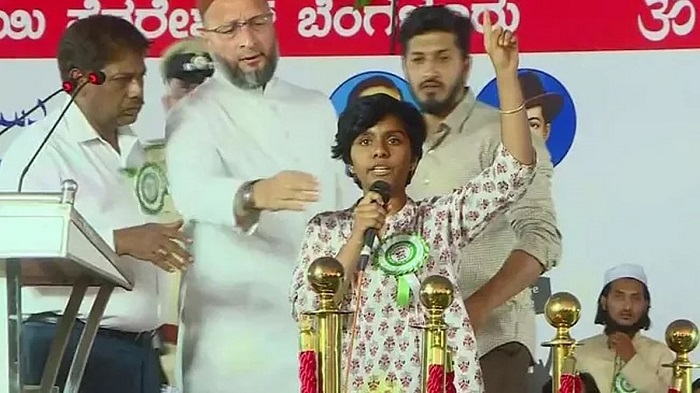
Bengaluru student Amulya Leona was charged with sedition for her actions in the presence of All India Majlis-e-Ittehad-ul-Muslimeen chief Asaduddin Owaisi. She was arrested by the Bengaluru police for allegedly shouting ‘Pakistan Zindabad’ slogans at an anti- CAA Protest in Bengaluru in February this year. On June 11, she was granted conditional bail by the Bengaluru civil court.

Her bail plea was earlier rejected by a Bengaluru court, after she had spent a three-month period in jail, stating that she may abscond if she is released. The sessions judge Vidhyadhar Shirahatti had also stated that if the petitioner is granted bail, she may abscond and may involve in similar offence which affects peace at large and hence her petition is liable to be rejected. The court had also noted that Amulya Leona is an influential person who may threaten and influence the witness and hamper the case in case of the prosecution and will abscond if released on bail.

Comments

Add new comment

  • Coastaldigest.com reserves the right to delete or block any comments.
  • Coastaldigset.com is not responsible for its readers’ comments.
  • Comments that are abusive, incendiary or irrelevant are strictly prohibited.
  • Please use a genuine email ID and provide your name to avoid reject.
News Network
January 21,2020

Bengaluru, Jan 21: A private hospital in Bengaluru, the capital of Karnataka, on Tuesday claimed that it has successfully performed a live liver transplant on a Jehovah's Witness from Nigeria, by not using blood or blood products, in order to protect the patient's religious beliefs.

It is said that Jehovah's Witnesses are followers of a Christian faith that prohibits the use of blood or blood products during their treatment. Gehojadak (37), a Jehovah's Witness follower, had developed decompensated liver disease and visited more than three countries seeking treatment over the last four years but was turned away by most doctors due to the highly risky nature of surgery, Aster CMI Hospital said.

The surgery was challenging compared to a normal liver transplant because in order to protect the patient's religious beliefs, the medical team could not use blood or blood products (Fresh frozen plasma, Cryoprecipitate, Platelets etc), it said in a release, adding that very few such surgeries have been successfully conducted worldwide.

The patient's brother was the donor, the hospital said, adding, without a liver transplant, Gehojadak's chances of survival were less than 10 per cent over the next two years. A team of liver specialists from the Hospital thoroughly reviewed the patient's medical history before recommending a bloodless liver transplant and charted out a feasible pathway to make the surgery a success.

"This transplant was especially challenging as we did not have the safety net (of using blood) even if the patient's life was at risk due to their advance directive. We have performed other non-transplant liver surgeries in Jehovah's Witnesses and this gave us the confidence to take on Gehojadak's transplant," Dr Rajiv Lochan, Consultant Liver Transplant Surgeon, said.

The critical surgery took a 12-hour period to complete where two teams of specialists with close to 25 doctors including anaesthetists, intensivists worked in absolute sync with each other and Gehojadak finally received a life-saving liver transplant, the Hospital said. In a period of two weeks, the patient and his brother were fit enough to go home and were discharged from the hospital.

"Even if their haemoglobin levels dropped to life-threatening levels, the patients were clear that they would not accept a blood transfusion. Keeping the limitations in mind, the most effective treatment path was planned, and we spent close to two months preparing the patients for surgery," Arun V, Consultant Anesthesiologist said. The hospital arranged customised artificial products like synthetic drug molecules, to conduct a bloodless liver transplant, he added.

Comments

Add new comment

  • Coastaldigest.com reserves the right to delete or block any comments.
  • Coastaldigset.com is not responsible for its readers’ comments.
  • Comments that are abusive, incendiary or irrelevant are strictly prohibited.
  • Please use a genuine email ID and provide your name to avoid reject.